
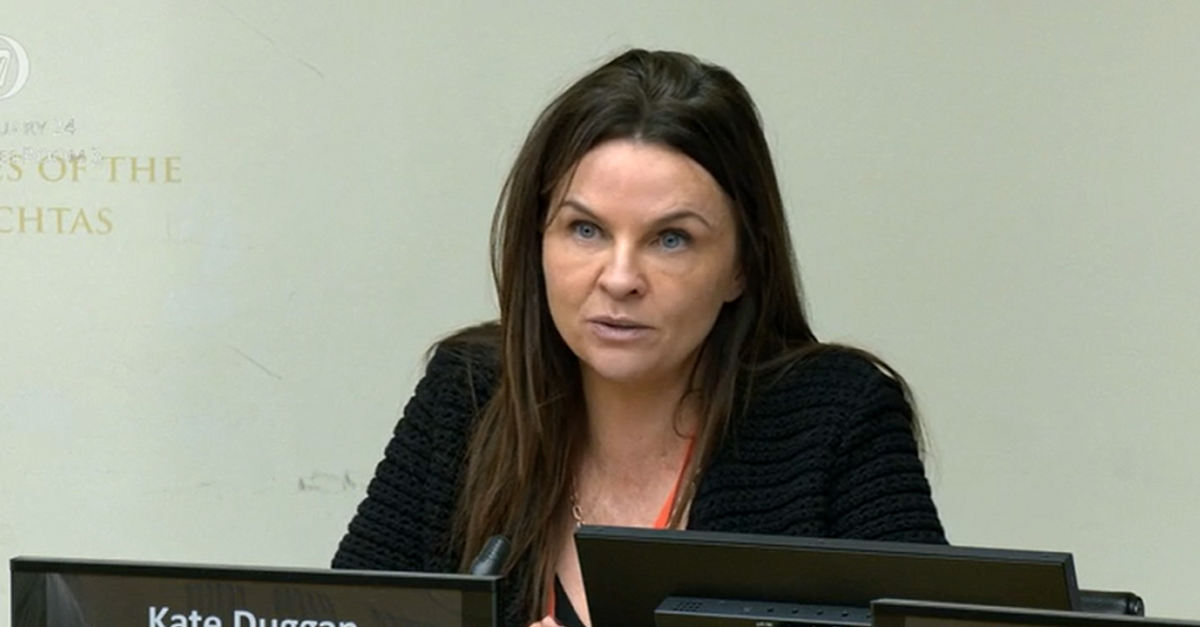
Kate Duggan, the chief executive of Tusla, has defended the service and said that every child in the care of the state deserved to feel supported by all the services of the state and where that had not happened it was “completely unacceptable.”
Responding to an RTÉ Primetime programme about the use of unregulated facilities for children in care, Duggan told RTÉ radio’s Morning Ireland, “With the support of our Minister and Department, we will, in the months ahead, continue to absolutely reduce our reliance on these arrangements.”
The television programme had been “very distressing”, she said.
“I think the young people that we heard from represent certainly a lived experience of young people today in the care of the state that all of us are very concerned about.
“We absolutely know that every child who is in state care deserves to feel supported by all services of the state, and where that hasn’t happened, it is completely unacceptable.”
The experiences in the programme had been those of a small number of vulnerable young people, she said.
“The vast majority of children in our care, the almost 6,000 children in our care, they are receiving very good services, living in foster care with loving foster care families, living in registered centres where they’re cared for by staff, they’re engaged in education, and they’re doing very well.
“But we absolutely have to do better by this group of young people who have very vulnerable and complex needs, and certainly for me, I want every young person that needs a bed in special care to be able to get that bed,” she said.
“I want every young person to be able to be accommodated in a registered care placement, and while we are making significant progress in achieving that, we haven’t yet been able to provide that to every young person.”
Duggan said that the Department of Children, Disability and Equality is now working on a promise to look at an alternative care strategy, to consider how the state comes together to support those children and young people better.
When asked about the case of a fake reference, Duggan said there were no staff using fake references working in a special emergency arrangement.
“A provider became aware of an internal issue within their company. They notified us immediately of that. We were able to check, and we were able to make sure that no staff member with a forged reference was using and providing services on behalf of Tusla.”
Meanwhile, Monica Hynds, a Guardian ad Litem with children’s charity Barnardos, has called on Tusla and the government to cease using unregulated placements for children in care and to immediately implement a plan for children with complex needs.
Hynds was responding to the report on RTÉ Primetime, which highlighted the number of children who continue to be placed in unregulated care, which costs €2,000 per child per week.
Unregulated placements were introduced a number of years ago as a temporary measure, she explained to RTÉ radio’s Morning Ireland.
“What we are seeing now is protracted use of them, and it’s really, really disappointing, grossly disappointing for those young people and for the young people who are coming after them who can end up in those arrangements for quite some time as well.
“We are calling for the cessation of these and we have been consistently calling for these. They’re not regulated at all because they’re illegal,” she said.
“So in order to be regulated, you have to have been approved by Hiqa and you have to meet certain standards.”
Hynds pointed out that the people who work in the unregulated placements are vetted, but they were not qualified and there had been at least one allegation where staff falsified references.
“What we want to see is a government-led approach that sees a timed and action-driven plan that sees the elimination of these over a period of time.
“The government knows that they’re unregulated and that they’re illegal, and they still continue to this day.”
“You have to invest in the system that’s around. There is no silver bullet to this. There is no easy one answer to this. You have to invest in the system around this. And that starts with trying to reduce the number of children who are coming into care.”