
AT THE 2025 Prefontaine Classic, a sold-out crowd of 12,606 was treated to two profound demonstrations of human potential on a perfect July afternoon.
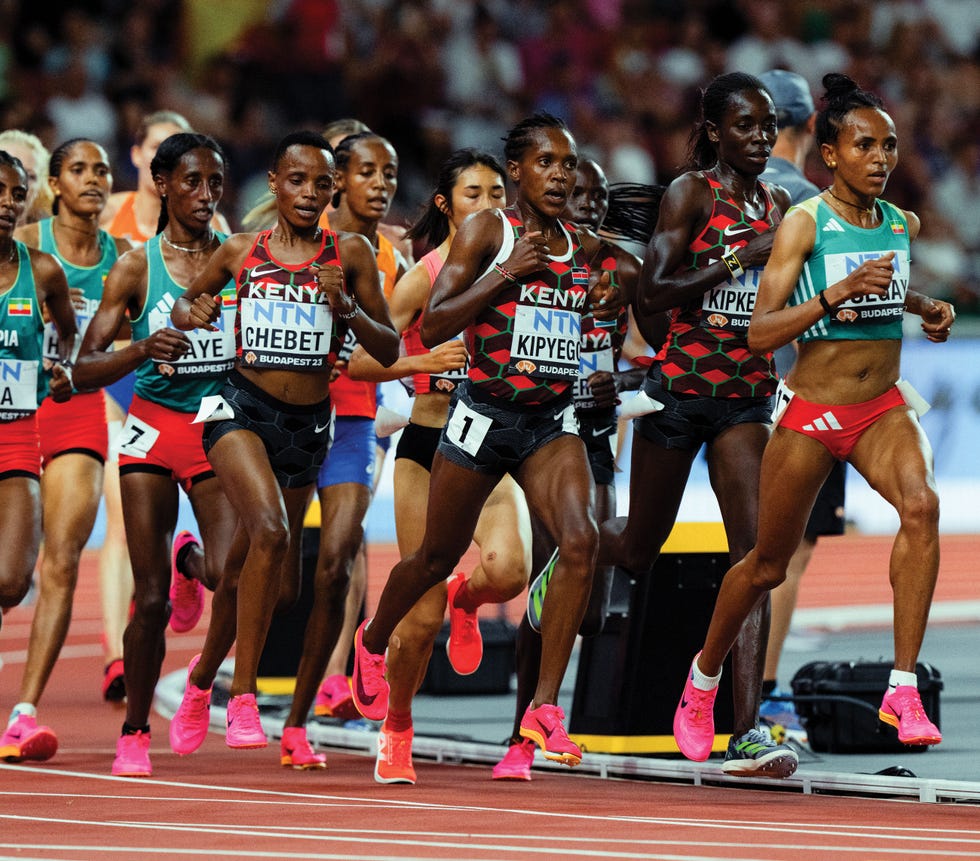
First up was Beatrice Chebet. In the closing laps of the 5,000-meter run, the Kenyan ticked off an electrifying pace with two women on her heels until she snapped the cord with an ethereal kick over the final 200 meters. As Chebet crossed the line, the clock read 13:58.06. She had sliced more than two seconds off Gudaf Tsegay’s 2023 mark to become the first woman in history to break 14 minutes—a whopping 26 seconds faster than the world record was 20 years ago. As the jubilant crowd at Hayward Field celebrated, Chebet hugged fellow Kenyan Faith Kipyegon, who had been watching trackside and lifted her countrywoman toward the heavens.
About 80 minutes later, it was Kipyegon’s turn to astonish—just nine days off her galvanizing attempt to become the first woman to break four minutes in the mile in Paris. The hype for this 1500-meter race was so high that organizers had decided to end the meet with the event, moving the Bowerman Mile, the usual finale, earlier in the program. From the moment the pacer stepped aside, Kipyegon took control, and with 300 meters left, she broke into a full sprint, leaving no questions about the race other than the final digits on the clock. The numbers 3:48.68 flashed on the finish line display, about a half second faster than her previous best, pronouncing Kipyegon’s third 1500 world record since 2023.
These two extraordinary displays were, of course, hardly the only track-and-field world records set in recent memory. The conception of what is possible in the marathon has been permanently altered—with Eliud Kipchoge’s stunning success in Breaking2 (a record-ineligible Nike project to break two hours in the marathon by leveraging pacers and technical innovations) and Kelvin Kiptum nearly crossing that mythic threshold with a 2:00:35 world record at the 2023 Chicago Marathon. In 2024, Beatrice Chebet destroyed the 10,000-meter record. Meanwhile, the men’s half marathon best was eclipsed twice (by Yomif Kejelcha and Jacob Kiplimo) in four months. Three men have set the all-time top 25 marks in the men’s 400-meter hurdles in the past four years, while the top 27 marks for women at that distance have been set since 2021. Even the kids are in on the action, as Texan schoolboy Cooper Lutkenhaus, then only 16, ran 800 meters in a breathtaking 1:42.27, a new U18 world record, in August 2025.
To be sure, watching massively talented athletes redefine the contours of possibility is mesmerizing and inspiring. But it also raises reasonable and knotty questions. Why do humans keep getting better and running faster? Is there a limit to how fast the very best runners can go—and if so, what is that limit? And is all of this happening because the shoes are better?
 ELIJAH AGURS
Women have historically trained like men, but ongoing studies looking into hormonal differences may change that in the next decade.
In July 2024, the Washington Postpublished a long feature on this topic, reaching the unassailable but unsatisfying conclusion that the pace of human evolution moves too slowly to be noticeable—and certainly too slowly to impact how fast humans can run. That Jesse Owens and Grete Waitz would still be world class if they were born today and able to take advantage of all the latest technology and training science. The story proclaimed that with track records, “we may be approaching the razor’s edge of possibility.”
It doesn’t seem likely. This is not just my opinion—it’s what I heard from top researchers who study the topic, the physiologists who consulted on projects like Kipchoge’s Breaking2 and Kipyegon’s Breaking4, and those who work with the best runners on earth. Their view is that the persistent nibbling of world records that has delighted fans for many decades will continue for many more to come, and that certain popular views—like extraordinary performances being largely attributed to advanced technology or novel doping techniques—don’t fully explain what fuels this relentless progression.
In 2008—before Usain Bolt and Kipchoge had completed their best work, and long before Kipyegon and Chebet were on the world’s stage—Stanford biologist Mark Denny published a study in the Journal of Experimental Biology in which he modeled out the fastest time men and women would ever run in the most popular track and field distances. For the men, Denny predicted an “absolute world record” of 18.63 for the 200 and 25:03 for the 10,000-meter mark, both of which seem very safe in early 2026. On the women’s side, Denny forecast a 100-meter record of 10.39 and an 800-meter mark of 1:50.83, which again seem untouchable.
But the endeavor to predict the boundaries of human performance, even with rigorous scientific underpinnings, is a tricky business. Only 18 years after he published the study, two of Denny’s “absolute” records have already been broken—Kiptum’s 2:00:35 marathon eclipsed the study’s predicted limit of 2:00:47, and six women have beaten Denny’s 2:14:57 threshold. And Kipyegon’s best 1500-meter run is only 0.76 seconds from the supposed all-time record.
Surely there is a limit to how fast humans can run, but even now, in an era of great scientific knowledge, it may not be possible to determine definitively what that limit might be. But it is possible to discern where these gains will come from.
 ELIJAH AGURS
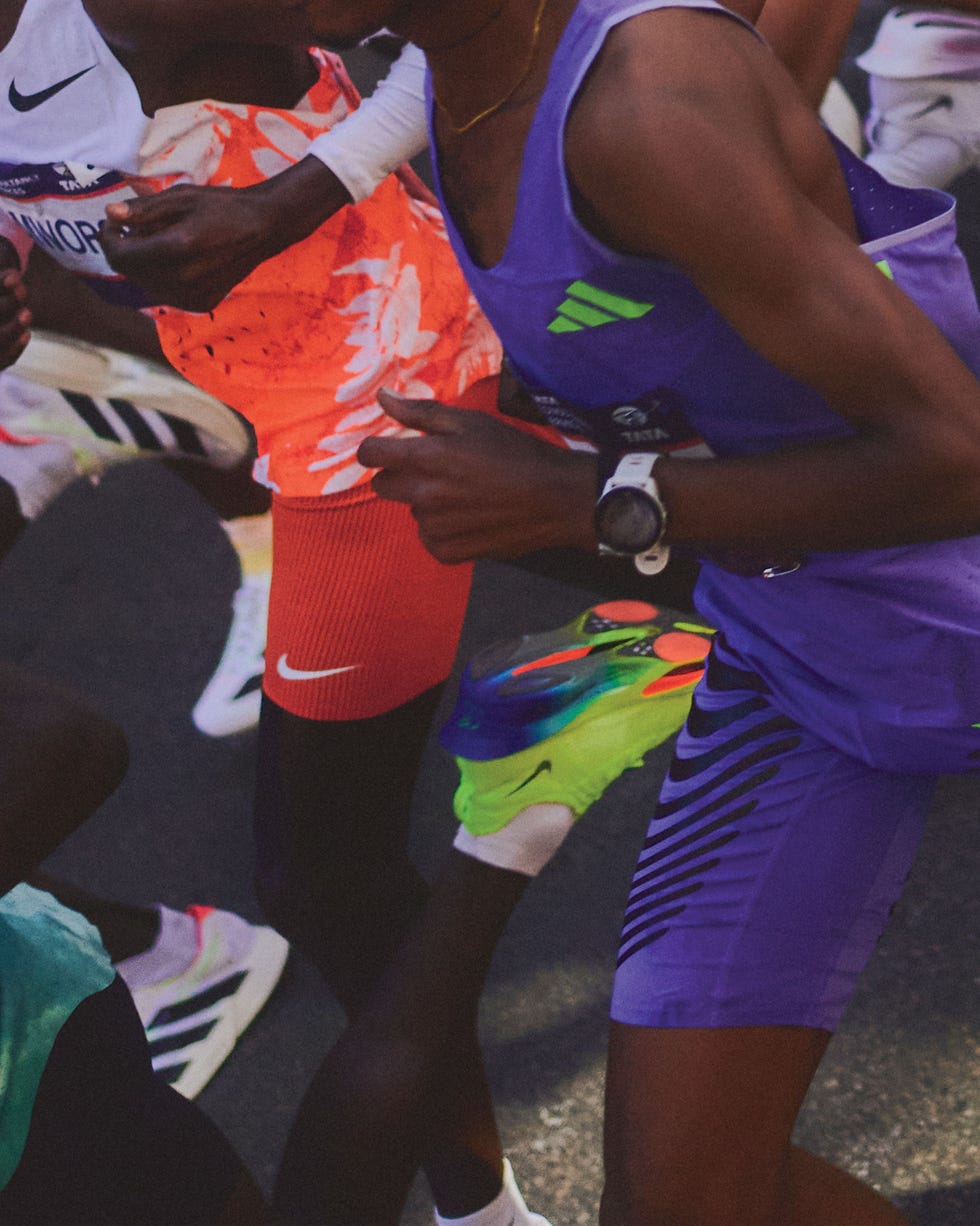
Elite runners constantly train in super shoes, and evidence suggests that the shoes attenuate damage from training, getting athletes to the starting line in better shape.

WHEN THE MARS Blackmon character that Spike Lee played in Nike commercials almost 40 years ago proclaimed, “It’s gotta be the shoes!” he was boasting about hoops and Michael Jordan, but that sentiment has reemerged as conventional wisdom about distance running. It all started in 2016, when a new category burst onto the scene: the so-called super shoe. Extremely lightweight, with a carbon plate encased in thick foam, the Nike Vaporfly started a revolution and has become the new normal in elite distance racing.
There’s no doubt the shoes work, but just how much? “The shoes may give you a 1 percent advantage,” says Edward Coyle, an applied physiologist and director of the Human Performance Laboratory at the University of Texas at Austin. “Some were saying 4 percent when the first Nikes came out, but it’s been proven to be a lot less. Still, 1 percent is a lot.” That modest-sounding benefit translates into one or two minutes for an elite marathoner.
But experts say that the advantage of super shoes likely goes beyond race-day performance. “People often forget that elite athletes train in the shoes all the time,” says Andrew Jones, a professor of applied physiology at the University of Exeter in the U.K., who was involved in both the Breaking2 and Breaking4 projects. “And now evidence suggests that the amount of damage they feel when they train is massively attenuated in those shoes—meaning they can do a higher volume or the same volume at a higher speed. So, probably athletes are getting to the start line in better condition than in the past.”
Why do humans keep getting better and running faster? Is there a limit to how fast the very best runners can go – and if so, what is that limit?
But super shoes are hardly the only technologically advanced equipment top runners are benefiting from. As part of Nike’s Breaking4 initiative, Faith Kipyegon wore a sports bra made with a soft, pliable polymer called FlyWeb that was 3D-printed and optimized for moisture management—all to reduce thermal load under peak exertion. She also wore a one-piece suit constructed with tiny raised half-circles called Aeronodes that reduced her aerodynamic drag at 15 miles per hour.
And if you watch races from 800 to 10,000 meters at a Diamond League meet, you’ll see strips of LED lighting along the track’s edge that give runners (and fans) real-time insight on how their effort compares to predetermined pace. First allowed in competition in 2020, Wavelight technology has become common in non-championship races. Published research indicates that the lighting has allowed elite distance runners to maintain more optimal pacing strategies.
Experts shrug when asked whether these new advancements are somehow unfair—making it impossible to compare contemporary records with those from the past. “You cannot separate advancements in technology from advancements in performance,” says physiologist Brad Wilkins, director of the Oregon Performance Research Laboratory at the University of Oregon. He and Michael Joyner, a physiologist at Mayo Clinic, cowrote a 2024 viewpoint piece in the Journal of Applied Physiology that highlighted a century of technological change in track and field. Cinder tracks have been supplanted by sophisticated synthetic surfaces that deliver significantly higher energy return; the sport has seen the adoption of stopwatches and intermediate split clocks and professional pacers, as well as the emergence of data-driven training tools.
Can the steady pace of technological innovation continue? The experts say definitely… maybe. “The distance running record books have changed dramatically in the last five years because of the breakthrough in shoe technology,” says Peter Weyand, a biomechanics expert and director of the Locomotor Performance Laboratory at Texas Christian University. “So if we project forward, can the materials get better? Yes. But we probably won’t see jumps in the future that are as large as what we’ve already seen if the technical regulations stay the same.”
With shoes, lights, nutritional supplements, and other innovations that help make athletes faster, governing bodies like the World Athletics and World Anti-Doping Agency (WADA) determine what’s permitted. Currently, for instance, super shoes are allowed to have a maximum midsole thickness of what appears to be an arbitrary standard of 40mm and only one carbon plate. But if those standards were to change, more advancement might be possible.
The endeavor to predict the boundaries of human performance, even with rigorous scientific underpinnings, is a tricky business.
ELIJAH AGURS
IN MARCH 2025, American Grant Fisher electrified the crowd watching the 5,000-meter race at the Valentine Invitational at Boston University, setting a world indoor record—running 12:44.09 to slice five seconds off a long-standing mark set 21 years earlier by the legendary Kenenisa Bekele of Ethiopia. When reporters asked how he could explain his amazing performance, he said he had started consuming—wait for it—baking soda as a performance booster.
Wilkins, who has watched the sport evolve for decades, says that “one factor that keeps changing is our understanding of the limits of physiology and how we can modify that through training adaptations.” Physiologists have gotten much better at figuring out load management—the process of monitoring and optimizing an athlete’s status and workouts to maximize strength and adapt to new training stresses without causing undue fatigue or injury. And that understanding, he says, will continue to progress.
Two of the more prominent advances in the nutrition space are centered around the use of bicarb—short for sodium bicarbonate, the scientific name for baking soda—and carbohydrate loading. Neither of these methods is new. For decades, experts have known that bicarb could raise muscle pH and thus reduce the buildup of lactic acid during intense anaerobic efforts, and that relatively high carbohydrate intake could improve endurance performance.
The consumption of bicarb and carbohydrate-loading is fully compliant with existing WADA standards. Bicarb alone might translate to two seconds for a top miler, Coyle says. And many elite runners are using it to their advantage. Recently, the Swedish company Maurten, which markets a gooey hydrogel mixed with bicarb that can be easily absorbed in the stomach and intestines, claimed that two-thirds of all track-and-field medalists at the 2024 Games in distances from the 800 to the 10,000 were using their products.
In the past, top endurance athletes consumed roughly 60 grams of carbohydrates per hour (to keep their glycogen stores topped off) because it seemed the body couldn’t absorb more than that. But scientists discovered that glucose and fructose (sugars that are common carbohydrate sources) are absorbed by different mechanisms. So now elite marathoners commonly consume 90 to 120 grams of carbohydrate per hour (the equivalent of downing four to six gels in 60 minutes) using formulations with an optimal glucose-fructose blend.
In this way, the nature of “training” continues to evolve—and it doesn’t stop at traditional training to maximize an athlete’s aerobic and anaerobic output. “We’ve also improved our understanding of recovery methods, sleep, heat stress, and hormone status—and we can track different blood markers,” Wilkins says. “So now we can monitor these things and make sure people can improve the probability of an optimal adaptation.”
 ELIJAH AGURS
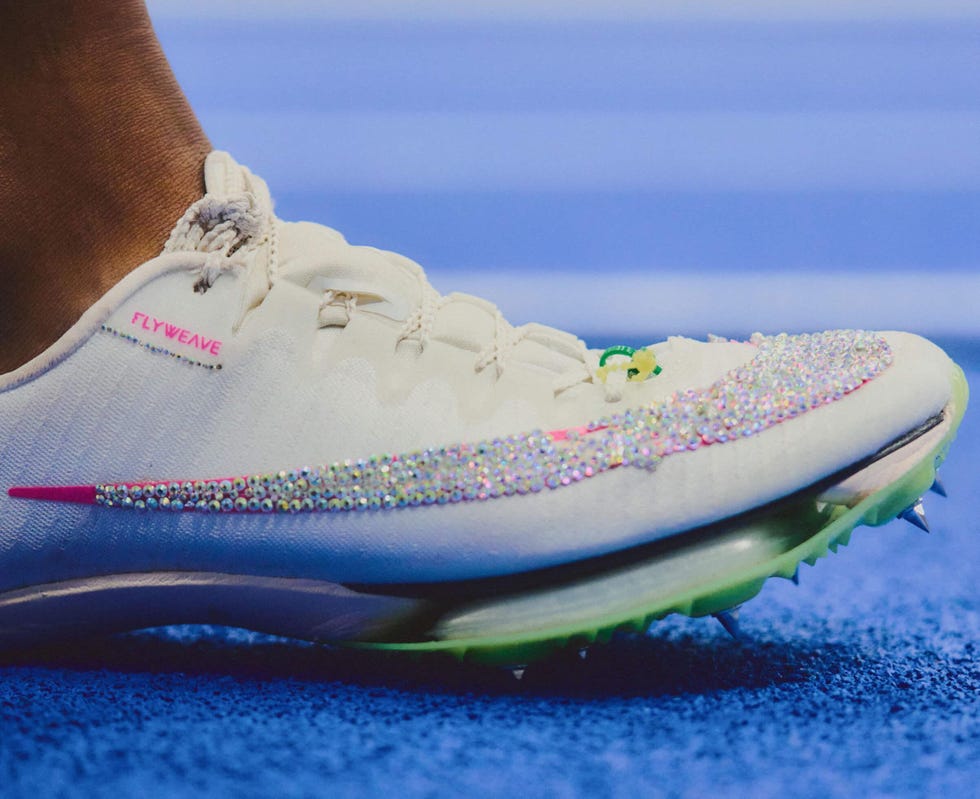
The Nike Air Maxfly is a sprint spike super shoe built for elite runners in the 60- to 400-meter range.
ON A COOL autumn morning in October 2019, Eliud Kipchoge completed a marathon in Vienna like no one had ever seen before. For most of this effort, he sat behind an aerodynamically optimal platoon of pacers, who kept the Kenyan on the perfect pace to become the first human to break two hours at the distance. And with 500 meters to go, he surged in front of the seven remaining pacers to sprint alone to the finish line. The clock read 1:59:40 as he triumphantly pounded his chest and then hugged his wife. And while there is no question about his physiological achievement, Kipchoge’s success underscored how psychology and sociology play a role in pushing the boundaries.
Experts increasingly understand how the mind is a powerful force in setting records. That’s what differentiated Kipchoge from the other athletes who participated in the project, says Jones. “The other guys…couldn’t get their head around the possibility of running three or four minutes faster than they ever had before. Eliud genuinely thought he could do it.”
Jones points out how both Kipyegon and Kipchoge have an outsize belief in their coach, Olympic medalist Patrick Sang. “He’s the kind of guru figure that enables this mindset that success breeds s
uccess,” Jones says. “You’re never going to break a record if you don’t believe that you can.”
Also, experts say, record-setting begets more record-setting. The impact may not be instantaneous, Joyner says, “but eventually somebody breaks an important barrier and…suddenly, more athletes believe in themselves, and promoters get on board, and the whole ecosystem just shifts to a faster time.” Now, more than 70 years after Roger Bannister broke the four-minute-mile barrier, more than 2,000 men have run sub-four, the world record is 3:43, and the odds that a woman will cross that threshold soonish look plausible.
“These attempts are our moon shots: bold and deeply human,” says Amy Jones Vaterlaus, VP of Women’s Research at Nike Sport Research Lab and innovation lead for Breaking2. “They are cultural inflection points that shift what people believe is possible.”
New technology has allowed distance runners to push the boundaries of human performance, but the technology alone can’t explain the scale of improvements we’ve seen in the last decade.
IN THIS ERA of attention-grabbing moon shots, many experts think that the pace of longer-distance record-setting on the women’s side will outpace the men, due to the comparatively short period of time female distance runners have been competing at the highest level and getting similar opportunities. In the Olympics, for instance, women didn’t run the marathon until 1984; the 10,000-meter run wasn’t introduced until 1988; and the 5K didn’t replace the 3K until 1996.
In a similar vein, physiological research and training protocols focusing on women have been rare. “Women are still training like men have for decades, but I think that’s going to change in the next five to 10 years,” says Wilkins, adding that studies of performance differences across the menstrual cycle are under way and also look at hormonal differences between men and women, trying to understand how the physiological limits may be different. “As we learn more, that gets translated into training plans,” he says. “The full application isn’t happening yet, but that part is coming.”
Kipyegon’s Breaking4 sits at the front lines of this process. On paper, this goal is more challenging than the initiative that led to Kipchoge’s sub-two marathon. For one thing, the 3.1 percent improvement required to break the women’s mile record is substantially greater than the 1.4 percent jump Kipchoge had to achieve.
Research into the physiological challenges women face in middle-distance races lags behind pure endurance events.
“With women, if you look at where the sex differences are greatest, it’s in the 800,” says Joyner, adding that the event’s demands are half aerobic and half anaerobic. Nearly all men who have broken the four-minute barrier can run a 1:50 half mile and a 50-second final lap, Joyner points out. But he and other experts believe mile records will continue to come and that eventually the four-minute mark and 800-meter records will fall.
 ELIJAH AGURS
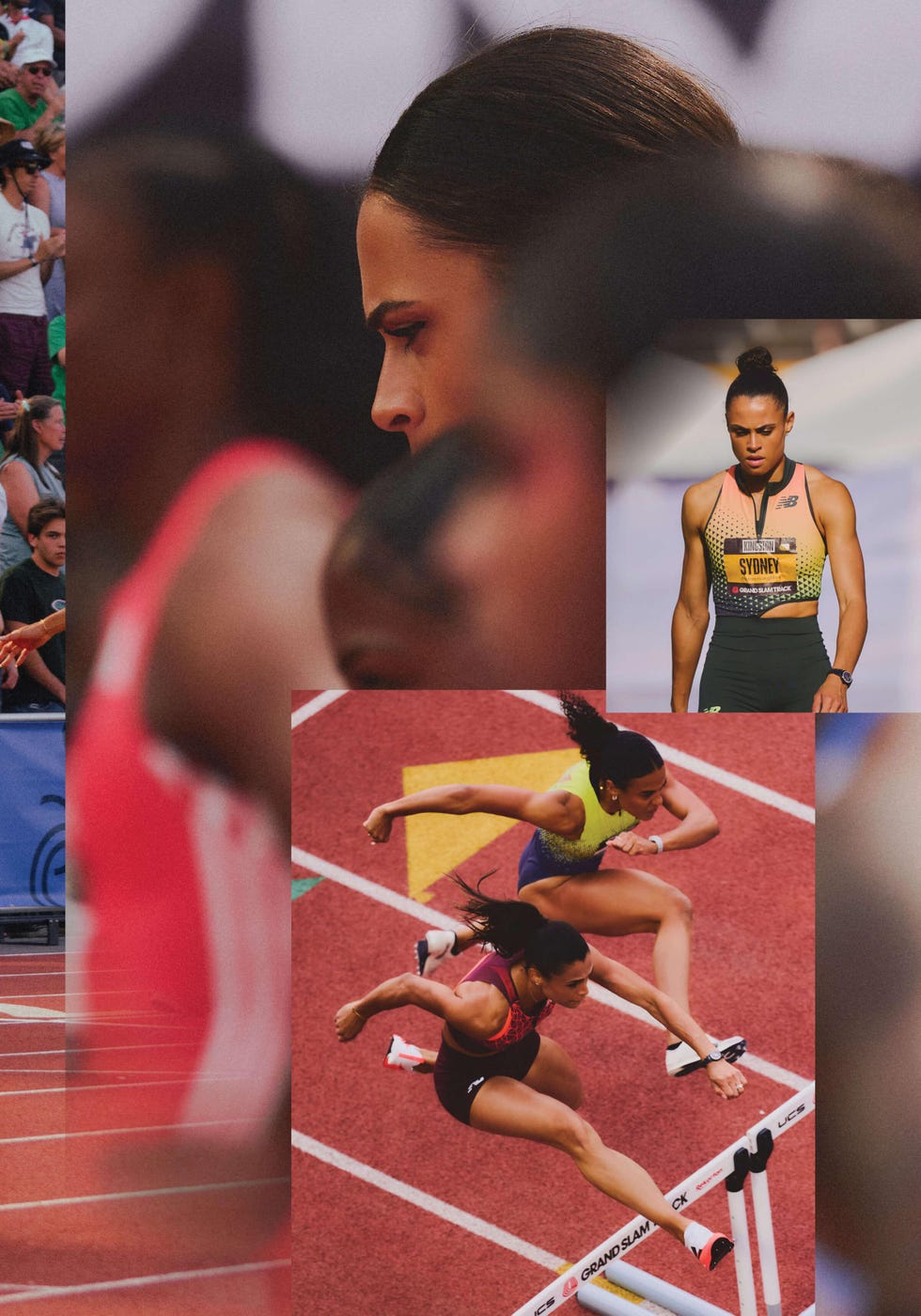
Sydney McLaughlin-Levrone holds the second-fastest time in the 400-meter race with 47.78, only 18 hundredths off the world record.
IT’S UNWISE TO talk about the ever-changing boundaries of human performance without addressing the specter of performance-enhancing drugs. PEDs have and always will be a concern. Athletes who use them will continue to be caught and sanctioned. But many of the experts I talked to say the impact of illegal drugs and techniques is smaller than in the past and that they’re a less impactful variable than some may suspect.
“Sometime in the mid-2000s, drug testing got better, so now we can say for sure that the era of industrial-strength doping is over,” says Joyner, referring to advancements like the invention of accurate urine and blood tests for erythropoietin (EPO) and the later development of the athlete’s biological passport, which tracks each competitor’s biomarkers over time. “But that doesn’t mean people aren’t microdosing or that there aren’t novel compounds out there.”
If you look at the world record times for all events and for both men and women, the ones that appear toughest to break are middle-distance marks that were set in an era when doping was more common, and some performances have questions or shadows hanging over them. In a perverse manner, the fact that the 100-, 200-, and 400-meter records from the 1980s still stand is an encouraging sign that today’s top performances—which are getting increasingly close to those marks—are on solid ground. At the 2025 Tokyo World Championships, Sydney McLaughlin-Levrone won the 400-meter race in 47.78, the second-fastest time in history and only 18 hundredths of a second off the mark East Germany’s Marita Koch ran in 1985.
While Coyle agrees that doping is present, he thinks people overestimate the long-term impact. “Consider blood doping or taking erythropoietin, which raises blood volume and improves performance by 1 or 2 percent,” he says. “In a given race, that could be a lot. But over the course of continued setting of world records, we’re talking about 20 to 30 percent improvements. That’s not coming from drugs.”
Coyle is bemused by the discourse around the so-called Enhanced Games, which will allow athletes to use drugs banned by the World Anti-Doping Code and is set to debut in May in Las Vegas. While some observers envision a wild west where records are smashed, Coyle thinks that notion is “ridiculous” and that few enhanced athletes will match the results of those who are the most talented and hardworking. “Some people have too much faith in drugs,” he says.
ULTIMATELY, PERFORMANCE IS a matter of probability and math. If you watch a record attempt, you’re seeing the results of hard work and smart training and the application of the latest technology and a fiery competitive spirit. But none of this is possible without one thing: raw talent.
Think of it like a lottery ticket. Maybe an athlete needs a one-in-a-million ticket to reach an Olympic final and be a one-in-a-billion winner to be physiologically capable of setting a rarefied world record. So in the quest for more world records, coaches need to find and develop more athletes with winning tickets.
This partially explains the explosion of top talent from East Africa, where endurance running is the premier sport. And while some countries (like China, Germany, and Australia) have sophisticated programs to identify young athletes with specialized gifts and then steer them into specific sports, that sort of infrastructure has fallen out of favor in the U.S. Joyner, for instance, points out that some of the top American distance runners in past eras were first identified by running the 600-yard dash in the controversial Presidential Fitness Test (which was created in 1956, discontinued at the end of the 2012/2013 school year, and reinstated in July 2025).
If you watch a record attempt, you’re seeing the results of hard work and smart training and the application of the latest technology and a fiery competitive spirit. But none of this is possible without one thing: raw talent.
Coyle has created mathematical models that quantify the variables leading to elite running performances. One of them analyzes the factors that inform how fast men can run a mile (a similar analysis for women has not yet been done). “It mostly boils down to how much energy they can produce aerobically and how efficient they are at converting that energy into speed,” he says. “But there are about 20 things that impact your body’s ability to produce energy aerobically for three or four minutes—the biochemistry of [the] muscles, the quantity of blood vessels, the size of [the] heart, [the] ability to clear lactic acid from muscles, and so on.” The odds of one person having the very best score or results in all or even most of those 20 factors are extremely low, he adds. He points to other researchers’ models of the optimal times elite runners are physiologically capable of performing—what mathematicians call the asymptote, the spot where a curve flattens out. For the men’s mile, one study predicted an asymptote at 3:17.
Which sounds crazy. But as Coyle points out, 3:43 would have sounded crazy in 1954 after Roger Bannister ran 3:59.4. And perhaps no crazier than comparing a sub-four-minute mile for a woman to Mary Decker’s 1980 world record of 4:21.68. Over time, the small leaps add up to mind-boggling results.
What’s Holding Your Athletic Peak Back?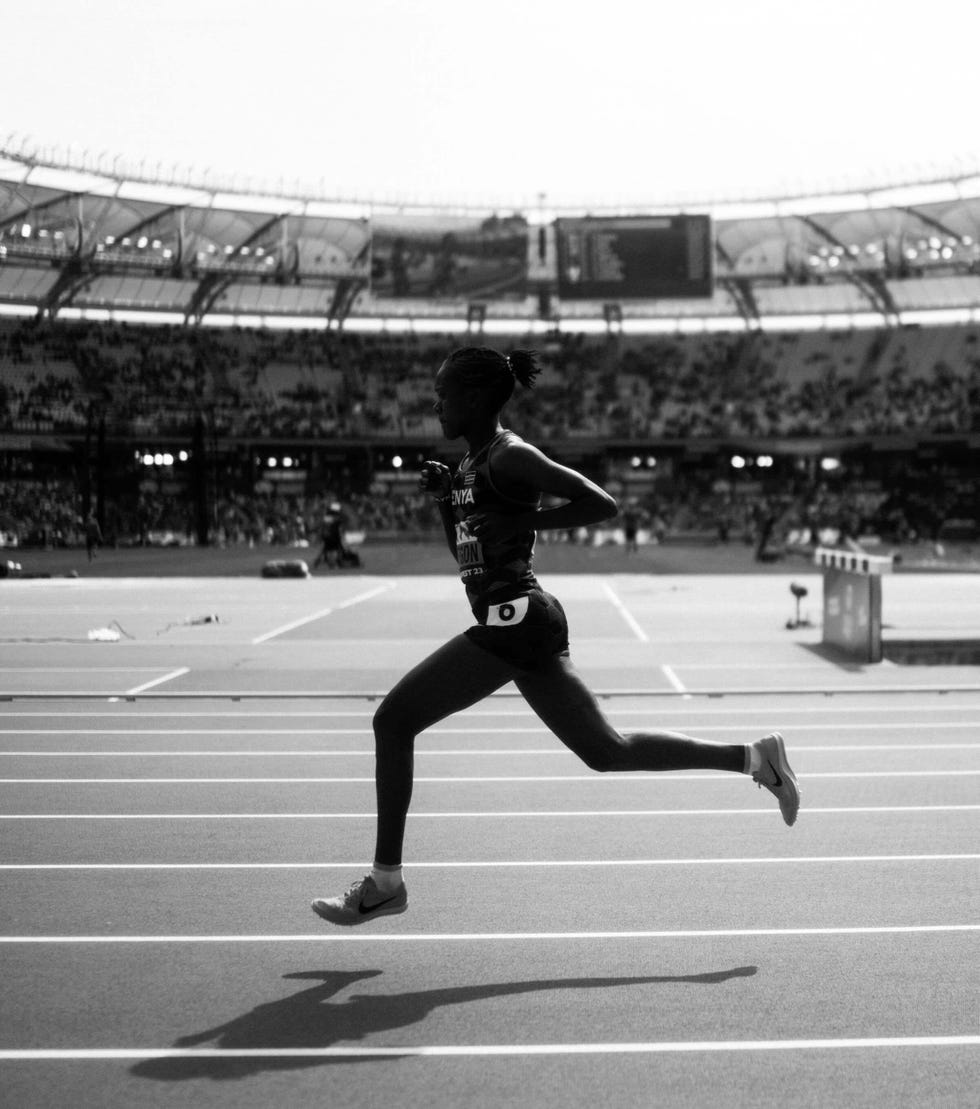 ELIJAH AGURS
Faith Kipyegon is the only woman who’s attempted to run a sub-four-minute mile so far.
To hit faster speeds, working on boosting your easy pace can be the key to your long race success. For most runners, the “easy pace” is somewhere in between high zone 1 and low zone 2 effort, explains Sasha Gollish, PhD, registered professional engineer and middle- and long-distance run coach. It’s easy to get stuck at this effort, considering it’s where we just want to feel calm and steady. You’re still working, just not very hard. To get out of a speed rut, ask yourself these questions:
1 / How does your “everyday pace” actually feel?
If you’re barely able to wheeze out a sentence, you may be pushing too hard, and that extra effort is ironically slowing you down. Hitting the right endurance pace allows you to improve your aerobic system, and that lets you get faster as you move into tempo and threshold efforts.
2 / How long have you been stuck at this pace?
If it’s only been a few months since you saw progress, that’s normal…especially once you’ve been running regularly for a few years, says Alex Ullman, cross-country coach at the University of Waterloo in Ontario, Canada. Gains become more incremental as you get fitter, which may feel unfair as you see new runners around you making huge strides. However, if you’ve been stuck for a year or two despite following a training plan, you may need to tweak an aspect of your training.
3 / What factors could be affecting your pace?
If you’ve only noticed this plateau in the heat of summer, you may want to curb your panic until temps cool off, considering the heat can make your run feel harder, says Gollish. After an injury, it may take months to return to your faster paces. And age plays a role as well: Too often, Gollish notes, we try to compete with our past selves and hold onto paces that made sense 20 years ago. Yes, it’s possible to improve fitness in your 60s, but you may need to temper your expectations.
4 / Is your barrier mental or physical?
While there is no perfect ‘one size fits all’ run form, if you’re flailing around, slamming into the ground, and wasting energy, “you’re going to see massive gains from working on your stride,” says Gollish. “But a lot of us get stuck at a certain pace because we mentally [limit] ourselves. If you’ve got a beautiful stride but you’re constantly stuck in your head, you need to [think hard about] where that block is coming from.”
5 / Are you running by pace, feel, or heart rate?
None of these metrics are bad, but each can cause you to get stuck if you’re too caught up in it, says Ullman. Depending on which you tend to lean on, there are different strategies you can use to bust out of your rut.—By Molly Hurford
Can Science Predict Peak Speed?
In 2008, Stanford biologist Mark Denny published a study in the Journal of Experimental Biology in which he shared a mathematical model that predicted the fastest time men and women would ever run in the most popular track-and-field distances.
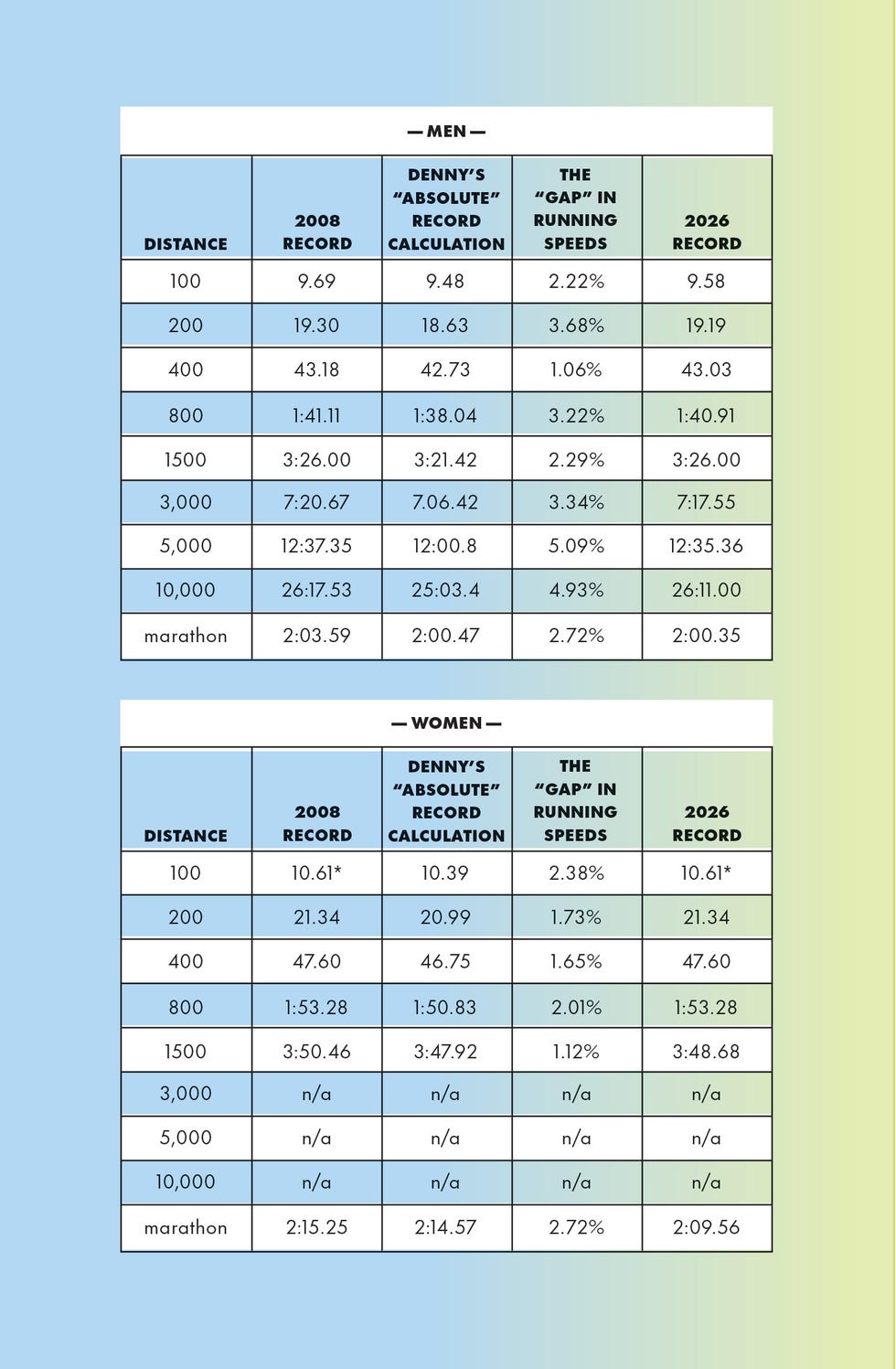
* Denny decided to disqualify FloJo’s 10.49 due to wind-related objections and instead used her 10.61 time. Although World Athletics recognizes 10.49 as valid, RW followed Denny’s decision for 2026 for data consistency. n/a: not enough data to do a valid analysis.
How to Actually Drop Seconds Off Your Pace? ELIJAH AGURS
Experts increasingly understand how the mind is a powerful force in setting records.
Unstick Your Brain / “If you’re an experienced runner who has been stuck for a year or two at the same pace…you need to get out of the mental holding pattern you’re in,” says Alex Ullman, a cross-country coach at the University of Waterloo.
Ullman likes to assign runners various interval workouts to get them used to different feelings. For example, if you’re doing mile repeats, Ullman would set one of them faster than goal pace, one slower, and one at goal pace. Often, runners realize they can actually hit that faster pace with no problems, he says. The slower-pace interval also allows them to release the idea of the “perfect workout” where every interval is right on target.
Stop Looking at Your Watch / Cover the watch face with masking tape and get used to doing your run analog-style by basing your pace on feel. “Just start slow and then pay attention to your body signals,” says Ullman. “Toward the end of your run, start pushing your boundaries by picking up the speed just a little bit. The more you work on this, the more you’ll adapt to learning how to run by feel and understand when you can push.”
Pplay in Your Zone / You’re likely attached to one specific heart rate that feels comfortable—but if it’s not at the top of the heart-rate zone you’re training in, you have room to play. “That’s the only way you’re going to improve—pushing your boundaries,” says Ullman. “You learn so much about yourself when you do push a bit.”
Expect to Fail / “A lot of people get discouraged when they do a run and try to increase pace slightly halfway through but then realize in that last mile that they pushed it way too fast,” says Ullman. “You learned that you can’t hold that faster pace. Maybe you can hold a slightly slower pace the next time, though. Don’t get discouraged; use it as information, and next week, you can do a similar workout and know where your boundaries are.”
Take Other Factors Into Account / Lack of sleep, fatigue, weather, and terrain can all affect your pace. If you’re doing trail running or hillwork or if it’s 100 degrees, your pace will change.
Sasha Gollish, PhD, registered professional engineer and middle- and long-distance run coach, notes that there are intangibles, including life stress, that can also slow you down. “You need to be able to back off and accept the pace that feels right in that moment.” Don’t get discouraged if your new speedier pace isn’t there on every run.—By Molly Hurford