
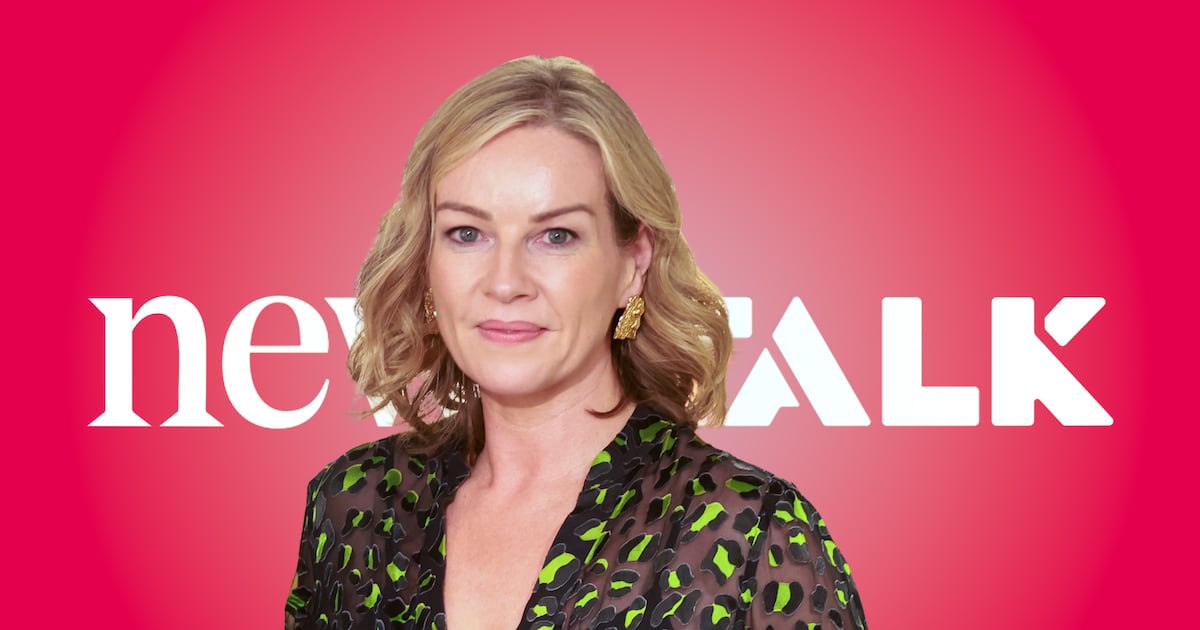
In an era when traditional broadcast media are ever more squeezed by online platforms, it makes sense for even the highest-profile presenters to look beyond their customary audience and appeal to different, more digitally attuned listeners.
So when Claire Byrne hears a shocking revelation from one of her guests, for a brief moment it sounds as if she might be gearing up to chase the wildly popular true-crime podcast market.
The host is talking to the actor and comedian Ardal O’Hanlon about the effect of celebrity on Monday’s Claire Byrne Show (Newstalk, weekdays) when proceedings take an unexpectedly dark turn. “I remember being at a party and someone telling me about the murder they committed,” O’Hanlon says, his chirpy admission causing consternation in Byrne.
“What?” she blurts out, clearly perplexed. “What do you do with that information?”
O’Hanlon jokes that his first reaction was to get away, but Byrne still struggles to process what she’s just heard: “That’s a moral dilemma.”
Before she can drill down into the realm of unsolved homicides, O’Hanlon takes the wind out of her sails: “The guy had served time,” he stresses.
“Okay,” the host responds, a hint of disappointment in her voice as the prospects of a sensational scoop evaporate. (One assumes she’s happy the guilty party was caught.)
She may not be about to pivot to a career in podcasting, but since decamping from RTÉ to Newstalk in February, Byrne sounds like a broadcaster enjoying a new lease of life.
As her absorbing interview with O’Hanlon attests, she certainly sounds more open. Offering her guest condolences on the recent death of his father, the former Fianna Fáil minister Rory O’Hanlon, Byrne also offers her own insights into such bereavement.
“As much as you think you might be ready for it, it always hits you hard,” she says. “It changes your perspective a little when your father goes.” (O’Hanlon agrees, in heart-rending fashion: “For the first time in your life you’re not a little boy any more.”)
It’s not just in the personal sphere that the host displays a renewed freedom of expression. When the interview turns to the impact of Donald Trump’s decision to attack Iran, Byrne doesn’t hide her views. “It’s extraordinary, isn’t it, that one man’s whim can cause so much destruction, death, in one part of the world, but also impact our lives so profoundly here?” she says.
Her tone is more one of fatalistic wonder than seething anger, but it’s still a notable moment. (Having chided Byrne in a recent column for being overly circumspect about Trump’s actions, I stand duly castigated.)
Other encounters speak of the presenter’s more free-flowing approach. Speaking to the former Connacht rugby player Fergus Farrell about his unlikely recovery from a catastrophic spinal injury, Byrne sympathetically quizzes him on the physical and mental trauma he endured along the way.
But as Farrell recounts how seven months in rehab was followed by a stay in a psychiatric ward – “I had time to declutter” – and how, after the failure of a subsequent charity rowing challenge, he sought counselling, the host takes on a note of genuine concern: “Are you dealing with what happened to you or are you trying to climb a mountain all of the time?”
When Farrell remarks that the question has never arisen in his counselling treatment, Byrne’s reaction punctures any awkwardness. “What a can of worms we’ve opened,” she says with a chuckle. Fortunately, Farrell says he’s now in a good place.
As indeed is Byrne. That she has comfortably settled into the mid-morning slot formerly occupied by Pat Kenny is hardly a surprise, given her pedigree as a current affairs presenter. But in her reflective asides and easy-going flourishes she is showing a refreshing new side to her on-air persona.
With no audience figures due until next month, it’s a bit early to say she’s slaying it, but Byrne has taken to her new role with applaudable conviction.
Loosening up has never been a problem for Seán Moncrieff (Newstalk, weekdays), whose demeanour couldn’t be more relaxed if he turned up at the studio in sweatpants and flip-flops. (Who knows? Maybe he does.) But, as the longest-serving presenter at Newstalk, he has built his show on more than insouciance; the real key to Moncrieff’s longevity is his ability to treat serious subjects in an unorthodox way, and vice versa.
So, amid obviously niche items, such as the sale of a life jacket from the Titanic, Moncrieff filters hardy perennials of public discourse, such as religion and class, through a skewed lens. For instance, hearing that the conservative US pundit Sean Hannity has quit the Catholic Church in protest at the Pope’s anti-war statements, the host invites Michael Nugent of Atheist Ireland to outline the labyrinthine process of formally leaving the faith.
Elsewhere, he investigates the concept of poshness with the etiquette consultant Brenda Hyland Beirne, who insists that the English obsession with social status has no equivalent in Ireland. “There’s no division today, in my eyes anyway,” she says, suggesting her glasses possess a rosy tint, as well as causing Moncrieff to splutter in disbelief: “Really?”
In response, he ventures that being an “etiquette consultant” is posh. “Etiquette is about respect,” Hyland Beirne replies, her immaculate affability underscoring her own respectful attitude, even if she can’t convince her host on the innate egalitarianism of Irish society.
Sometimes, however, Moncrieff covers a topic so critical that his mood cannot but be sober, as when he talks to the human rights monitor Sam Simpson about the displacement of Palestinians by Israeli settlers in the West Bank. The presenter restricts his contributions to pertinent questions as his guest recounts what he has witnessed in the Occupied Territory: “They’re really being ethnically cleansed, and I use that word advisedly.”
Simpson details how armed settlers seize land from local farmers almost overnight, with the banished Palestinians being corralled into crowded urban areas. (He uses the charged term “Warsaw ghettos”.) Moreover, Simpson says the pace of such land grabs – illegal under international law – has grown exponentially since his previous visits, “like a snowball”. No wonder Moncrieff is reduced to the odd gobsmacked “yeah”. Some people are unabashed about their crimes, no matter how brazen.
Moment of the week
Two weeks into Radio 1’s station-wide sonic rebrand, rumblings of discontent can be heard on Liveline (weekdays), with callers’ ire particularly stoked by the culling of the signature tune to the venerable weekly new-writing compendium Sunday Miscellany, ever-present since the programme’s debut in 1968.
There’s ample testament to the Proustian qualities of Samuel Scheidt’s composition Galliard Battaglia, as well as bafflement at its being sacrificed for the kind of jingle that, as one caller acidly remarks, “sounds like it could have been written on an iPhone”.
Kieran Cuddihy, Liveline’s host, gamely plays devil’s advocate – “Are we not just auld lads raging against the dying of the light?” – but it’s hard to disagree with the verdict that, whatever about its commercial benefits, the station has ditched beloved themes for a new sound that’s “bland and vanilla”. Then again, when it comes to art versus commerce, there’s usually only one winner.