
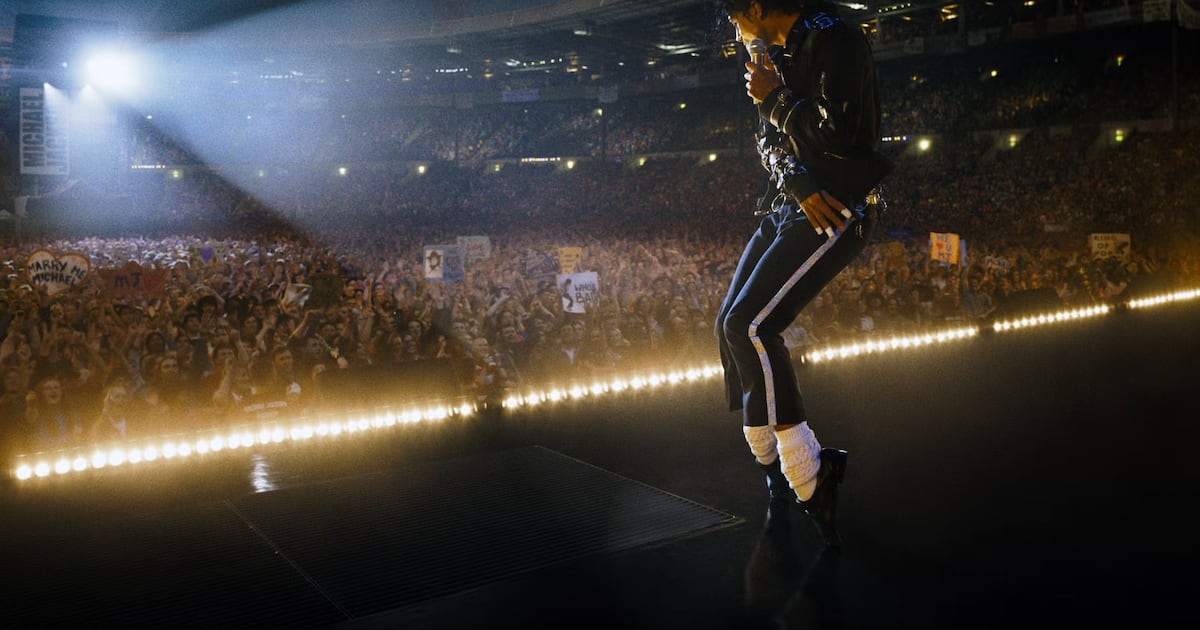
Might Antoine Fuqua’s Michael be sufficiently appalling to terminate the current epidemic of musical biopics?
The compromised study of Michael Jackson’s first 30 years on Earth is certainly bad. (It’s bad, it’s bad, shamone!) No blame attaches to Jaafar Jackson. The late star’s nephew is maybe a little too physically robust for the role, but his musical and terpsichorean chops cannot be faulted.
It is everything else that’s wrong. Long before the film halts itself at the release of the Bad album, in 1987, so avoiding engagement with later allegations of sexual misconduct, it has become clear we are dealing in scarcely qualified hagiography. Michael is closer to Song of Bernadette than it is to Walk the Line.
The answer to the rhetorical question above is still “no”. Michael is likely to take in a ton of money. Even if it doesn’t, the subgenre will survive. The musical biopic has, over the past few years, proved irresistible to risk-aversive Hollywood.
Casual filmgoers are likely to nod along as they remember Baz Luhrmann’s Elvis or Dexter Fletcher’s Rocketman. Closer examination reveals a locust swarm of titles they may have missed. There was Springsteen: Deliver Me from Nowhere, Back to Black (on Amy Winehouse), Whitney Houston: I Wanna Dance with Somebody, Respect (on Aretha Franklin), Stardust (on David Bowie), England Is Mine (on Morrissey).
We could go on all day. James Mangold’s A Complete Unknown secured Oscar nominations in 2024. Bob Marley: One Love, released earlier the same year and starring Kingsley Ben-Adir as the reggae great, was less celebrated but ended up taking $40 million more than the Bob Dylan flick.
There is much speculative discussion of upcoming films about Joni Mitchell, Roy Orbison, Sinéad O’Connor, Britney Spears and Snoop Dogg. We know for certain that Paul Mescal, Barry Keoghan, Harris Dickinson and Joseph Quinn will be playing Liverpool’s finest in, due for 2028, Sam Mendes’s The Beatles: A Four-Film Cinematic Event. It will take more than a stuttering second weekend at Michael’s box office for the industry to back away from the lucrative jukebox.
This conversation takes place a year before the genre’s possible centenary. Okay, The Jazz Singer, the first feature with lip-synchronous speech, is not, strictly speaking, a biopic of Al Jolson – he plays a blackface singer called Jakie Rabinowitz – but both character and star were the son of a cantor from New York’s Lower East Side. Both have an early hit with My Mammy.
At any rate, one can already see the shape of the contemporary genre forming itself. Generosity to the title character. Early obstacles courageously overcome. Plenty of opportunities to air the hits.
Nearly 20 years later, Larry Parks trotted through the same tropes in the formal biopic The Al Jolson Story. You saw a few more of those in Yankee Doodle Dandy, an electrifying study of George M Cohan, from 1942, featuring an Oscar-winning Jimmy Cagney, and Anthony Mann’s The Glenn Miller Story, from a decade later, starring Jimmy Stewart as the doomed band leader.
It was not until rock‘n’roll matured into middle age that the current, endlessly replicable format reached its finished condition. Just as This Is Spinal Tap, a parody, is the key text for the rockumentary form, Walk Hard: The Dewey Cox Story, another spoof, offers the defining commentary on the music biopic. Released in 2007, Jake Kasdan’s film spread its fire widely, but its inspiration was plainly two titles that had recently won Oscars: Ray, from 2004, and Walk the Line, from 2005.
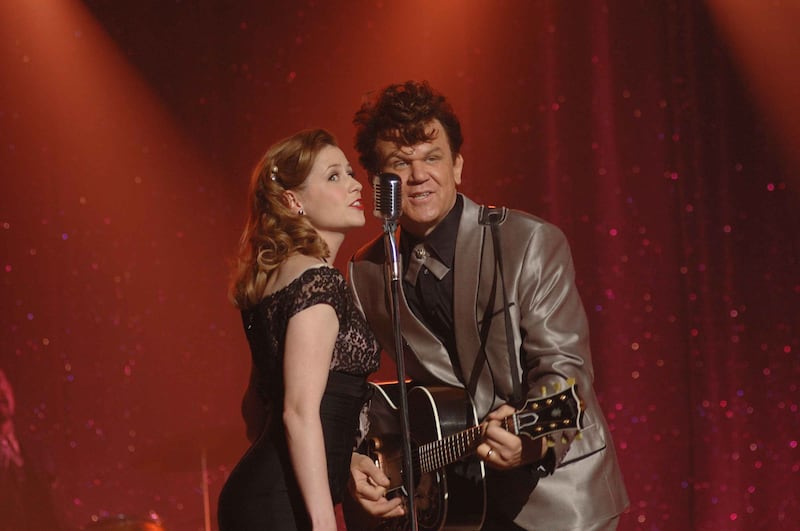 Jenna Fischer and John C Reilly in Walk Hard: The Dewey Cox Story, directed by
Jake Kasdan
As many remarked at the time, how peculiar that, despite Ray Charles and Johnny Cash being such different men, they inspired such eerily similar films. Blue-collar roots. Early hurdles. Drug issues. Eventual redemption. All that interspersed with startling performances witnessed by drop-jawed spectators.
Even if Walk Hard had been more widely seen, it would not have hindered the advance of such a saleable configuration. Audiences already know the protagonists and their songs. They are already willing to nod at familiar plot turns. The format is perfect for an increasingly conservative industry that yearns to give audiences what they already know they want. Like Star Wars. Like Super Mario. Like The Beatles.
The unexpected hugeness of Bohemian Rhapsody in 2018 confirmed the form was here to stay. Not every critic was on board with the Queen flick, but the closing, extended Live Aid sequence exemplified the cosying effect of the long familiar.
The studios and those in charge of the music rights are locked in a mutually beneficial chokehold. Those protecting the stars’ image (living or dead) don’t want any controversial or avant-garde swerves. For the most part, the studios aren’t much interested in taking such risks either.
Fine films such as Todd Haynes’s I’m Not There, a Bob Dylan fantasia from 2007, or Alex Cox’s Sid & Nancy, from 1987, an unsettling study of Sid Vicious’s decline, may have won raves, but they didn’t draw in audiences like Bohemian Rhapsody. Even the super Better Man, featuring Robbie Williams as a chimp, was too outre to score big bucks.
The music biopic will survive the worst Michael can throw at it. And it will continue to skew conservative. It remains to be seen, however, if the folk behind the Jackson film really can deliver a threatened follow-up. There are innumerable dangers to manoeuvre in those weeds. Jarvis Cocker mooning Jacko at the Brits will be the least of their concerns.