
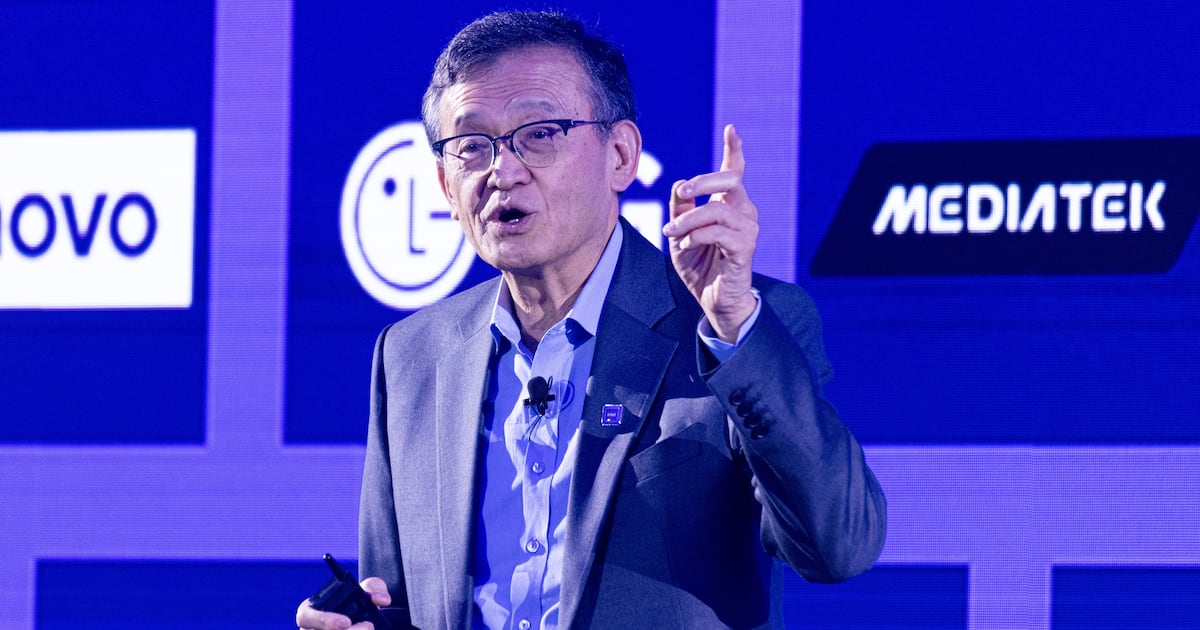
Intel shares surged on Thursday after it reported strong earnings and financial forecasts, and its chief executive hailed a “fundamental” change at the US chipmaker from a year-long turnaround and booming AI demand.
The stock rose as much as 20 per cent in after-hours trading, surpassing an all-time high set in 2000, after the company projected revenue of between $13.8 billion (€11.8 billion) and $14.8 billion in the current quarter, beating Wall Street expectations.
Lip-Bu Tan, who became chief executive just over a year ago, told investors his efforts to revive Intel were bearing fruit. “A year ago, the conversation about Intel was about whether we could survive,” Tan said
“Today it’s about how quickly we can add manufacturing capacity … to meet enormous demand … This is a fundamentally different company today,” he added.
He said Intel had benefited from an AI-driven appetite for its central processing units and other products. It reported first-quarter revenue of $13.6 billion, up about 7 per cent year on year, surpassing average analyst estimates of $12.4 billion compiled by Visible Alpha.
Big Tech groups are pouring hundreds of billions of dollars into AI data centres, for which Intel supplies CPUs that work alongside the advanced processor chips designed by the likes of Nvidia and mainly manufactured by rival TSMC.
The robust earnings report adds to Intel’s momentum after a huge increase in its share price, which has risen more than 50 per cent in the past month.
Intel stock has gained ground since Donald Trump brokered a deal last summer for the US government to take a 10 per cent stake in the US chipmaking champion, a move followed by investments from Nvidia and SoftBank.
Its recent partnership with Elon Musk on his Terafab chipmaking facility and its decision to repurchase its equity stake in a chip factory in Ireland from Apollo have added to investor confidence in its manufacturing turnaround.
Intel has pumped billions of dollars into a loss-making strategy to regain its position as a world-leading semiconductor manufacturer to rival Taiwan’s TSMC, a risky bet that cost former chief Pat Gelsinger his job in 2024.
Under pressure from Trump, Tan has continued a slimmed-down version of the chipmaking push.
Earlier this week, HSBC analysts upgraded their rating on Intel stock, saying the company appeared poised to benefit from a global rush to buy AI infrastructure that will benefit its server CPU business.
Data centre and AI products brought in $5.1 billion in revenue in the first quarter, far surpassing expectations. Intel said the shift from AI model training to the “inference” computing needed to run the models meant more CPUs were needed for each GPU.
Tan said that for the past few years, the story around AI computing was “almost exclusively” about GPUs and other “accelerator” chips, but that the CPU was now proving to be an “indispensable foundation of the AI era”.
Intel reported a net loss of $3.7 billion, which it blamed on a $3.8 billion writedown of goodwill related to its acquisition of Mobileye in 2017. On an adjusted basis, it reported net income of $1.5 billion.
Chief financial officer David Zinsner cautioned that Intel, along with the rest of the chip industry, was still feeling the squeeze from a constrained supply of memory, wafers and other critical supplies.
Its chip manufacturing business saw revenue of $5.4 billion, above the $4.6 billion expected by analysts. However, this still came mostly from Intel manufacturing its own products as it hopes to land external customers in the second half of this year.
Musk on Wednesday expressed confidence in Intel’s upcoming 14A manufacturing process for advanced chips, saying he planned to use it in his vast factory to supply SpaceX and Tesla. It would make him the first major customer for 14A.
Intel said it was hitting internal targets for the yield of its current 18A manufacturing process, the measure of its efficiency. It said 14A was showing a better yield than 18A at the equivalent stage in its development. – Copyright The Financial Times Limited 2026