
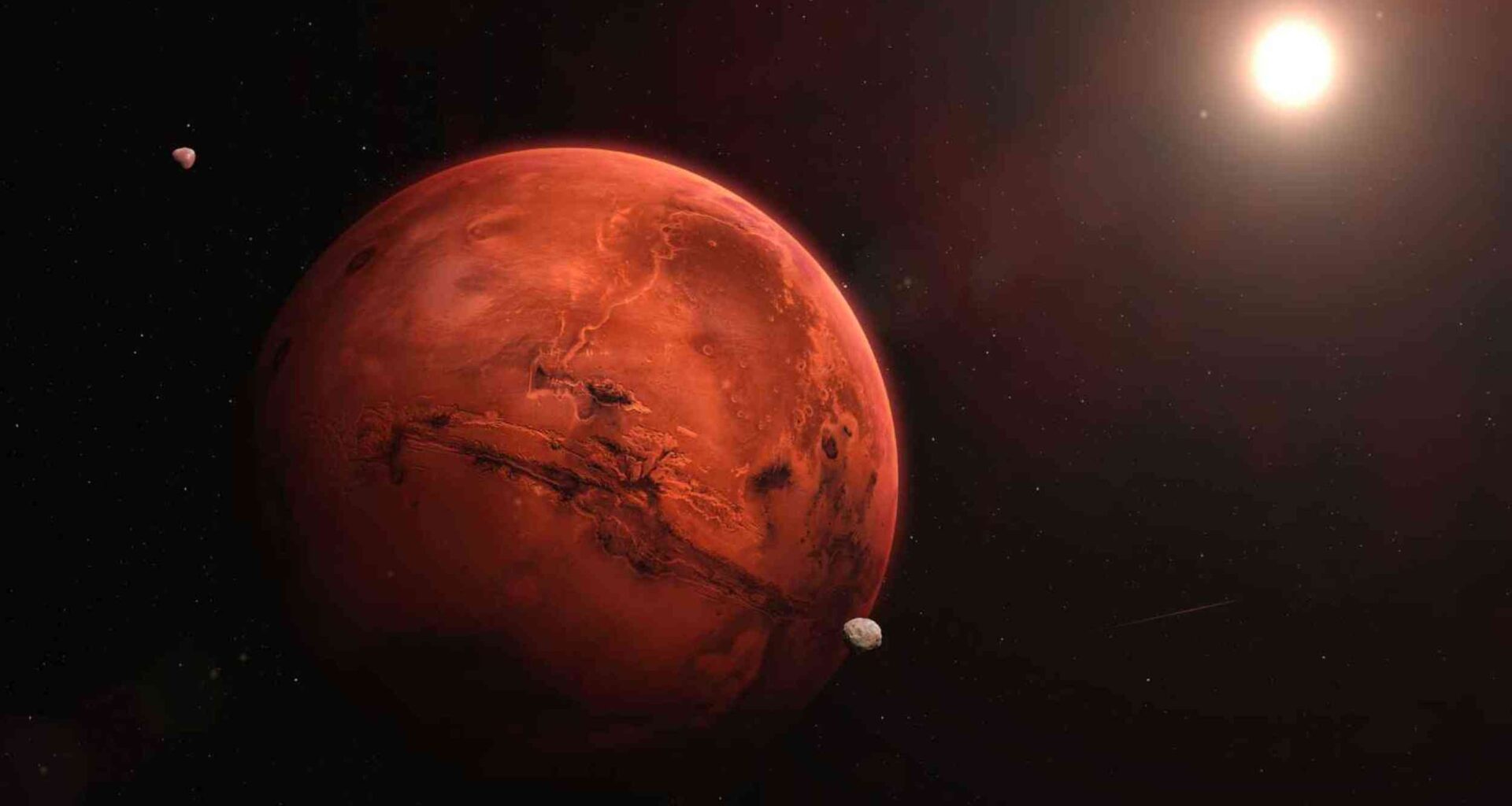
A new study has found that early orbital data from an asteroid reveals a fast, round-trip route to Mars that cuts total mission time to as little as 153 days.
That result turns a discarded early trajectory into a possible shortcut for reaching Mars and getting back far sooner than standard plans allow.
Asteroid 2001 CA21 and Mars travel

In the 2031 Mars window, the proposed route links Earth and Mars through a geometric corridor tied to the asteroid 2001 CA21.
Using that corridor, Marcelo de Oliveira Souza at the State University of Northern Rio de Janeiro (UENF) documented two complete round-trip mission designs that closed in 153 and 226 days.
Those results narrow to one unusually favorable launch window, with the faster option pushing the limits and the longer one framed as the more workable case.
The finding now rests on how that corridor works, why 2031 stands apart, and how much technology each route would demand.
How blazars are involved
Markarian 501, an elliptical galaxy with a spectrum extending to the highest energy gamma rays, belongs to a class of galaxies called blazars.
Powered by a supermassive black hole, blazars blast intense jets of plasma toward Earth at nearly the speed of light. Because the jet points directly at us, blazars appear as the brightest, most energetic objects in the universe.
Over 23 years, radio records gave the team repeated chances to test whether one jet could explain everything.
However, a single active core jet hypothesis struggled to match the two beam directions and the repeating 121-day brightness changes observed by astronomers.
Signals that repeat
Using the Very Long Baseline Array, a U.S. network of ten radio dishes, the team reworked 83 observations.
Those observations came from 2011 to 2023 at 43 gigahertz, a frequency that sees closer to the galactic core.
Earlier views at lower radio frequencies had shown one main jet, leaving the inner structure partly blurred.
“That was unexpected,” Britzen said, after sharper views revealed a second beam moving differently from the known one.
A possible orbit
If the galaxy has two supermassive black holes, and both black holes weigh 100 million to one billion Suns, each can feed matter and launch a beam.
As they orbit, their gravity can tilt the launch points and make brightness rise on schedule from Earth.
In Britzen’s model, a seven-year wobble and a 121-day orbit together matched several radio patterns over years.
That explanation remains powerful but provisional, because complex jets can imitate some signs of paired black holes.
Why caution remains
Independent astronomers treated the claim carefully, since earlier binary black hole candidates have lost support after closer checks.
Messy plasma, hot charged gas, near a black hole can bend, brighten, and fade in patterns that challenge clean explanations.
Still, any rival explanation now has to explain two beams, not just one changing outflow near the core.
That burden makes the candidate harder to dismiss, even before anyone calls the case settled for astronomy.
Light bent strangely
One 2022 image added intrigue by showing part of an Einstein ring, a curved band made when gravity bends light.
The feature sat near the newer beam, where strong gravity could distort radiation passing close to a black hole.
Such bending does not prove a two-black-hole system by itself, because one massive object can also warp light.
Paired with the repeating signal, the distorted arc gives astronomers another clue to test over time with sharper maps.
Gravity waves ahead
A merger would release gravitational waves – ripples in space from accelerating massive objects – at unusually low frequencies.
Existing ground detectors hear smaller black hole crashes, but this pair would move through much longer cycles.
Scientists can search those waves with pulsars, dead stars that flash with clocklike timing across the Milky Way.
“It would be a truly stunning gravitational wave signal,” Britzen said, because the pair would shake space-time together.
A rare timeline
Most galaxy mergers unfold across millions of years, which makes a 100-year collision estimate unusually startling for observers today.
Close pairs lose energy as waves carry it away, so their orbits can shrink faster near the end.
In this candidate, the black holes may sit only 27 to 128 Schwarzschild radii apart, a scale tied to black hole size.
That closeness would explain why future observations might see the 121-day orbit shorten within a decade of monitoring.
Mars travel, asteroids, and next steps
Confirmation will depend on whether the timing pattern keeps tightening instead of drifting randomly over years of careful watching.
Continued radio monitoring can track both beams and test whether their motion follows one shared orbit around the center.
Better gravitational wave searches could add independent evidence if pulsar timing arrays catch the same system from afar.
Until then, Markarian 501 stands as a candidate, not a confirmed collision on a set schedule for Earth.
Markarian 501 ties radio imaging, repeating light, and gravity-wave astronomy to one possible century-scale black hole merger in progress that observers can measure.
If the signal holds, astronomers could study the final approach without waiting millions of years for another chance.
The study is published in Monthly Notices of the Royal Astronomical Society.
—–
Like what you read? Subscribe to our newsletter for engaging articles, exclusive content, and the latest updates.
Check us out on EarthSnap, a free app brought to you by Eric Ralls and Earth.com.
—–