
Researchers have documented wildfire activity 237 million years ago by identifying charred wood preserved in the fossil record.
The finding places fire at the center of a thriving Triassic ecosystem, showing that ancient forests were already shaped by burning.
Triassic wildfire charcoal

Charred wood fragments preserved in lake sediments at Madygen, a fossil site in southwestern Kyrgyzstan, record these ancient fires.
By examining these remains, Dr. Philippe Moisan, a paleobotanist at the University of Atacama (UDA), demonstrated that the wood had been transformed into charcoal during past wildfires.
Microscopic structures within the fragments show that multiple types of cone-bearing trees burned, indicating that fire moved through a diverse forest rather than isolated patches of vegetation.
Because the material was transported and deposited after burning, the evidence confirms nearby wildfire activity while leaving open how often these events occurred.
Why charcoal counts
Charcoal matters in the fossil record because intense heat hardens plant tissue before it can fully rot away.
In a 2026 interview, Moisan said charcoal lets scientists confirm burning and identify the wood that caught fire.
“Paleofires are natural phenomena that occurred in the geological past,” said Dr. Moisan.
That explanation fits Madygen well, because the surrounding rocks do not point to lava or ash flows as the source of the charring.
Triassic wildfire archive in Madygen
Few places preserve Triassic life as completely as Madygen, where plants, insects, shell-bearing animals, and vertebrates settled into river and lake sediments.
A 2021 study described the beds as about 237 million years old and identified them as a Fossil Lagerstätte, meaning a site where fossils are preserved in unusual detail.
“More than 25,000 fossil insect specimens have been collected at Madygen,” said Moisan.
That richness matters here because burned wood could wash off nearby land and still be buried quickly enough to keep its fragile anatomy.
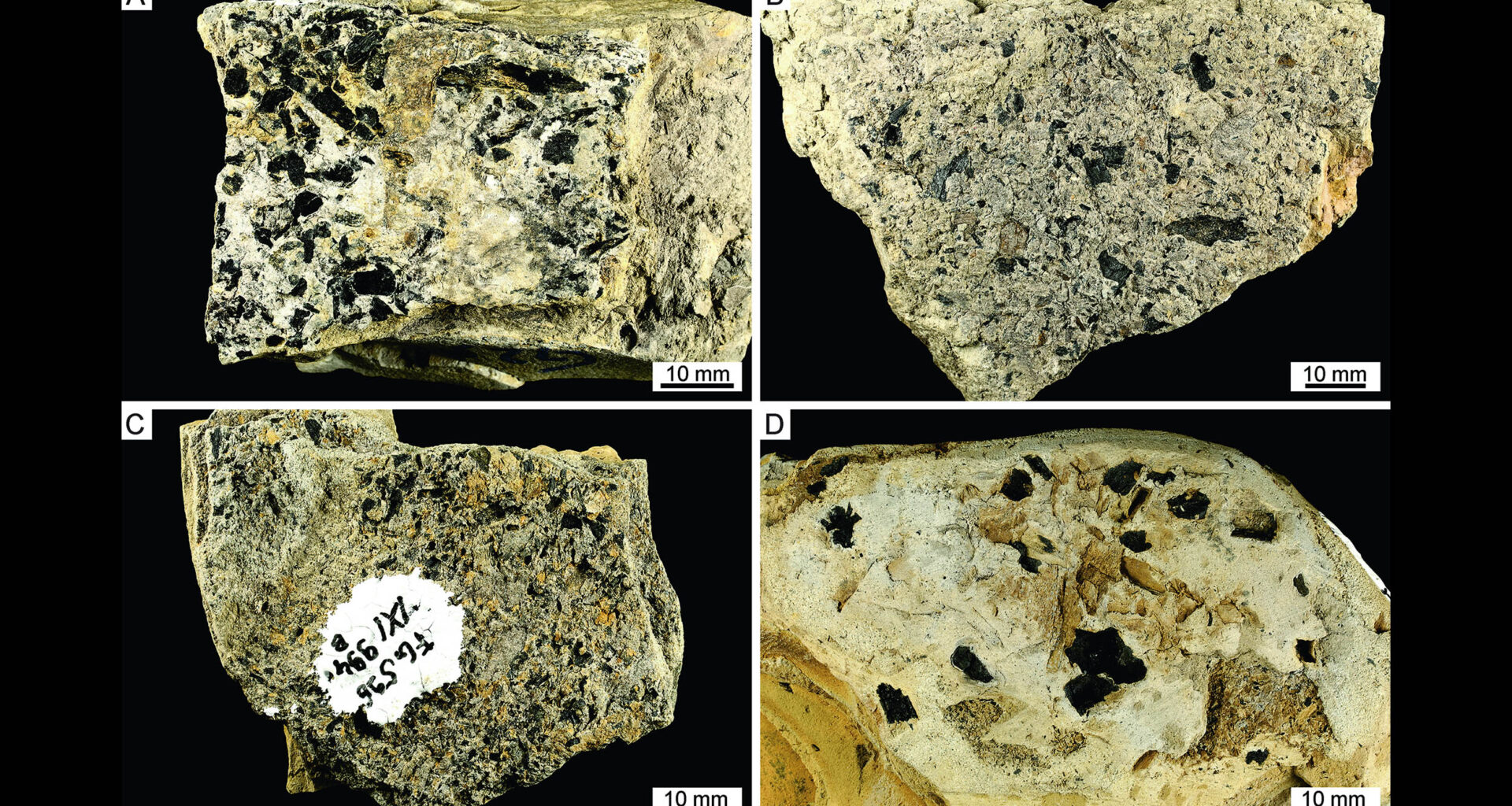
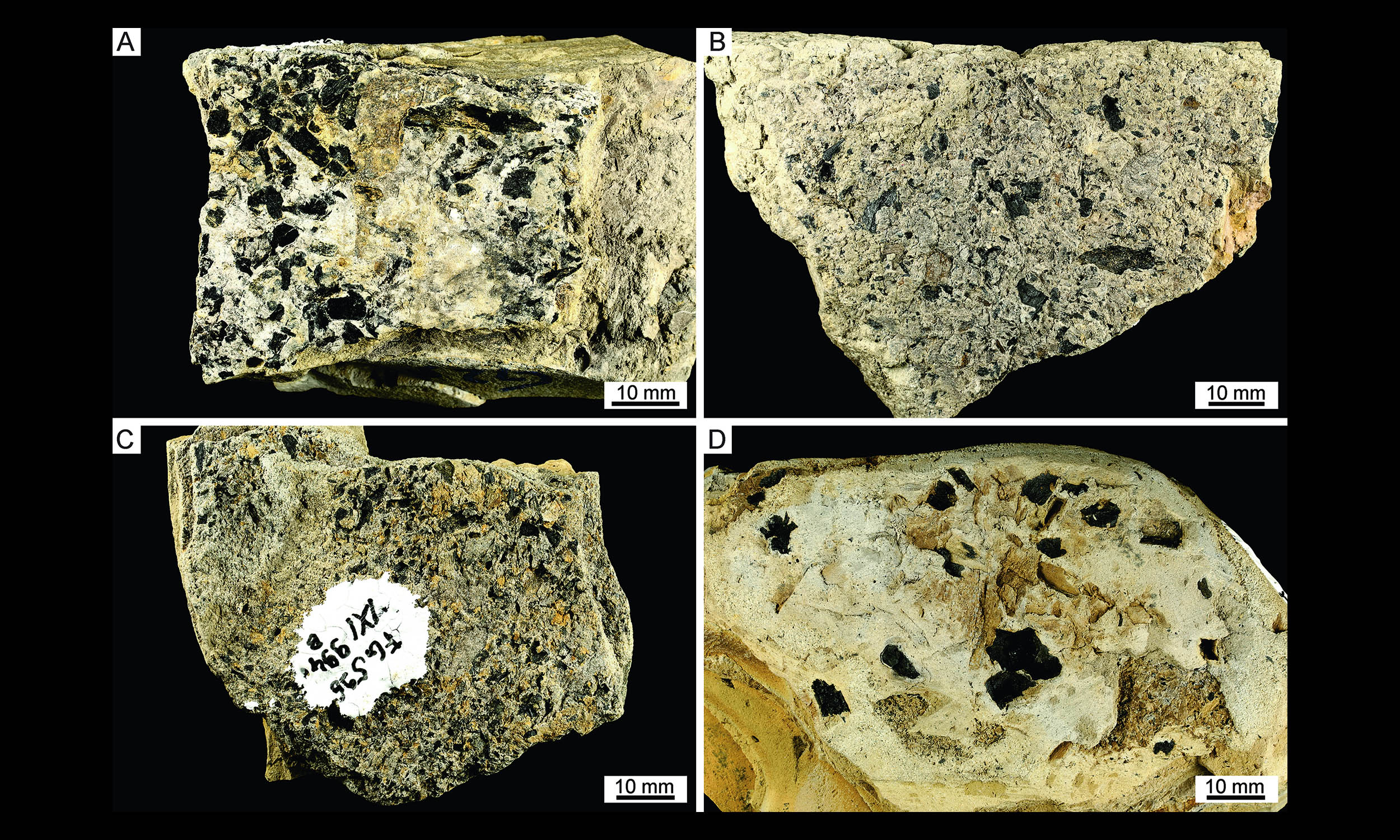 Examples of mudstone samples containing the studied charcoal wood remains. (A) Mudstone sample from Locality 1. (B–D) Mudstone samples from Locality 2. Credit: Review of Palaeobotany and Palynology. Click image to enlarge.Trees that burned
Every charred fragment the team studied came from gymnosperms, seed plants that include many cone-bearing trees.
Several wood patterns appeared in the charcoal, so the fires likely consumed more than one kind of tree.
Because charring shrinks and cracks tissue, the researchers could not name every lineage, but at least three wood types came from different genera.
That limit keeps the claim careful, yet it still shows fire had enough fuel variety to move through a real forest community.
Life after collapse
Madygen’s fires burned during a long recovery after the Permian-Triassic mass extinction, Earth’s worst known die-off.
Earlier in the Triassic, forests had thinned so badly that both coal deposits and charcoal became scarce in many places.
By the time the Madygen trees grew, vegetation had returned strongly enough to build fuel, carry flames, and leave blackened wood behind.
That sequence turns fire into a sign that land ecosystems were no longer merely surviving, they were functioning at a larger scale.
Mapping Triassic wildfires
The charcoal did not burn where the team found it preserved in the mudstone layers.
Streams or runoff likely swept burned wood from drier land into the lake, where fine mud sealed it away from decay.
Some fragments held tiny spaces between cells, a feature sometimes seen in wet-habitat wood, but that clue cannot map the forest precisely.
For now, the safest picture is a basin ringed by plains and uplands, with trees growing in more than one habitat.
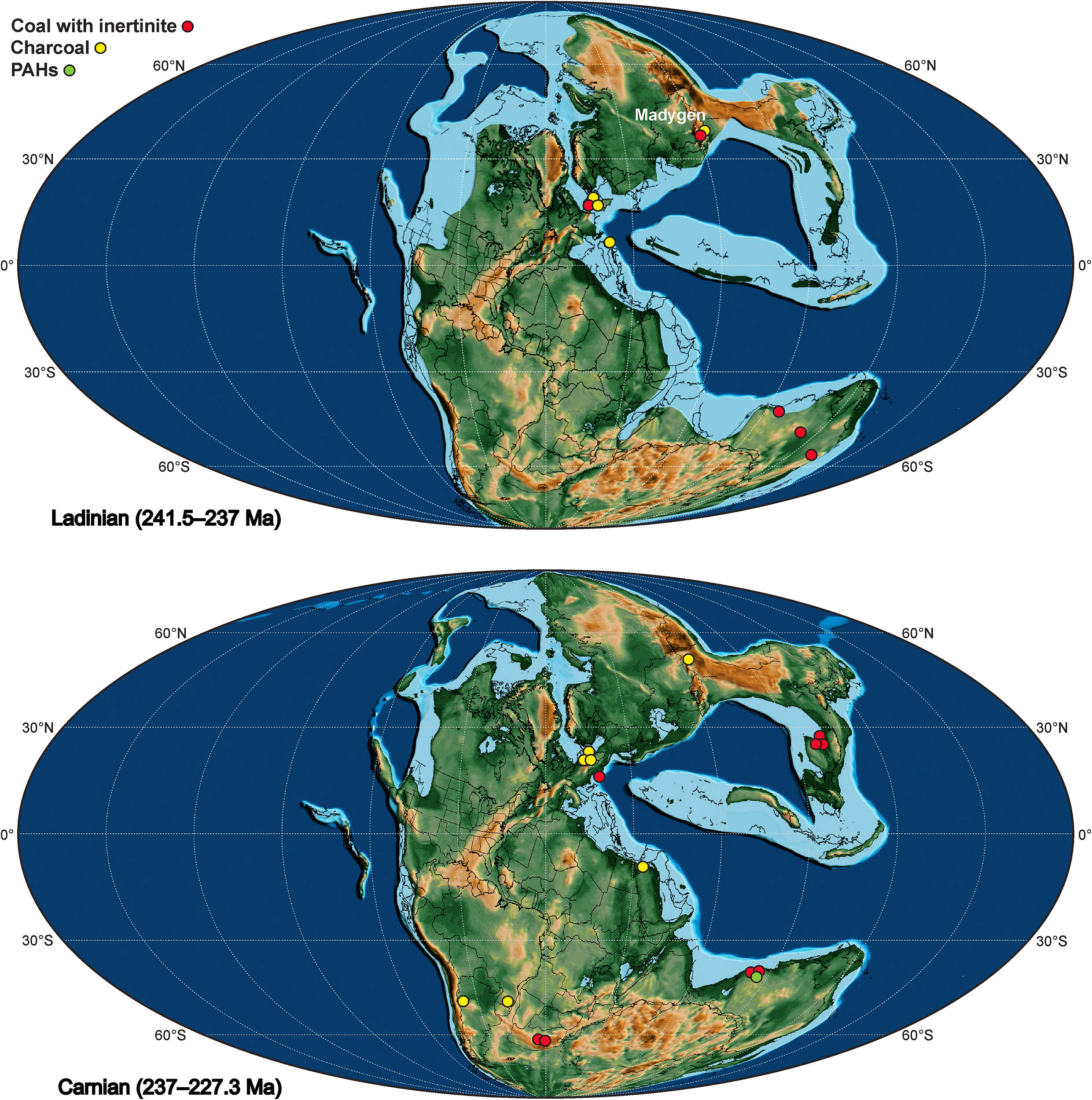 Palaeogeographical distribution of published palaeo-wildfire Triassic records for the Ladinian–Carnian interval. The upper map displays Anisian–Ladinian, Ladinian, and Ladinian–Carnian occurrences, while the lower map illustrates Carnian and Carnian–Norian ones. Credit: Mollweide projections from Scotese et al. (2024). Click image to enlarge.A patchy fire map
Madygen is not the first Triassic fire site, but it fills a blank spot on the world map of ancient burning.
A review of Triassic fire records suggested the charcoal record is thinner than the vegetation record would predict.
By adding Madygen’s charred wood and older fire traces from the same formation, the paper places wildfire deep inside Pangaea, the ancient supercontinent.
That broader spread matters because fires need both plant fuel and enough oxygen to keep burning.
What fire changes
Fire does more than kill trees in an ecosystem still recovering from the mass extinction.
It opens ground, recycles nutrients, and changes which plants can return first, because ash releases minerals back into the soil.
In a recovering Triassic world, that would have helped shape competition among the plant groups rebuilding land ecosystems after the end-Permian crisis.
Such evidence makes the charcoal more than a disaster trace and shows disturbance had become part of normal ecological life again.
Return to Madygen
The site is far from exhausted, despite decades of collecting, sorting, and scientific work there.
After a 17-year gap forced by armed conflict, Moisan said the team plans to return to Madygen in August 2026.
New field seasons could tie burned wood to specific plant beds, search for more charcoal layers, and test how often the basin burned.
That next step matters because each new fragment can sharpen the picture of how often Triassic forests burned and what kept feeding them.
Lessons from Triassic wildfires
Across lake mud, charcoal, and a patchy global record, the Madygen fossils show fire was woven into land life 237 million years ago.
Future work may reveal how often those blazes struck, but one point is clear: even a well-preserved ancient ecosystem lived with smoke.
The study is published in Review of Palaeobotany and Palynology.
—–
Like what you read? Subscribe to our newsletter for engaging articles, exclusive content, and the latest updates.
Check us out on EarthSnap, a free app brought to you by Eric Ralls and Earth.com.
—–