
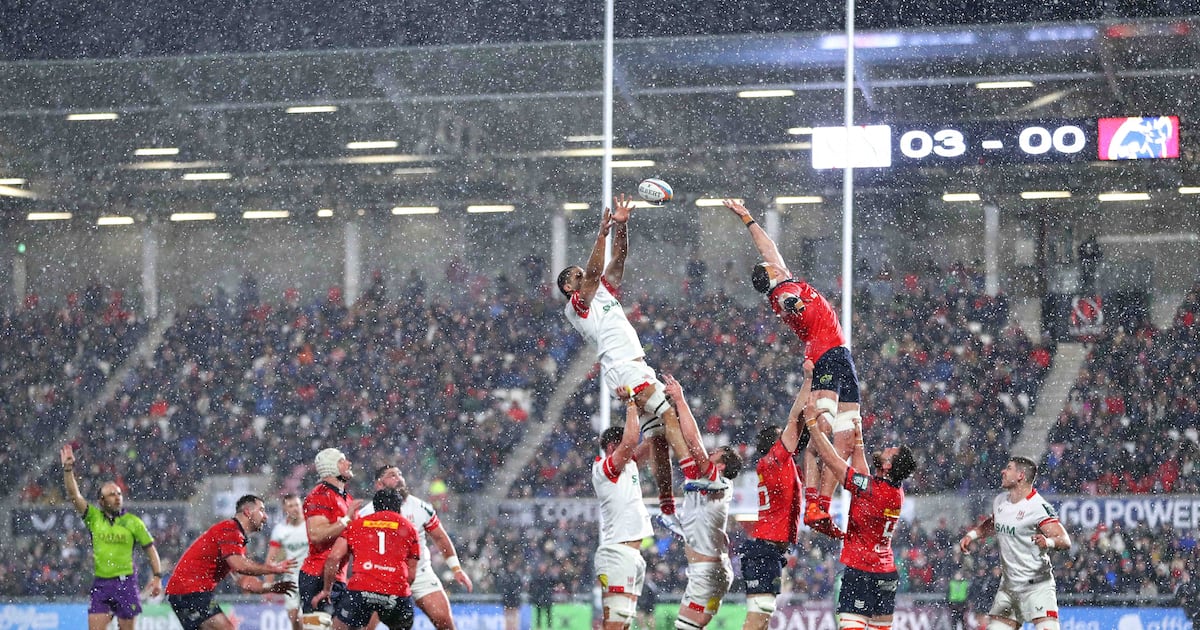
The only show in town this weekend is Munster hosting Ulster at Thomond Park. Fifth place visits sixth in the United Rugby Championship (URC).
Neither province is in the Champions Cup. Ulster could go one better than Munster by beating Exeter in the Challenge Cup semi-final, but the picture of the entire season can be altered by Saturday’s result.
As it stands, Munster are having a difficult year, to say the least, while Ulster have made genuine progress under the coaching of Richie Murphy and Mark Sexton.
As it stands, late Saturday evening is what really matters. There are just four points separating the Lions in fourth and Connacht in ninth. The URC run-in can turn a poor campaign into a good one – and vice versa.
This applies to both the provinces and to individual players.
[ Ulster set to bring depleted squad for visit to MunsterOpens in new window ]
Look at the past few months of Sam Prendergast’s career. Going from being the Ireland number 10 to not making the match day squad for Leinster’s recent European knockout games, Prendergast went up to Belfast last Friday with all sorts of thoughts invading his psyche.
Not only has Jack Crowley taken his international place, but Harry Byrne and Ciarán Frawley appeared to have pushed him down the provincial pecking order.
Most positions have specific jobs. The scrumhalf controls the tempo of a game, the tighthead holds up the scrum and so on. But the outhalf is responsible for a multitude of decisions that prove the difference between winning and losing. They have to kick their goals, nail restarts and be a leader of bigger, more powerful men.
At the age of 23, Ronan O’Gara and Johnny Sexton were allowed to fail and fail again until they became generational strategists who guided their teams to the promised land.
That’s what Prendergast must be allowed to evolve into. Step one for him was to take his chance against Ulster. The silence was deafening around some of his performances this season, so hopefully he will have heard the key phrases delivered by his coach Leo Cullen: “Sam was excellent, Sam put Ulster on the back foot, Sam kept his head down and kept working away, Sam just had to be patient.”
It’s all well and good to knock players down, but Irish rugby is built on the ability to build them up for the long haul.
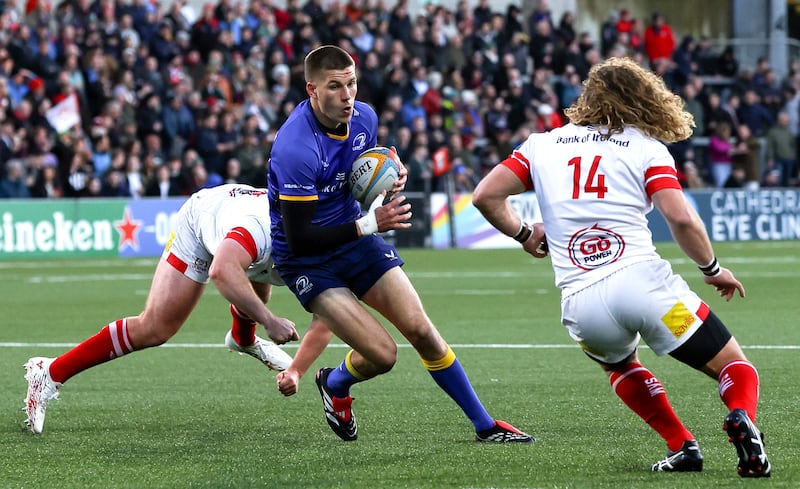 Leinster’s Sam Prendergast comes up against Werner Kok of Ulster. Photograph: Grace Halton/INPHO
Ulster, under Murphy, and Connacht, under Stuart Lancaster, have produced seasons that indicate sustainable progress. But it is what happens in April and May that will be remembered.
Munster are, clearly, a club in transition. Clayton McMillan was chosen over Mike Prendergast to lead my old team back to better days.
One way to quell talk of a transitional period is to beat a weakened Ulster and get into a home seeding in the URC playoffs. It’s a real opportunity as Ulster travel without injured internationals Nick Timoney, Rob Baloucoune, Tom O’Toole and, one of my favourite young players, the backrower Bryn Ward.
My generation of Munster players strived to unburden ourselves of what it meant to Stand Up and Fight as the song goes.
Simply put, we wanted our resilience under pressure to be a given. We wanted to evolve. Much like Ireland’s reputation 10 years ago, we sought to become a team that didn’t just hit its straps when our backs were to the wall.
As a group, both in red and in green, we aimed to end the idea of an Irish team beating the All Blacks or Toulouse being considered a major surprise.
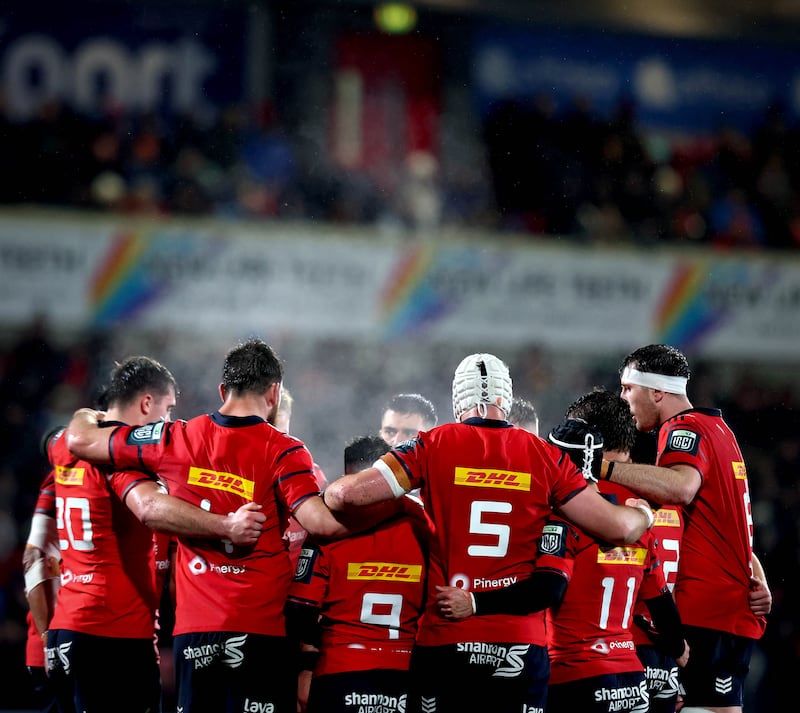 Munster players huddle at their URC game against Ulster last January. Photograph: Ryan Byrne/INPHO
Munster had a seat at the top table after winning European titles in 2006 and 2008. And Ireland after the 2009 Grand Slam. Our generation went about becoming a permanent member of rugby’s elite tier. Not just an interloper.
Ireland got there via Six Nations titles – I know, a World Cup quarter-final still needs to be won – while eventually Munster, led by Peter O’Mahony, captured a URC title in Cape Town three years ago.
(Speaking of O’Mahony, I’m looking forward to hearing his stories from following Shane Lowry around Augusta – more when we have it.)
The URC trophy wasn’t as valuable as a third star on the jersey, but silverware had been our ultimate goal since Paul O’Connell and Rog lifted the Heineken Cup in 2008.
The next step is always the hardest. Returning to the mountain top year-on-year is almost impossible.
Look at New Zealand at World Cups between 1987 and 2011. Look at Leinster getting back to four European finals since their fourth title in 2018. The consistency is phenomenal, but losses to La Rochelle and Toulouse will have hurt the players and staff more than being perennial semi-finalists, like Munster managed until recently.
Thomond Park on Saturday is a throwback fixture. Munster have their backs firmly pinned to the wall. The off-field financial issues and recent resignations of ex-players, Killian Keane, Billy Holland and Mick O’Driscoll, from the professional games board cannot distract from the job at hand: salvaging the season.
Munster captain Tadhg Beirne nailed the messaging this week: “I can’t get drawn into this stuff, all our focus is on Ulster.”
Hopefully, better days are ahead under McMillian.
Step one: beat Ulster.
Stand up and fight.
The majority of players, at Munster and Ulster, have two powerful motivations: securing Champions Cup rugby next season with a top-eight finish and getting to tour the southern hemisphere with Ireland in the summer.
If you’re hoping to run out at Eden Park to face the haka on July 18th, it’s now you want to stake your claim.