
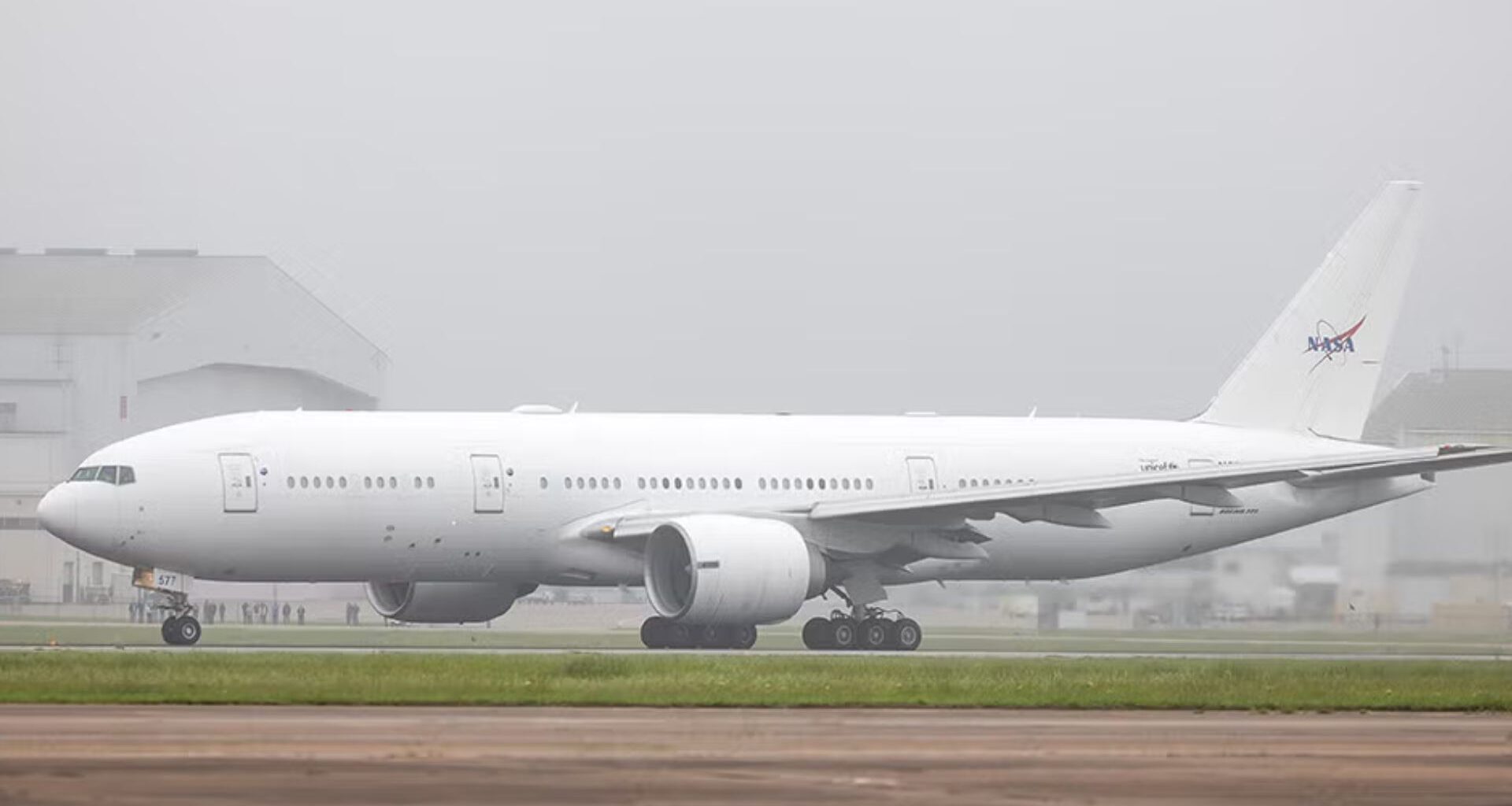
Most Boeing 777s spend their lives shuttling passengers between global hubs.
But one specific triple-seven just touched down at NASA’s Langley Research Center in Virginia with a much loftier career path ahead.
After a year-long scientific makeover in Texas, the massive jet is back in NASA’s hands and ready for work.
Serving as the successor to the retired DC-8, this aircraft is set to become the largest and most capable research vessel in NASA’s Earth Science fleet.
“Airborne missions at NASA use cutting-edge instruments to explore and understand our home planet,” said Derek Rutovic, program manager for the Airborne Science Program at NASA Headquarters in Washington.
“The 777 will be the largest airborne research laboratory in our fleet, collecting data to improve life on our home planet and extend our knowledge of the Earth system as a whole,” Rutovic added.
Structural changes for becoming NASA’s research lab
In 2022, NASA acquired 777 to succeed its retired DC-8 aircraft. The giant passenger plane has undergone “heavy structural modifications” to become the agency’s next-generation airborne science laboratory.
Since January 2025, engineers at L3Harris Technologies have been drilling, wiring, and reinforcing.
Engineers performed deep structural surgery on the aircraft, cutting into its frame to install specialized hardware.
This included enlarging cabin windows into observation viewports and carving open portals into the belly of the fuselage, allowing high-tech sensors and remote-sensing instruments a clear line of sight to the world below.
These modifications included installing dedicated research stations and complex wiring to connect payload systems equipped with advanced sensors, such as lidar and infrared spectrometers.
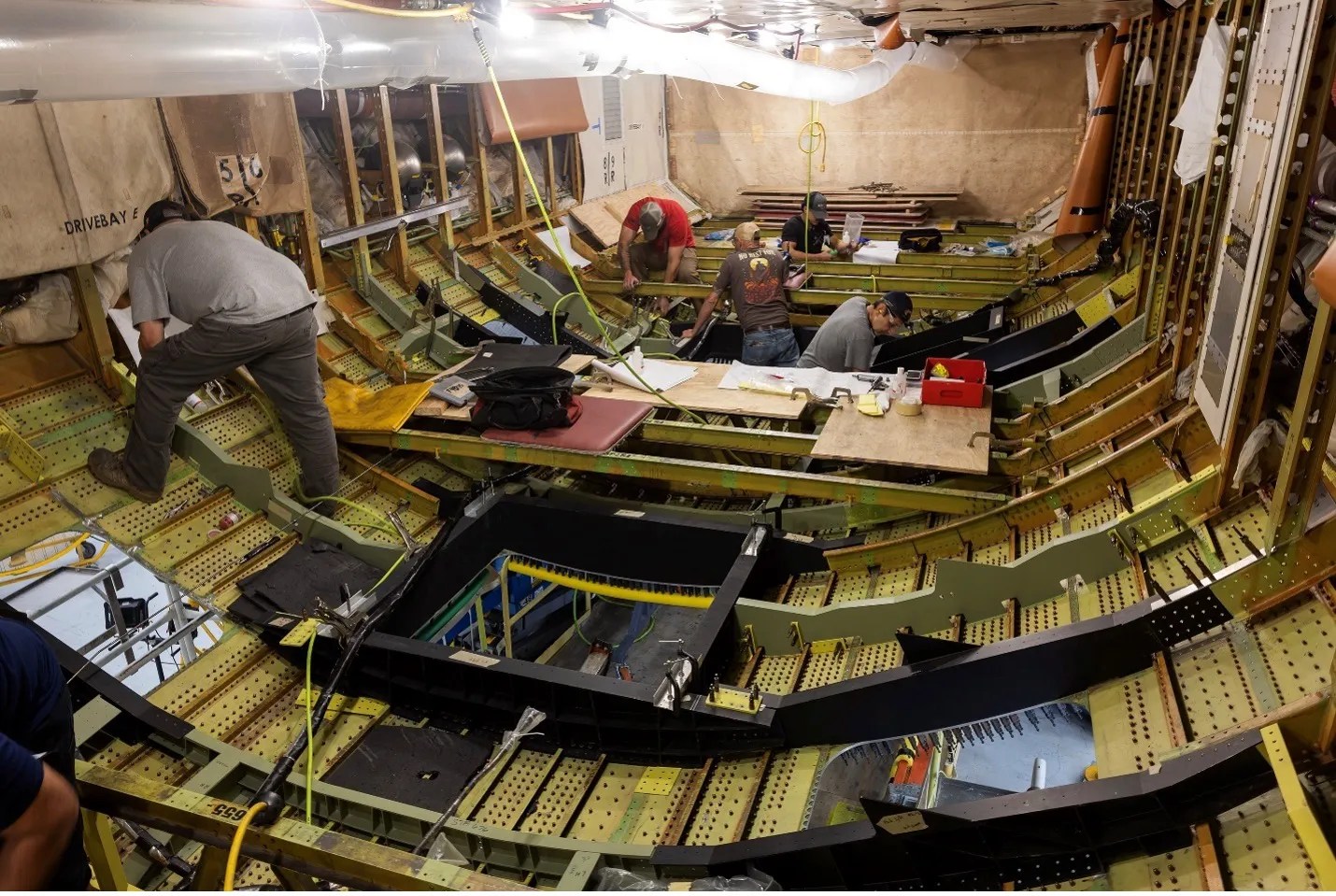 L3Harris installs viewports in the 777 aircraft cargo bay that will house advanced scientific instruments. Credit: L3Harris
The DC-8 was a legend, a 40-year workhorse that studied everything from polar ice to volcanic ash. Replacing it was no small feat. What sets the 777 apart is its incredible stamina, allowing it to stay airborne far longer than previous aircraft.
It can stay airborne for 18 hours straight and carry 75,000 pounds of equipment at a maximum altitude of 43,000 feet.
Moreover, the aircraft has been designed to accommodate up to 100 researchers, creating a massive think tank in the sky.
With a 9,000-nautical-mile range, it can probe the most remote corners of the Arctic and Atlantic in a single go
“I’m excited for what the 777 will bring. It gives us the ability to bring together more partners, more educational opportunities, and more instruments. That will make a real difference in the data we collect moving forward,” said Kirsten Boogaard, the NASA 777 program manager at NASA Langley and former deputy program manager of NASA’s DC-8.
Inaugural mission
Reportedly, the retired commercial jet was formerly operated by Japan Airlines.
NASA already has its first big assignment ready: a mission called NURTURE, which stands for North American Upstream Feature-Resolving and Tropopause Uncertainty Reconnaissance Experiment.
Slated for January 2027, the 777 will fly directly into the teeth of high-impact winter weather. The mission will gather comprehensive atmospheric data, reaching from North America and Europe to the Arctic, Greenland, and the North Atlantic.
It will hunt down “Tropopause Polar Vortices” — the invisible atmospheric drivers behind the severe cold snaps and ice storms that paralyze cities.
NASA hopes to advance how we predict extreme weather, potentially saving lives and billions in infrastructure costs by extensive measuring of these events.
“We’ve been completing the engineering design and analysis to install the NURTURE payload into the aircraft in parallel with the portal modification,” Rutovic said.
The jet is home. Now, the real work begins: scaling up NASA’s ability to conduct science from the sky.