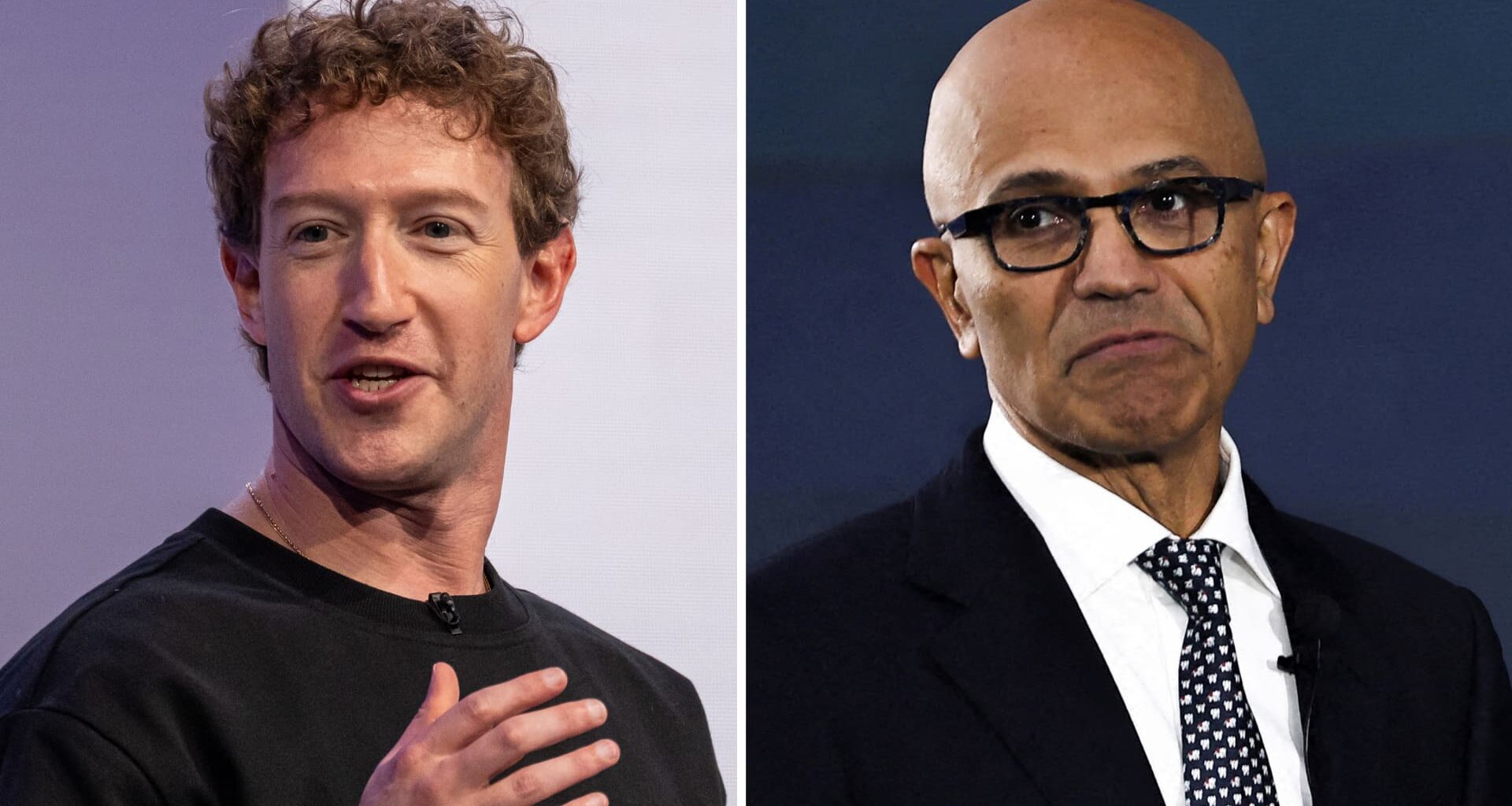
Meta CEO Mark Zuckerberg, left, and Microsoft CEO Satya Nadella.
Getty Images | Reuters
The more than 20,000 potential job cuts Meta and Microsoft revealed on Thursday, months after Amazon announced its most widespread layoffs ever, may only be the beginning.
The same companies that are collectively spending hundreds of billions of dollars a year to build out artificial intelligence infrastructure to meet soaring demand for AI services are seeking efficiencies from AI by slashing head count. They’re also still trying to rightsize from the pandemic-fueled overhiring.
Many economists and industry experts are fearful that a labor crisis may be upon us today — not coming sometime in the future — given how quickly AI is sweeping across corporate America. As of this week, over 92,000 tech workers have been laid off so far in 2026, according to Layoffs.fyi, bringing the total to almost 900,000 since 2020
“This represents a fundamental structural shift rather than a temporary market correction,” said Anthony Tuggle, an executive coach and leadership expert who previously worked in AI. “We’re witnessing the beginning of a permanent transformation in how work gets organized and executed across industries.”
Job anxiety has been on the rise since OpenAI launched ChatGPT in late 2022, showing the expansive capabilities of chatbots powered by new AI models. Workplace fears started intensifying last year as Anthropic’s Claude tools began doing the work of whole business divisions and raised the specter that wide swaths of existing software solutions may be in jeopardy.
Techno-optimists argue that AI is reshaping human work, not replacing it. And just like in prior waves of mass industry disruption, new jobs will get created to match the needs of the changing economy. Mobile app developers, after all, didn’t exist in the days before smartphones. And what use were IT administrators before we created servers?

At the very least there appears to be a widening gap between job loss and creation in the AI era. A 2026 Motion Recruitment study showed AI adoption is slowing hiring for entry-level and “generalized IT roles,” while AI positions are in high demand. Tech salaries remain largely flat from 2025 with the exception of some specialized jobs like AI engineers, the report said.
Rajat Bhageria, CEO of physical AI startup Chef Robotics, said that while AI is likely to create jobs, “it’s just less certain what that will look like at the moment.”
“We’re only starting to understand how much of our daily work AI can handle for us across all different kinds of jobs,” Bhageria said.
Meta only hinted at AI in its announcement on Thursday. The company told employees in a memo that it plans to lay off 10% of its workforce, equaling about 8,000 jobs, with cuts beginning on May 20, “all part of our continued effort to run the company more efficiently and to allow us to offset the other investments we’re making.” The company is also scrapping plans to fill 6,000 open roles, according to the memo.
Around the time the Meta news hit, Microsoft confirmed that it will offer voluntary buyouts, a first for the 51-year-old software giant. About 7% of U.S. employees are eligible, according to a person familiar with the plans who asked not to be named because the number isn’t being made public. With about 125,000 U.S. employees, that could add up to 8,750 cuts.
Tech jobs aren’t only at risk in the tech industry.
Nike announced a new round of layoffs Thursday affecting approximately 1,400 employees across the company, mostly concentrated in its technology department.
“These reductions are very hard for the teammates directly affected and for the teams around them, too,” Chief Operating Officer Venkatesh Alagirisamy told employees.
Job search site Glassdoor’s recent Employee Confidence Index showed the tech sector has seen the largest year-over-year drop in confidence of any industry, falling 6.8 percentage points in March from a year earlier to 47.2%.
Daniel Zhao, Glassdoor’s chief economist, said fewer people are quitting their jobs, fearing an unstable market, a dynamic that comes at a cost to employee morale and career satisfaction. It also means even more job cuts.
“Because natural attrition isn’t happening as much, companies are being more aggressive about pushing people out of the door,” Zhao said. “Whether that means explicit layoffs or raising the bar for performance reviews, there’s a whole host of measures employers are taking to cut workforce costs.”
Evan Spiegel, CEO of Snap Inc., attends the annual Allen and Co. Sun Valley Media and Technology Conference in Sun Valley, Idaho, July 9, 2025.
David A. Grogan | CNBC
Snap said last month it would slash 16% of its workforce, or roughly 1,000 staffers, and that at least 300 open positions would be closed. CEO Evan Spiegel cited AI-driven efficiencies in a letter to staff. Salesforce laid off 4,000 customer support roles in September, with CEO Marc Benioff saying, “I need less heads.”
Oracle said in March that it was laying off thousands of employees as it ramps up AI spending. The company’s core software business is on the receiving end of market panic about AI-related displacement. Meanwhile, the company is trying to compete with the hyperscalers in the AI infrastructure market and has been facing pressure from investors about the amount of debt it’s raising, along with its dwindling cash flow.
Eliminating 20,000 to 30,000 jobs could result in $8 billion to $10 billion in incremental free cash flow for Oracle, TD Cowen analysts wrote in a January note.
Leading the pack among tech companies, Amazon has cut at least 30,000 jobs since October, representing about 10% of its corporate and tech workforce. Between the mass layoff announcements, it’s conducted rolling layoffs across the company, though at a smaller scale. Google has also carried out small but regular cuts since 2023.
But the spending continues.
Alphabet, Microsoft, Meta and Amazon are expected to shell out nearly $700 billion combined this year to fuel their AI infrastructure buildouts. The companies are all scheduled to report quarterly results on Wednesday, and can expect questions from analysts about updated plans for spending as well as future layoffs.
In the startup world, the AI boom is creating a very clear pattern: companies are growing far faster with far fewer people. Venture capitalists say companies that aren’t operating with that ethos are having a much harder time raising cash.
Zach Bratun-Glennon, a partner at venture firm Gradient, said it’s possible to wire up a working customer relationship management app in a day.
“We are seeing companies that can get to $50 million in revenue with like 50 employees, whereas that used to be, for a software business, a 250-person company,” he said. “Do I think there are going to be 50- or 100-person unicorns and decacorns? Absolutely. Can you build a public company with 200 employees? Absolutely.”
Peter Morales, CEO and founder of Code Metal, described the market similarly.
“Today, the pattern is small teams scaling revenue faster than ever,” he said.
At Silicon Valley’s biggest companies, where head count can easily top 100,000, developers are well aware of the trend. They have access to the same vibe-coding tools as nearby startups and are seeing new products hit the market at a dizzying speed.
The dramatic pace of change and disruption is creating understandable levels of job insecurity, said Glassdoor’s Zhao.
“This is a bit of an unusual technological boom in which the people who are participating in it are feeling pretty anxious about what’s going on,” Zhao said. “Many workers do feel stuck right now.”
— CNBC’s Annie Palmer, Jordan Novet, Lora Kolodny and Jonathan Vanian contributed to this report.