
Scientists have long believed that sharks and giant marine reptiles dominated the seas during the Cretaceous era – such as 11-metre-long mosasaurs and 12-metre-long plesiosaurs.
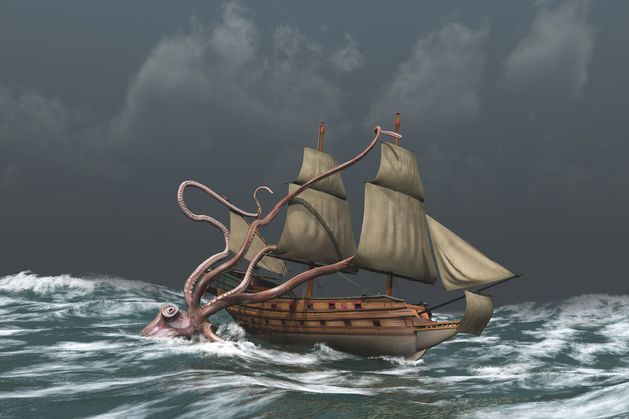
But new fossils suggest that early octopuses resembling the mythological ‘kraken’ from Norse folklore could have been just as big, with one creature potentially measuring 19 metres in length – the same size as a lorry, or two double-decker buses.
Palaeontologists from Hokkaido University used a new technique called “digital fossil mining” to revisit the 15 large fossil jaws previously identified as belonging to early octopus relatives.
The technique involves grinding away a thin layer from the fossil-bearing matrix, taking a high-resolution photo, then repeating the process thousands of times to create a 3D, full-colour model.
Using the technique on late Cretaceous sediments collected from Hokkaido Island, northern Japan, one jaw was found to surpass that of a living giant squid, whose body can stretch up to 12 metres.
Due to their soft bodies, squids and octopuses don’t preserve as well, making the fossil record less complete than that of other creatures
The study, published in Science, found that all the fossils belonged to two species of extinct octopus: Nanaimoteuthis jeletzkyi and N. haggarti. The latter may have stretched between seven and 19 metres long, one of the largest invertebrates ever described.
Due to their soft bodies, squids and octopuses don’t preserve as well, making the fossil record less complete than that of other creatures; chitinous beaks are often the only traces of their existence.
Modern-day octopuses are revered for their intelligence, impressive problem-solving and learning capabilities. The fossil evidence suggests early cephalopods may have been the same.
Yasuhiro Iba, from Hokkaido University, suggested early octopuses were “huge, intelligent” carnivores that used long tentacles to seize bony fish and molluscs before crushing them.
Palaeontologists observed from the extensive wear on the jaws that they crunched on hard shells and bones.
Where some beaks were more degraded on one side, fellow palaeontologist Shin Ikegami said there may be an indication of the cephalopod equivalent of handedness, in the same way humans are left or right-handed.
“This laterality is related to the complexity of the brain,” Mr Ikegami added.