
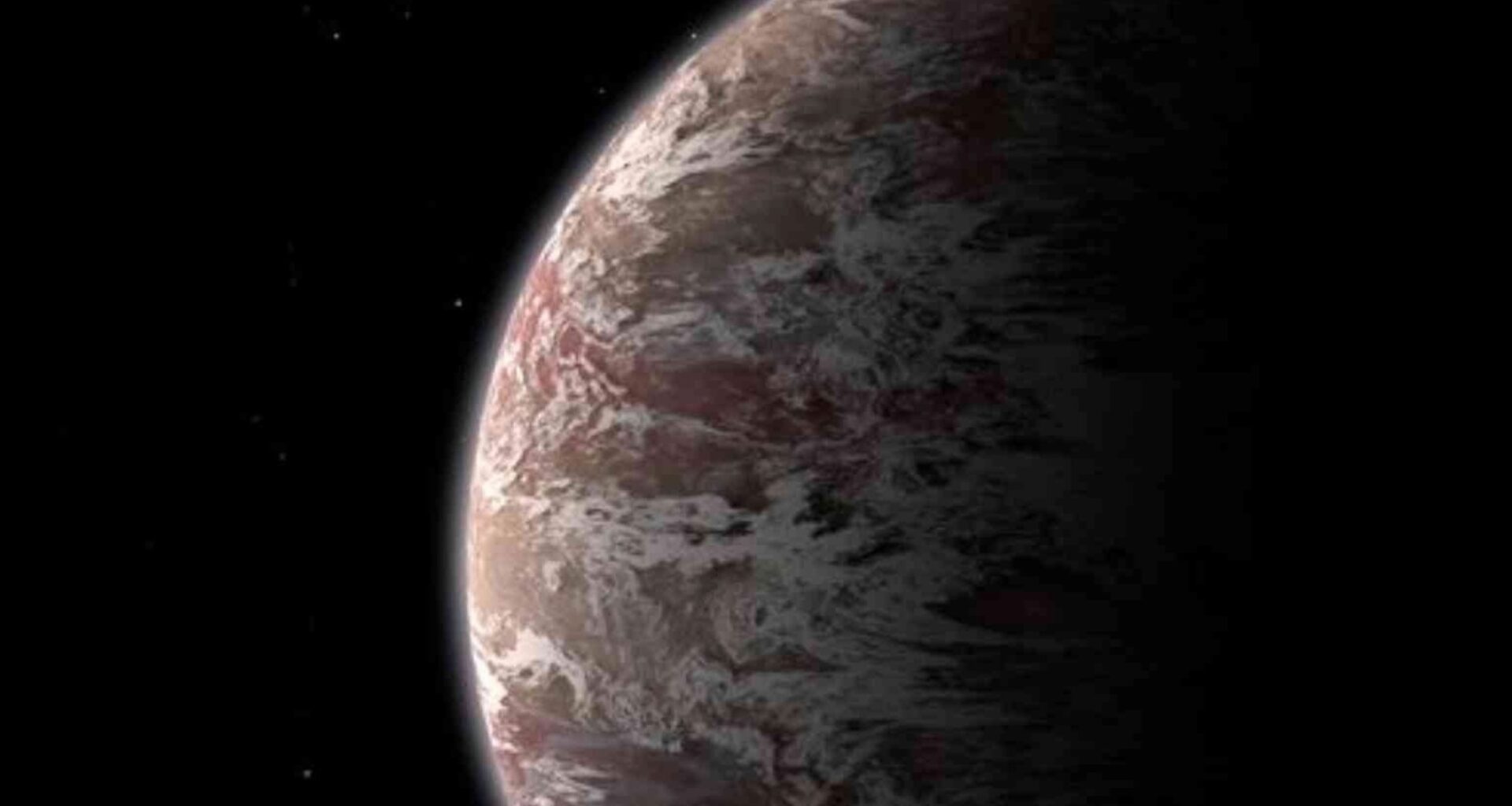
High-altitude water-ice clouds have been revealed in the atmosphere of a giant planet that lives 12 light-years away from Earth.
There have been long-standing mysteries of mismatch regarding its atmospheric signals. This discovery charts a new path toward identifying similar features on smaller, potentially habitable worlds.
Nearby world with unusual signals

Infrared images of Epsilon Indi Ab, a giant exoplanet orbiting a nearby Sun-like star, revealed a world whose upper atmosphere that possesses obscure expected chemical signatures.
Elisabeth Matthews and her team at the Max Planck Institute for Astronomy (MPIA) analyzed these images, looking for patterns.
The photos showed that the planet’s ammonia signal appeared weaker than what was predicted for a clear atmosphere.
That discrepancy revealed upper layers that were blocking heat. Additional water-ice clouds emerged as the only explanation that could fit the full pattern.
The result narrows the range of possible atmospheric structures and demands confirmation of whether the clouds alone caused the signal.
Seeing heat instead of light
Only direct imaging could clearly capture this world, because cold giants rarely cross their stars from our point of view.
The James Webb Space Telescope (JWST) uses its Mid-Infrared Instrument to see heat from five to 28 microns, ideal for cool planets.
Using a coronagraph, a starlight-blocking mask, the team compared pictures at 10.6 and 11.3 microns, a unit of length equal to one millionth of a meter.
Those windows were similar enough to expose ammonia without a full spectrum, yet far enough apart to show the mismatch.
A colder, distant giant
Earlier observations showed a world roughly Jupiter’s size, near 35 degrees Fahrenheit (1.6°C) and colder than most directly imaged exoplanets.
At 7.6 Jupiter masses, it circles Epsilon Indi A, the star it orbits, at roughly four times Jupiter’s distance from the Sun.
Leftover heat from formation keeps the planet warmer than Jupiter, even though it sits much farther from its star.
Those traits render it a rare stand-in for our solar system’s giants, as compared to the scorched gas worlds Webb often probes.
Clouds can solve the mismatch
Clear-air explanations struggled because no simple chemistry change could match all of the measurements at once.
Low metallicity, meaning fewer heavy elements in the atmosphere, could weaken ammonia, but it should also brighten shorter infrared wavelengths.
Patchy water-ice clouds solved both problems by concealing gas and dimming the planet between three and five microns.
That double effect offered clouds as the strongest explanation, even though the team still has to rule out rarer chemical alternatives.
Limitations of current simulation
Many published atmosphere models leave clouds out because adding them multiplies the number of layers, particles, and possible outcomes to the analysis.
Once cloud decks enter the calculation, light escapes from different heights, and the chemistry no longer looks as precise from above.
“It’s a great problem to have, and it speaks to the immense progress we’re making thanks to JWST,” said James Mang of the University of Texas at Austin.
That warning means future planet searches will need weather factored into their models, not just cleaner chemistry.
Astronomers isolate faint worlds
Transit studies usually favor giant planets that hug their stars, since those worlds cross the star’s face more often from Earth.
Cold giants like Epsilon Indi Ab rarely line up that way, so direct imaging is one of the few accessible routes to them.
“JWST is finally allowing us to study solar-system analogue planets in detail,” said Matthews.
This result is a rehearsal for difficult, future work, where a faint, temperate planet must be separated from a much brighter star.
A future telescope steps in
Another check may come from the Nancy Grace Roman Space Telescope, NASA’s next big space observatory for exoplanet studies.
Roman carries a coronagraph of its own, so it should test how well astronomers can spot worlds in reflected light.
Ice clouds matter because bright, high particles bounce back visible light and can change how a planet’s atmosphere looks from far away.
A good match between Roman data and Webb’s heat measurements would tighten the cloud case and sharpen future methods for studying smaller planets.
Alternative explanations still stand
Clouds are the preferred answer to these questions, but the case still lacks a final verdict.
A nitrogen-poor or metal-poor atmosphere could also flatten the ammonia feature, although each explanation creates trouble elsewhere in the spectrum.
Future measurements across many wavelengths should show whether clouds really caused the weak ammonia signal or stranger chemistry did.
For now, the evidence shows that weather, chemistry, and formation history are intertwined with one another on the cold giants in space.
Testing the pattern elsewhere
Observing other cold giants matters because one planet cannot tell astronomers whether weak ammonia is rare or normal.
Follow-up Webb programs should show whether Epsilon Indi Ab keeps matching cloudy models across a broader slice of light.
Similar measurements of other chilly giants could reveal when this cloud cover first appears and whether the missing-ammonia pattern repeats.
That broader sample would turn one atmosphere into a rule, a loophole, or a warning about cold planets.
Improving the search for other worlds
Piece by piece, the study shows that finding another Earth will depend on reading faint atmospheres well enough to spot hidden clouds.
The immediate payoff is found in better planet-weather models and precise observation plans, charting us to worlds like ours.
This study was published by the Max Planck Institute for Astronomy.
—–
Like what you read? Subscribe to our newsletter for engaging articles, exclusive content, and the latest updates.
Check us out on EarthSnap, a free app brought to you by Eric Ralls and Earth.com.
—–