
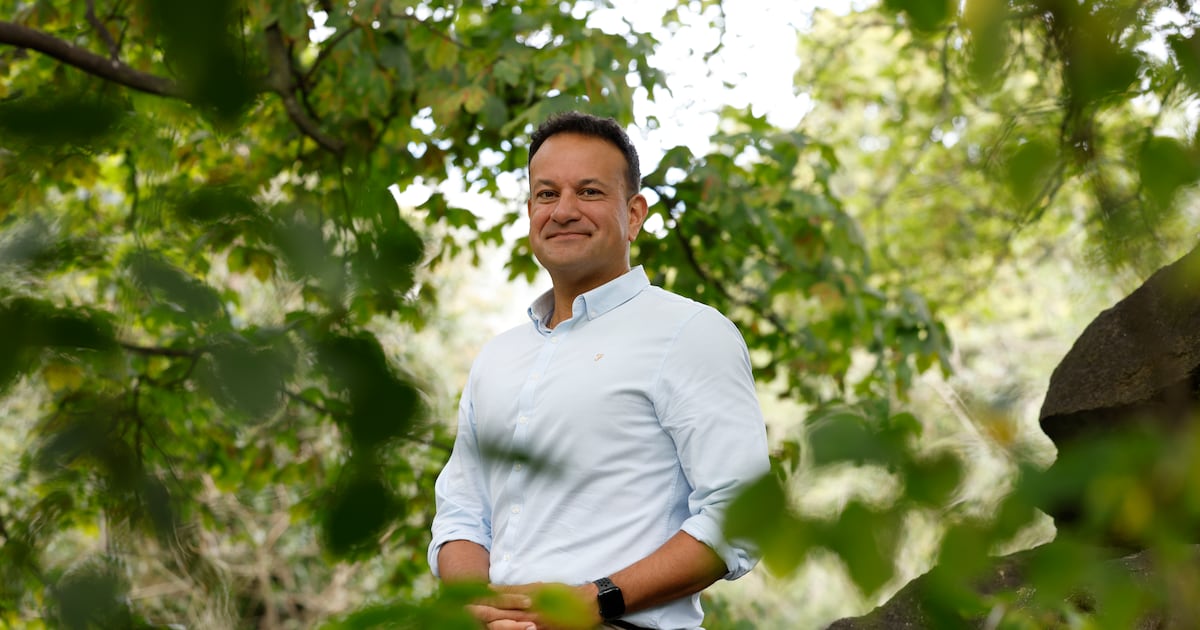
Leo Varadkar is sorry for saying that urban Ireland pays the bills while farmers receive subsidies. He “did not mean to annoy anyone”, he said on Wednesday.
But, as anyone who has ever encountered a privately educated centre-right Dubliner may not be surprised to hear, it wasn’t the first time he had a remark to pass about the country cousins. And Leitrim, it seems, never forgets.
Cllr Paddy O’Rourke, the leas-cathaoirleach of Ballinamore Municipal District, pointed out on Ocean FM during the week that Varadkar had once claimed “there’s no such thing as Leitrim”. This is clearly an existential issue for a Leitrimite.
Astonishingly, he’s right. In 2005, the youngest member of Fingal County Council, a 25-year-old Leo Varadkar, was faced, along with his colleagues, with a proposal for tsunami aid generated by their counterparts in Connacht. To hear the name of Leitrim at all was, it seems, a source of humour to the Celtic Tiger-era golden gods of north Dublin.
“Leitrim is a figment of the imagination and is nothing more than a social welfare scam,” was the Wildean quip made by the political prodigy. “His gag,” it was reported, “reduced the chamber to howls of laughter.”
Cue ructions, with Varadkar accepting that the statement was “a very poor attempt at humour and a very silly and an ill-informed comment”, according to a Leitrim councillor who rang him to give out. A Fingal colleague with Leitrim links said the whole thing was a misunderstanding related to a possible typographical error in the motion.
“I don’t think anyone should be allowed to make a skit of Leitrim people, no matter who they are,” said Independent councillor Enda Stenson “angrily” to the Leitrim Observer at the time.
But why not bring him to see the land where the Shannon waters flow with his own eyes? It could be a good investment in a hotly tipped young politician.
Stenson didn’t see it that way. “I wouldn’t lower myself to invite him down to Leitrim,” he said. And so the urban-rural divide grew.
Pope Leo for peace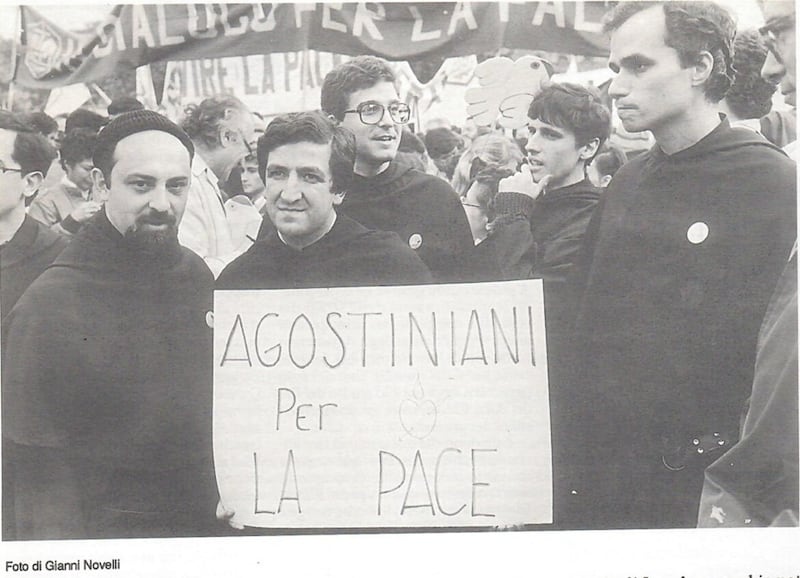 Robert Prevost (right), the future Pope Leo XIV, protests against militarisation in 1983 with fellow Augustinians. Photograph: Gianni Novelli
As Pope Leo XIV locks horns with fellow Americans Donald Trump and JD Vance over the war in the Middle East, it’s instructive to know that his objection to bombs and missiles is not a new one. In fact, a photograph from more than four decades ago show him taking to the streets.
“In 1982/83, widespread demonstrations against nuclear proliferation took place all over Europe,” Fr Iggy Donovan, an Augustinian priest still active in Ireland, explains.
“At the time, the United States were deploying a new generation of intercontinental ballistic missiles. A group of us young Augustinians in Rome became members of a peace group Agostiniani per la Pace (Augustinians for Peace).
“This photo from 1983 shows a section of our group at an anti-war demo. On the right you will notice a young serious Bob Prevost. His anti-war credentials are well established.”
He’s using them. US secretary of war Pete Hegseth made waves last week by reading a prayer based on Samuel L Jackson’s righteous pre-murder monologue in Pulp Fiction, ostensibly by accident, in support of his nation’s “war fighters”.
To no avail, says the pope. God, according to his closest interlocutor, “does not listen to the prayers of those who wage war, but rejects them”.
Heavy going in Magnier challenge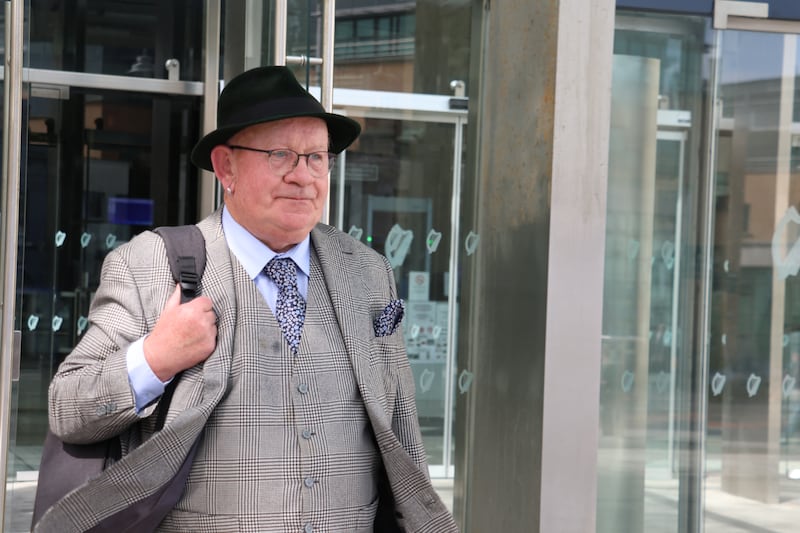 Vincent O’Donoghue is taking a private prosecution against billionaire businessman John Magnier, alleging he lied under oath during the Barne Estate case. Photograph: Ronan McGreevy
There was some confusion in the courts this week as the High Court case involving the battle over the Barne Estate in Co Tipperary took an unusual tangent in a lower court.
Vincent O’Donoghue, the former solicitor from Dublin who was once convicted of fraudulently converting cheques worth €44,000, had no involvement in the Barne Estate case, though he was a regular attendee.
He is now taking a private prosecution against billionaire businessman John Magnier for alleged perjury, claiming the judgment of Judge Max Barrett in the prior case shows he lied under oath.
Last September, Magnier, along with his co-plaintiffs, his daughter Katherine Wachman and son John Paul Magnier, lost a case they brought against the owners of the Barne Estate over a claimed sale which took place at Magnier’s home in Coolmore on August 22nd, 2023.
Magnier said he concluded a sale with Richard Thomson-Moore for €15 million. The judge felt otherwise.
There was a verb for reshaping a story to suit objectively demonstrated facts, Barrett said: “Lying, and that is what happened here.”
O’Donoghue hit upon some procedural difficulties with his rather unusual case, as our reporter Ronan McGreevy heard in court. District Court appeals judge Christopher Callen said he could not hear the case until O’Donoghue got a written ruling from the District Court that it had declined to hear it.
“I don’t know what’s being appealed here,” he said. Back to the District Court with O’Donoghue to seek the decision.
Who needs diesel?
Once upon a time, Ireland was all ready to jump on the China bandwagon, graciously accepting a new source of foreign direct investment in the form of a large business park in Athlone.
The Europe China Trading Hub, granted planning permission in 2012, never materialised. But data shows some inroads by higher-end Chinese consumer technology in Ireland nonetheless.
The Department of Finance this week published a paper outlining that electric vehicles, from a base of near zero in 2015, are now the most common type of car registered in Ireland, and that EVs and hybrids together now vastly outstrip the humble internal combustion engine, which is down from its century-long high of almost 100 per cent to 31.6 per cent in 2026 to date.
The Chinese, say the wonks, are partly responsible.
“Falling prices for electric vehicles reflect, inter alia, increased competition in the sector,” says the report. “An important source of competition is the rise of Chinese manufacturing in emerging technologies. Despite tariffs, sales of EVs by Chinese new entrants have grown in Ireland in recent years.”
Chinese EVs – from BYD, XPENG, Leapmotor and others – now make up almost 10 per cent of the growing number of EVs sold. And that’s with an almost Trumpian tariff regime: BYD cars sold in Ireland face a 27 per cent tariff, while some manufacturers without specific deals pay 35.3 per cent.
Brussels, which sets the rates, is thinking about dropping them in exchange for negotiated minimum prices. And this comes as Chinese manufacturers, after years of brutal price wars, have started to run out of Chinese people to sell new electric cars to, despite the country’s population of 1.4 billion. That’s usually a sign that a lot of product is about to traverse the old Silk Road.
Some unfamiliar brands look set to become a lot more common on Irish roads. On the plus side, they don’t need diesel.