Foot-and-mouth disease (FMD) cases continue to rise across South Africa, with sharp increases in some provinces. Government says vaccination efforts are under way, but supply constraints and slow rollout remain major challenges.
By Michelle van der Spuy, senior journalist at African Farming and Landbouweekblad
In the Free State, the number of foot-and-mouth disease (FMD) cases rose by nearly 90 within a single week, the Department of Agriculture revealed in a presentation to the Portfolio Committee on Agriculture this week.
Dr Bothle Modisane, chief director for animal production and health, told the committee on Tuesday, 21 April, that 1 502 new cases had been reported countrywide as of 17 April.
The increase was particularly noticeable in the Free State, where cases rose from 328 to 414 within seven days. Significant increases were also recorded in North West (from 247 to 268 cases) and the Eastern Cape (from 71 to 104 cases).
As of 17 April, there were 257 cases in KwaZulu-Natal, 243 in Gauteng, 144 in Limpopo, 13 in the Western Cape and 4 in the Northern Cape.
Dipepeneneng Serage, deputy director-general for agricultural production, biosecurity and natural resources, said the fact that cases in the Western Cape had not increased since 27 March was due to the speed of vaccination in the province, and the effectiveness of the provincial government.
As before, the department attributed the continued rise in cases to increased reporting and improved surveillance. It also noted that some animals develop a subclinical form of the disease, which delays detection.
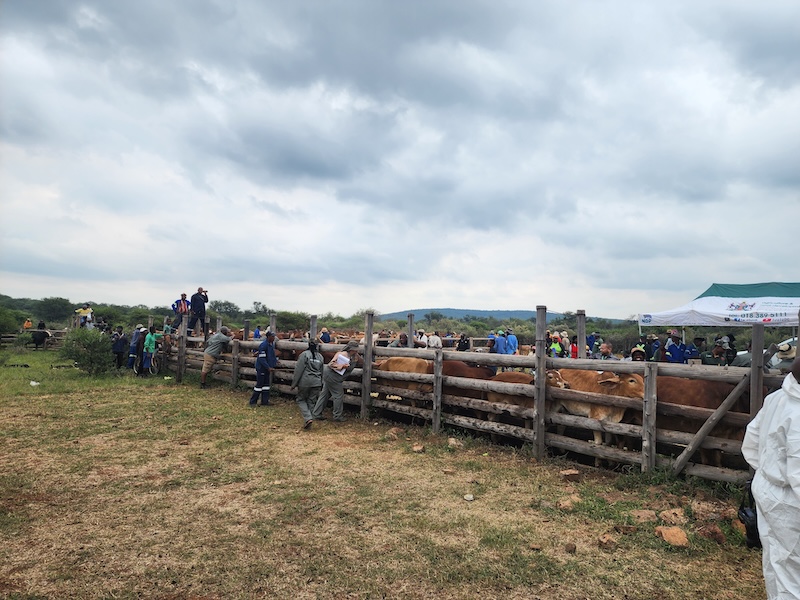 During the fifth nationwide mass vaccination campaign against foot-and-mouth disease (FMD) in Ramotshere Moiloa Local Municipality, more than 650 communal cattle were vaccinated with the Aftodoll oil vaccine manufactured by Dollvet. Photo: Lebogang Mashala
Modisane said the department would allocate additional vaccine doses to provinces where cases have surged to help bring the situation under control.
He added that other countries have also recently reported FMD outbreaks. The most recent was in China in March, where similar challenges were being experienced, particularly regarding vaccine availability. The department expects these outbreaks to increase global competition for vaccines.
Although it is therefore unthinkable that even a single drop of vaccine should be wasted, Modisane noted that between 6% and 8% of vaccine bottles were broken. The department has requested explanations for these losses.
Serage said the bottles were not damaged during transport, but rather on farms, where accidents during the vaccination process were sometimes unavoidable.
Vaccine Rollout Remains Slow
As of 17 April, about 2.13 million cattle had been vaccinated. Serage said the department was not satisfied with the slow progress of the vaccination programme, largely because vaccines have to be imported.
By Tuesday, 21 April, the department had received 4 million doses. A further 2 million doses of the Dollvet vaccine from Türkiye were received on Wednesday, 22 April, and will be distributed soon. This forms part of a 6 million-dose order from the manufacturer.
The department has also placed an order for 5 million doses from Biogénesis Bagó in Argentina. These will arrive in two shipments – 3.5 million and 1.5 million doses – once approved by the South African Health Products Regulatory Authority (SAHPRA).
Serage said that although there are plans to start producing vaccines locally, registration is a lengthy process and the private sector currently has little appetite for it. In addition, the necessary infrastructure is not yet in place. The department has, however, secured funding for equipment, and local production is expected to begin by the end of November.
Also read: From our editor: When progress doesn’t reach the farmer
Proposed Changes to Regulations
Modisane said the department was considering adjustments to regulations governing the movement of animals, but these changes had to be aligned with other regulations to avoid contradictions.
More than 350 submissions have been received on the proposed Routine Vaccination Scheme for Foot-and-Mount Disease under Section 10 of the Animal Diseases Act (Act 35 of 1984), and it is now under review.
In this draft scheme, published in the Government Gazette on Friday, 10 April, the department proposes a structured national framework for disease control through systematic vaccination, with a strong focus on traceability, surveillance, and cooperation between government and industry. It allows farmers and their workers to participate in vaccination, but only within a structured framework.
According to the Gazette notice, vaccinations may be administered by state veterinarians, authorised private veterinarians or animal health technicians, as well as by owners or their employees under supervision. Standard operating procedures are also provided for, covering everything from vaccine usage and dosage to monitoring, reporting and animal identification.
Modisane said the aim is to enable farmers to protect their animals, rather than placing full responsibility on government.
Also read: FMD | Disaster status allows changes to legislation
No Financial Relief for Farmers
FMD results in significant economic losses, said Laetitia Arries, an EFF MP and member of the Portfolio Committee on Agriculture.
She said the disease is not only a problem for farmers, but also poses a threat to the national economy. The financial impact is particularly severe for small-scale farmers who rely on livestock sales and have limited savings.
Serage said the department sympathises with affected farmers, but does not have the financial resources to compensate them for losses caused by FMD.
Department officials have met with their provincial counterparts this week and requested assessments to determine whether provincial disaster classifications are warranted. At present, FMD has only been classified as a national disaster.
Also read: FMD: ‘The virus does not care about factions or blame-shifting’
Concerns Over Vaccine Black Market
Désirée van der Walt, DA MP and alternate member of the Portfolio Committee on Agriculture, raised concerns about a possible black market for vaccines. She said doses were reportedly being sold for R300 in KwaZulu-Natal.
Serage said the department has also heard these reports and urged that any such incidents be reported to the police or the department, as it is illegal for private individuals to possess or sell FMD vaccine doses.
Also watch and read:
‘No FMD vaccines in black plastic bags’ – MEC Ramokgopa warns farmers against fraudsters
Weekly RMIS FMD update: Vaccine supply and strategic planning
Botswana’s FMD starting to run away from authorities
 FMD Control Centre
(toll-free): 0860 246 640