
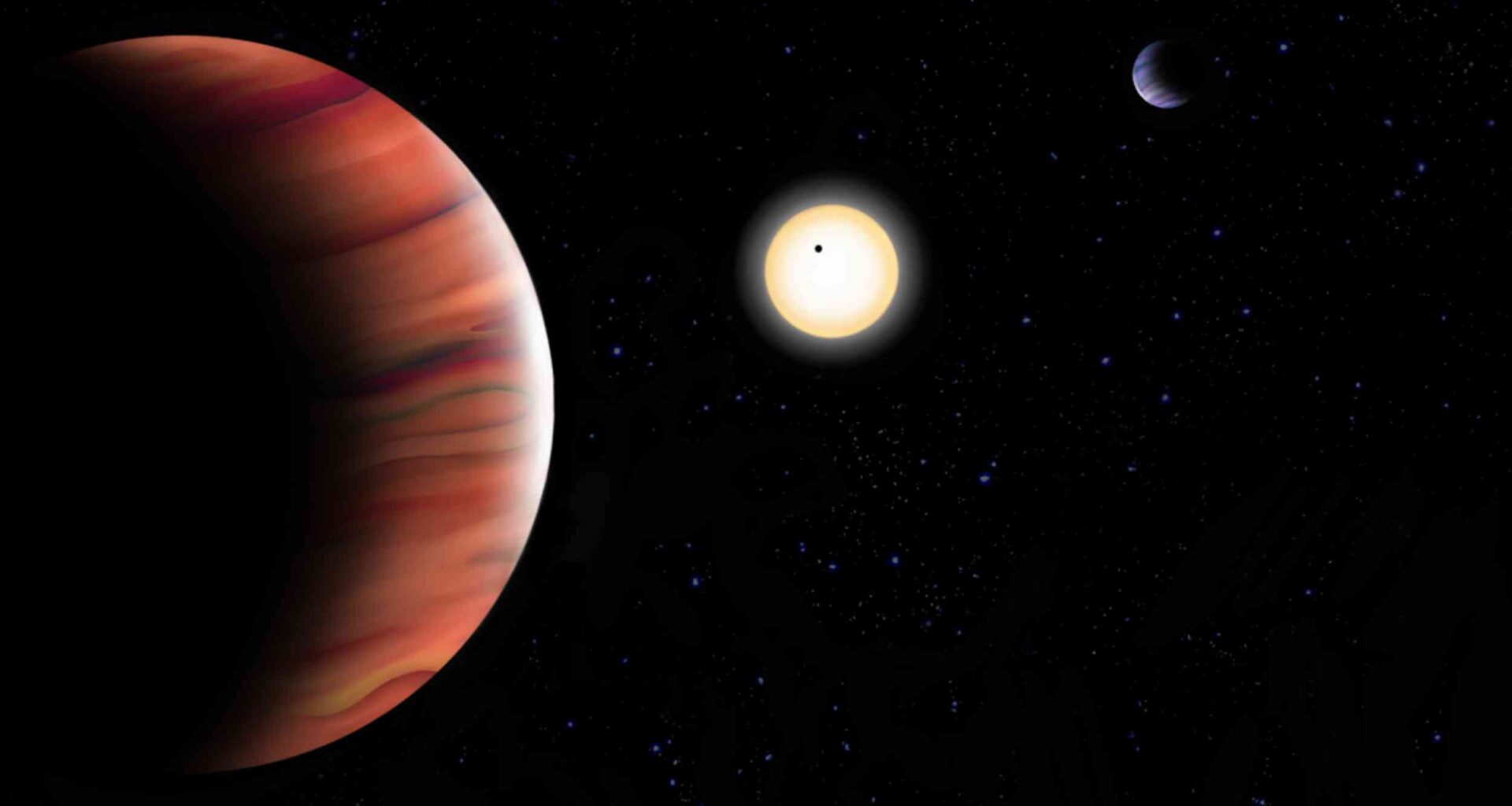
Researchers have found that a distant star system with three orbiting bodies is actively changing its orbital structure on human timescales.
That ongoing rearrangement allows astronomers to watch gravitational interactions reshape a planetary system in real time rather than infer them from ancient outcomes.
Three worlds emerge

In the system known as TOI-201, three bodies repeatedly pass in front of their star while their tilted paths continue to shift.
Working at the University of New Mexico, Ismael Mireles documented that a rocky inner planet, a gas giant, and a massive outer companion are pulling one another into new alignments.
Those shifting orientations are already altering how each body crosses the star, changing the timing and shape of the observed signals.
Because the configuration will not remain stable for long, the system offers a brief window before its current pattern disappears entirely.
TOI-201 c is the oddball
Far outside the inner pair, TOI-201 c follows a 7.9-year path from inside Mars’s orbit to beyond Jupiter’s.
Because it sits above the planet-star boundary, the outer object is a brown dwarf, too massive for a planet and too small for star-like fusion.
Most of the system’s strange behavior traces to this body, whose elongated orbit makes its pull change as it swings in and out.
That is why the longest journey in the system also controls what happens close to the star.
A hidden timing clue
When TESS, NASA’s planet-hunting space telescope, watched the system, one partial transit did not match either known inner world.
At nearly the same time, the gas giant arrived about 30 minutes late, showing that something massive had tugged on it.
Astronomers first had only that single, incomplete glimpse of the outer object, so many orbital periods still looked possible.
That odd timing turned an isolated dip in starlight into the clue that exposed a hidden companion.
Measuring the star
To turn those clues into a full map, the researchers measured how the star itself moved across the sky and toward Earth.
Using Gaia and Hipparcos, ESA missions that tracked stellar positions, they found the star changing course under the outer body’s pull.
Spectrographs in Chile and Australia added the star’s back-and-forth speed, while ground telescopes filled gaps in the transit record.
Those measurements let the team solve the system in three dimensions instead of settling for a flat, incomplete view.
The paths keep tilting
Because the three orbits are not stacked in one plane, each body keeps nudging the others into slightly different angles.
That slow reorientation changes how each transit cuts across the star, so the timings and durations do not stay fixed.
Within about 200 years, the current transit pattern should break, and the same alignment will not return for thousands of years.
“It offers a rare real-time window into the dynamic lives of planetary systems,” Mireles said.
How TOI-201 got weird
The present layout is hard to explain because planets usually grow inside a disk that leaves their orbits roughly aligned.
In one leading explanation, Kozai-Lidov cycles, a long gravitational rhythm driven by a distant companion, pushed the outer body into its current path.
Another idea, a violent scattering event among giant worlds, reproduced the modern system in only about one percent of the team’s simulations. Current evidence points to a long reshaping rather than a single brief disturbance.
Watching from Antarctica
Ground telescopes mattered because TESS did not keep watching TOI-201 without interruption.
From Antarctica’s Concordia station, Amaury Triaud of the University of Birmingham helped extend the record when TESS looked elsewhere.
The Antarctic site offered long darkness and stable conditions that helped the team follow a world on a long orbit.
That extra coverage mattered because a fast-changing system can hide its story when too many months go unobserved.
The next key transit
A major test arrives on March 26, 2031, when the outer companion is expected to cross the star again.
Such a full transit should tighten the orbital period, reduce uncertainty in the path, and reveal how much the inner planets have changed.
After the brown dwarf swings close again, the warm Jupiter’s path across the star should have moved enough to measure cleanly.
That makes one predicted crossing unusually valuable, because it can sharpen both the present picture and the forecast for coming centuries.
Why TOI-201 matters
Midrange giant planets remain hard to explain, and warm Jupiters sit in the middle of that enigma.
With a small rocky planet nearby and a massive distant companion, TOI-201 b preserves migration clues simpler systems lose.
“This helps scientists understand how planetary systems like our own Solar System form and evolve over time,” Mireles said.
That broader picture reaches past one star, because planetary history has to explain orderly systems like ours and unruly ones like this.
TOI-201 has become a compact lesson in how planetary systems can stay intact while their visible layout keeps changing.
As more data arrive, astronomers should learn whether the system’s restlessness came from an unseen star, an earlier planetary clash, or both.
The study is published in Science Advances.
—–
Like what you read? Subscribe to our newsletter for engaging articles, exclusive content, and the latest updates.
Check us out on EarthSnap, a free app brought to you by Eric Ralls and Earth.com.
—–