
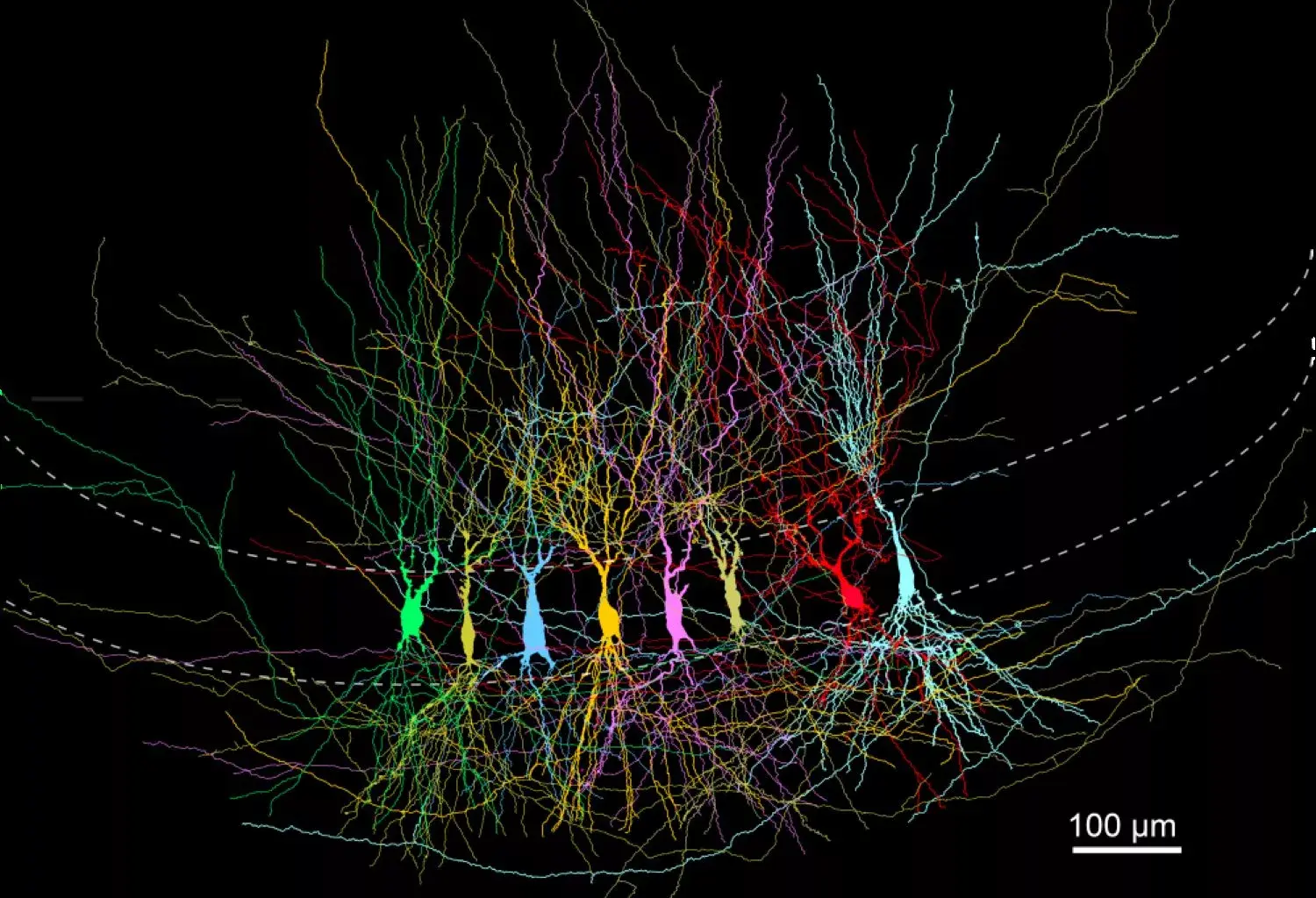
In the complex architecture of the mammalian brain, the hippocampal CA3 region serves as an essential organizer of memory. Its pyramidal neurons (PNs) form the largest known autoassociative network in nature, an immense matrix of memories that can be stored and recalled. Yet, until now, scientists have wrestled with a fundamental question: Is this complex wiring genetically hardwired into us, or is it experience that drives these connections?
A new study from the Institute of Science and Technology Austria (ISTA) uses multicellular patch-clamp circuit mapping at different developmental stages in mice to tackle this question. At different ages (early postnatal [P7–8], juvenile [P18–25], and adult [P45–50]), researchers were able to make recordings from between one and eight CA3 pyramidal neurons so that the network could be observed in real time.
The results show a remarkable turnaround. Connectivity in the CA3 is dense, local, and appears random during the first few days postnatally. This is followed by a reduction of this combinatorial complexity into sparse, distributed, and highly structured networks as the brain matures. In other words, experience seems to fashion the chaotic wiring of a newborn’s brain into an efficient memory architecture.
Peter Jonas from the Institute of Science and Technology Austria (ISTA) said, “This discovery was quite surprising. Intuitively, one might expect a network to grow and become denser over time. Here, we see the opposite. It follows what we call a pruning model: it starts full, and then it becomes streamlined and optimized.”
Scientists Discovered How the Brain Selectively Remembers New Places
Along with this architectural tuning, the strength of individual synapses changes. During development, a single synaptic event can trigger a postsynaptic neuron. As neurons mature, they need input from several synapses via spatial summation to trigger. This ongoing evolution is a shift from crude sensitivity to sophisticated selectivity.
Models based on Hebbian plasticity and pattern completion suggest these developmental changes improve memory fidelity. This leads to the CA3 network being better at coding individual details and using structured cues to recover those details, increasing the brain’s ability to differentiate distinct but similar memories.
The study indicates that the hippocampal CA3 network is, by its very nature, conceptually reconfigured rather than merely physically reorganized: the neuronal code itself changes. Something that starts as a set of responses to the aggregates becomes an additional closure mechanism.
In essence, memory is not just written down in the brain; it is constantly rewritten, edited, and restructured throughout development. The ultimate seat of memory, the Hippocampus was told to be just a more active storyteller, incorporated into its own story, rewriting it every time it had an experience.
Journal Reference:
Vargas-Barroso, V., Watson, J.F., Navas-Olive, A. et al. Developmental emergence of sparse and structured synaptic connectivity in the hippocampal CA3 memory circuit. Nat Commun (2026). DOI: 10.1038/s41467-026-71914-x