
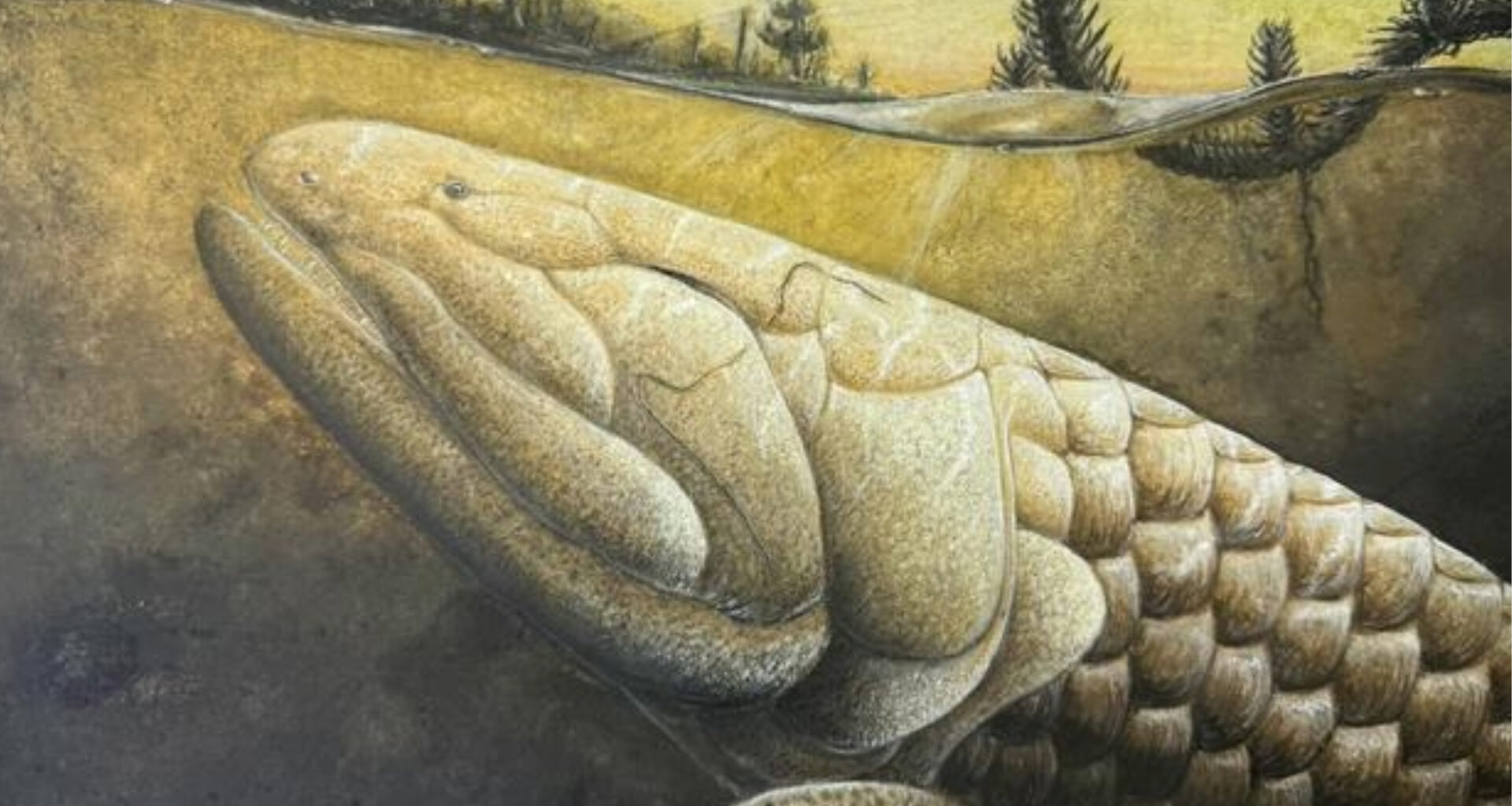
A rare Antarctic fossil is offering a clearer look at how early backboned animals lived just before the move onto land.
Using advanced scans, scientists uncovered hidden skull features in Koharalepis jarviki, a 380-million-year-old fish that hunted near the water’s surface.

The discovery adds an important southern piece to a story that has long relied on fossils from other parts of the world.
Fish fossil reveals hidden skull
Inside the stone, Koharalepis jarviki, an extinct fish with fleshy fins, kept the only three-dimensional skull known from its family.
At Flinders University, doctoral candidate Corinne L. Mensforth analyzed bones to document the senses, breathing, and predatory habits of the ancient fish.
Although damage had crushed parts of the fossil, its braincase still preserved rare clues from a body built for shallow water.
Those clues matter because one battered specimen now carries only partial evidence, and its wider meaning depends on ancient southern connections.
Fossil reveals ancient connections
Old Gondwana, the ancient southern supercontinent that once joined Antarctica and Australia, explains why this Antarctic fish also connects to Australia.
The fish belongs to Canowindridae, an extinct family known from river deposits in Antarctica and Australia.
During the Devonian Period, a time from 419 to 359 million years ago, rivers held many predatory fishes with fleshy fins.
“This precious fossil belongs to a group called the Canowindridae, which highlights the ancient links between Australia and Antarctica,” said Dr. Alice Clement, research fellow at Flinders University.
Advanced scans reveal hidden bones
Modern imaging mattered because cutting the fish fossil apart would have destroyed the only specimen scientists have.
To reach those sealed bones, the team used neutron tomography, a scan using neutral particles to see through dense rock.
Earlier synchrotron tomography, high-energy X-ray scanning that maps hidden structures, had already shown parts of the palate.
Because each scan highlighted rock and bone differently, their combined view exposed details that one method alone could miss.
Brain clues come into focus
Within the damaged skull, the preserved brain space pointed to a fish tuned to light, smell, and surface water.
A raised pineal gland, a light-sensitive organ that helps time daily rhythms, suggested life near the water surface.
Wide smell pathways fit an animal with small eyes, because scent could help locate prey in murky freshwater.
Small spiracular openings, holes on the skull top for taking in air, added another sign of surface use.
A shallow-water ambush hunter
At about 3.3 feet long, Koharalepis jarviki carried cone-shaped fangs that could pierce smaller animals in sudden attacks.
Small eye sockets also set it apart from later fishlike relatives with larger eyes, and a 2017 analysis modeled their stronger above-water vision.
With less visual reach, this fish likely relied on smell, timing, and close-range strikes near the surface.
That mix fits an ambush hunter, not a fast open-water chaser built to spot prey from far away.
Rare fish fossil holds key clues
Rarity makes neuroanatomy, the layout of brain and nerves, central when family fossils mostly preserve flattened molds.
“We chose to focus on Koharalepis as it is the only fossil in the entire family to preserve the internal bones of the skull, which gives us valuable insights into its braincase and neuroanatomy,” said Mensforth.
Other family members show broad heads and small eyes, but they cannot reveal the same braincase details.
With only one partial specimen, scientists can draw strong clues from anatomy without treating every feature as final.
Evolutionary ties become clearer
Shared skull traits placed Koharalepis jarviki firmly within Canowindridae family, not in an uncertain position near it.
A phylogenetic analysis, a test comparing shared body traits to estimate relationships, linked it with southern relatives.
Newly visible traits strengthened that placement, although nearby relationships in this ancient fish group remain hard to separate.
Better family placement narrows how this predator related to fishes close to the origin of four-limbed animals.
Southern fossils change the picture
Antarctica matters here because it records a southern river setting often missing from accounts of early backboned animals.
The fish fossil came from Aztec Siltstone, a Devonian rock layer in Antarctica, among non-marine rocks.
A 1992 description reported a diverse fish community there, including jawed and jawless species. Such places show that evidence for the transition to land also comes from southern rocks.
Rare evidence for further study
Compression after death flattened parts of the skull, leaving some fine nerve openings and inner-ear structures unclear.
Some differences from other fossil fishes may reflect damage rather than biology, especially around the jaw and backbone.
A scan window of about 7.9 by 7.9 inches also left the front fin outside the new images, though future imaging could test how that fin worked.
Even with those limits, the fossil has already expanded the available evidence. Hidden skull bones, light-sensing anatomy, breathing openings, and predatory jaws now place Koharalepis jarviki in a more specific evolutionary role.
One battered Antarctic fossil cannot tell the whole water-to-land story, but it gives scientists rare southern evidence to study.
The study is published in Frontiers in Ecology and Evolution.
Image credit: Flinders University
—–
Like what you read? Subscribe to our newsletter for engaging articles, exclusive content, and the latest updates.
Check us out on EarthSnap, a free app brought to you by Eric Ralls and Earth.com.
—–