
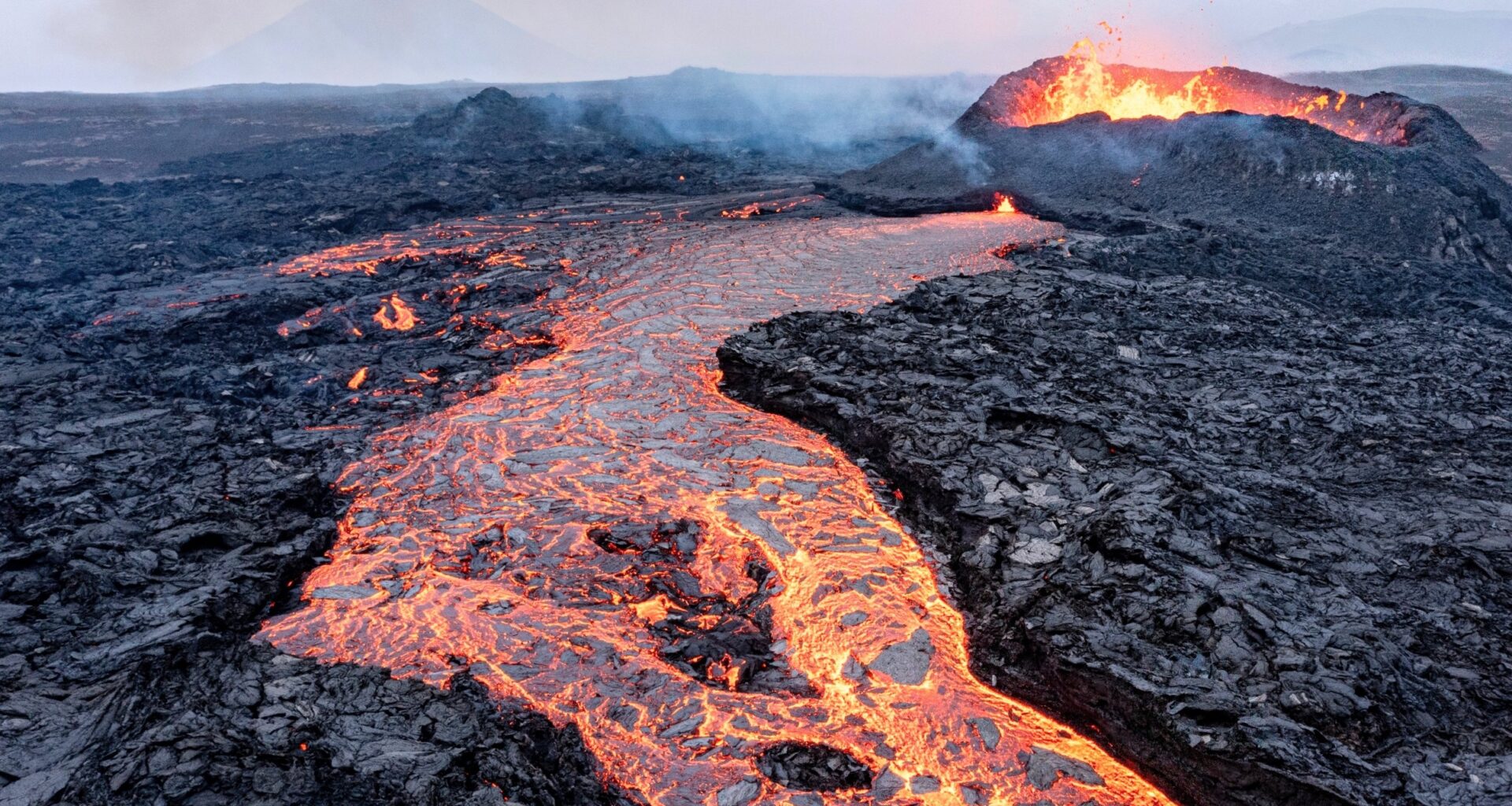
Life can return even after a place seems completely erased. Fresh lava flows look dead at first glance – black, jagged, and stripped of anything recognizable as living. But that emptiness does not last.
A new study shows that life begins reclaiming new land almost immediately, starting with microscopic organisms that arrive long before plants or animals.

By tracking how microbes colonize fresh lava in Iceland, scientists are watching life restart from zero – and learning lessons that could shape how we search for life beyond Earth.
Iceland’s natural lava experiment
The study was led by researchers from the University of Arizona, bringing together ecologists and planetary scientists.
They focused on the Fagradalsfjall volcano in southwestern Iceland, which erupted three times between 2021 and 2023.
Each eruption sent lava flowing across the tundra, sometimes covering lava from earlier eruptions.
Because the lava was newly formed, it created a rare opportunity to study primary succession. This is when life colonizes a place that had no life before, unlike areas recovering after a fire or flood.
“The lava coming out of the ground is over 2,000 degrees Fahrenheit, so obviously it is completely sterile,” said the study’s first author, Nathan Hadland, a doctoral student at the University of Arizona Lunar and Planetary Laboratory.
“It’s a clean slate that essentially provides a natural laboratory to understand how microbes are colonizing it.”
Where lava microbes originate
To find out how life begins on fresh lava, the team collected samples from many possible sources.
These included lava that had cooled only hours earlier, rainwater, airborne particles called aerosols, nearby soil, and surrounding rocks. The idea was to trace where the microbes settling on the lava were coming from.
The researchers extracted DNA from all these samples. Using advanced statistical methods and machine learning, they identified which organisms were present and how different environments contributed to the new microbial communities forming on the lava.
Thriving where little exists
Fresh lava is a harsh place to live. Even though Iceland gets plenty of rain, lava rocks do not hold water well and contain almost no nutrients. This makes survival very difficult, especially at the beginning.
“These lava flows are among the lowest biomass environments on Earth,” said Solange Duhamel, associate professor in molecular and cellular biology at the University of Arizona.
“They are comparable to Antarctica or the Atacama Desert in Chile, which is not that surprising considering they start out as a blank slate. But our samples revealed that single-celled organisms are colonizing them pretty quickly.”
Only some microbes survive lava
The study showed that microbial diversity increased during the first year after an eruption. However, after the first winter, diversity dropped sharply.
According to Hadland, this likely happened because only certain microbes could survive the cold and changing conditions. Over the next winters, fewer changes occurred, and the community became more stable.
“It appears that the first colonizers are these ‘badass’ microbes, for lack of a better term, the ones that can survive these initial conditions, because there’s not a lot of water and there’s very little nutrients. Even when it rains, these rocks dry out really fast,” said Hadland.
Over time, more microbes arrived, carried in by rain and from nearby land. This helped the microbial community slowly grow and settle into a more stable pattern.
Rainwater plays a key role
One of the most surprising findings was the role of rainwater. Early on, microbes mainly came from wind-blown soil and aerosols. After the first winter, rainwater became the main source of new microbes.
“Early on, it appears colonizers are mostly coming from soil that is blown onto the lava surface, as well as aerosols being deposited,” Hadland said.
“But later, after that winter shift in diversity we observed, we see most of the microbes are coming from rainwater, and that’s a pretty interesting result.”
Rainwater is not sterile. Microbes in the air can help form clouds and rain droplets. This means that tiny organisms can influence weather and also help seed new environments.
“Seeing this huge shift after the winter was pretty amazing,” Duhamel said, “and the fact that it was so replicable and consistent over the three different eruptions – we were not expecting that.”
Why this matters beyond Earth
This study is the first detailed look at microbial primary succession right from the moment new land forms. Because the volcano erupted three times in the same place, the researchers could repeat their observations, something very rare in nature.
“The fact that we were able to do this three times – following each eruption in the same area – is what sets our project apart,” Hadland said.
“In science, we want to measure things three times – what we call a ‘triplicate,’ if possible, and that is very rare in a natural environment. For this study, nature essentially is giving us a triplicate.”
What microbes on lava reveal
The findings also have implications for Mars. Much of Mars has volcanic rock similar to Earth. Volcanic activity could have created short periods when life was possible.
“For the first time, we are beginning to gain a mechanistic understanding of how a biological community established over time, from the very beginning,” Duhamel said.
Understanding how microbes colonize fresh lava on Earth helps scientists think about where and how to look for signs of life on other planets.
The study is published in the journal Communications Biology.
—–
Like what you read? Subscribe to our newsletter for engaging articles, exclusive content, and the latest updates.
Check us out on EarthSnap, a free app brought to you by Eric Ralls and Earth.com.
—–