
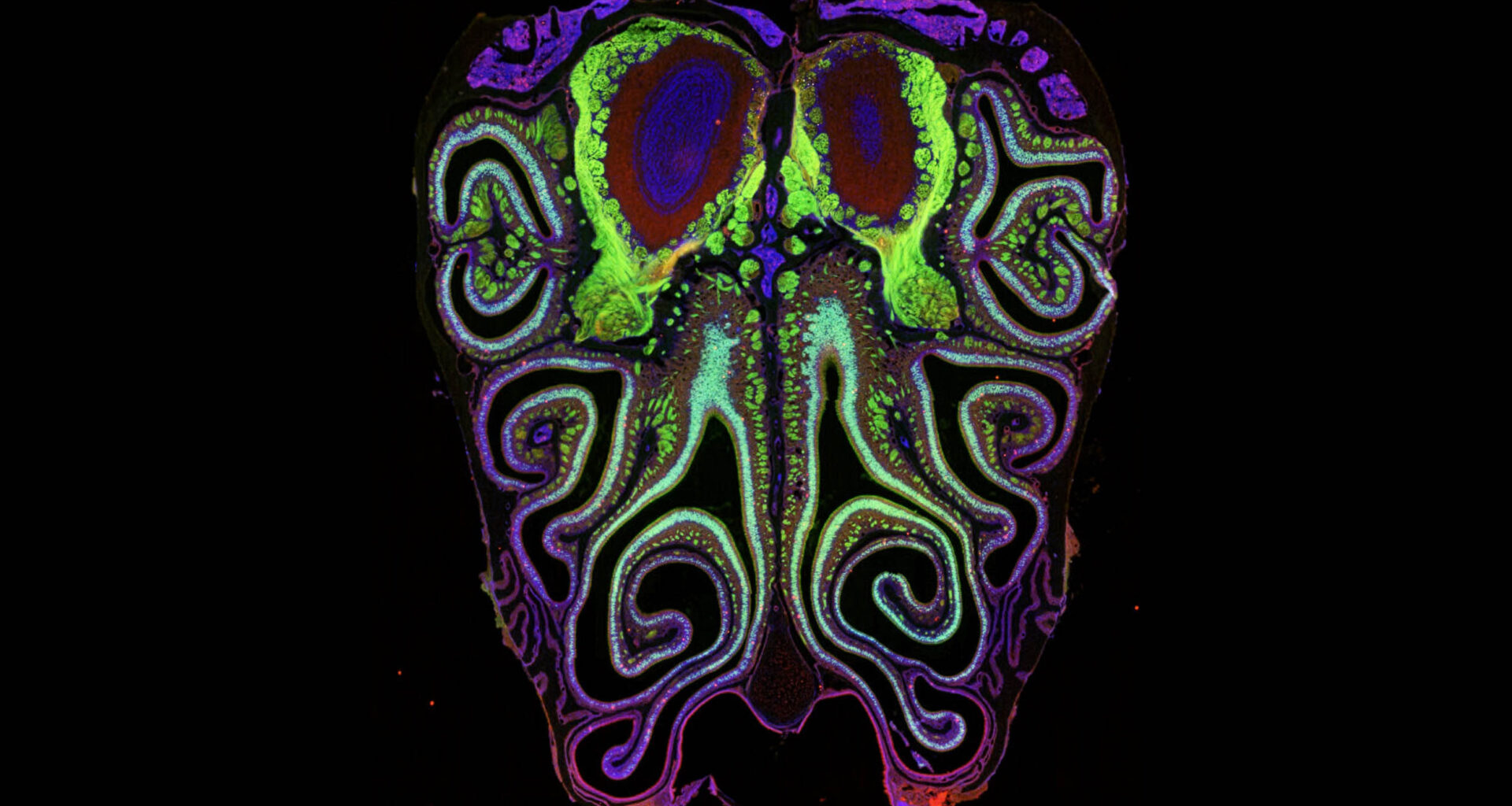
Smell is one of those senses most people barely think about until it disappears. It provides important warnings about smoke, spoiled food, and other issues of imminent danger.
Our sense of smell also shapes flavor, triggers memories, and can change the mood of an entire moment.

Yet for something so woven into daily life, scientists have long understood surprisingly little about how it is organized inside the nose. Now, a new study solves a major piece of that puzzle.
Working with mice, researchers have created the first detailed map of smell receptors in the nose.
A highly organized system
The study challenges a long-standing idea that the system was mostly disordered.
Instead, the team found that smell receptors are arranged in a highly organized way, forming horizontal bands from the top of the nose to the bottom.
Led by Professor Sandeep Datta in the Blavatnik Institute at Harvard Medical School, the research lays the groundwork for future treatments for loss of smell – something medicine still struggles to address.
Smell was the last unmapped sense
Scientists have had sensory maps for a long time in other parts of the body.
We know a great deal about how receptors in the eye are arranged to process vision, how the ear handles sound, and how the skin detects touch.
Experts have also worked out how those sensory maps connect to matching systems in the brain. But smell has been the exception.
That gap has lingered for years, partly because smell is a far messier system than the others.
Mice have around 20 million olfactory neurons and more than a thousand different kinds of smell receptors.
Smell receptors in the nose
By comparison, color vision depends mainly on just three kinds of visual receptors.
Each smell receptor detects its own subset of odor molecules, which makes the whole system vastly more complicated.
Scientists first identified smell receptor types in 1991. For decades after that, they kept looking for a clear map in the nose.
What they found seemed disappointing since receptors appeared to be grouped only loosely into a handful of broad zones.
That led to the dominant idea that smell receptor expression was largely random, and that smell simply worked differently from the other senses.
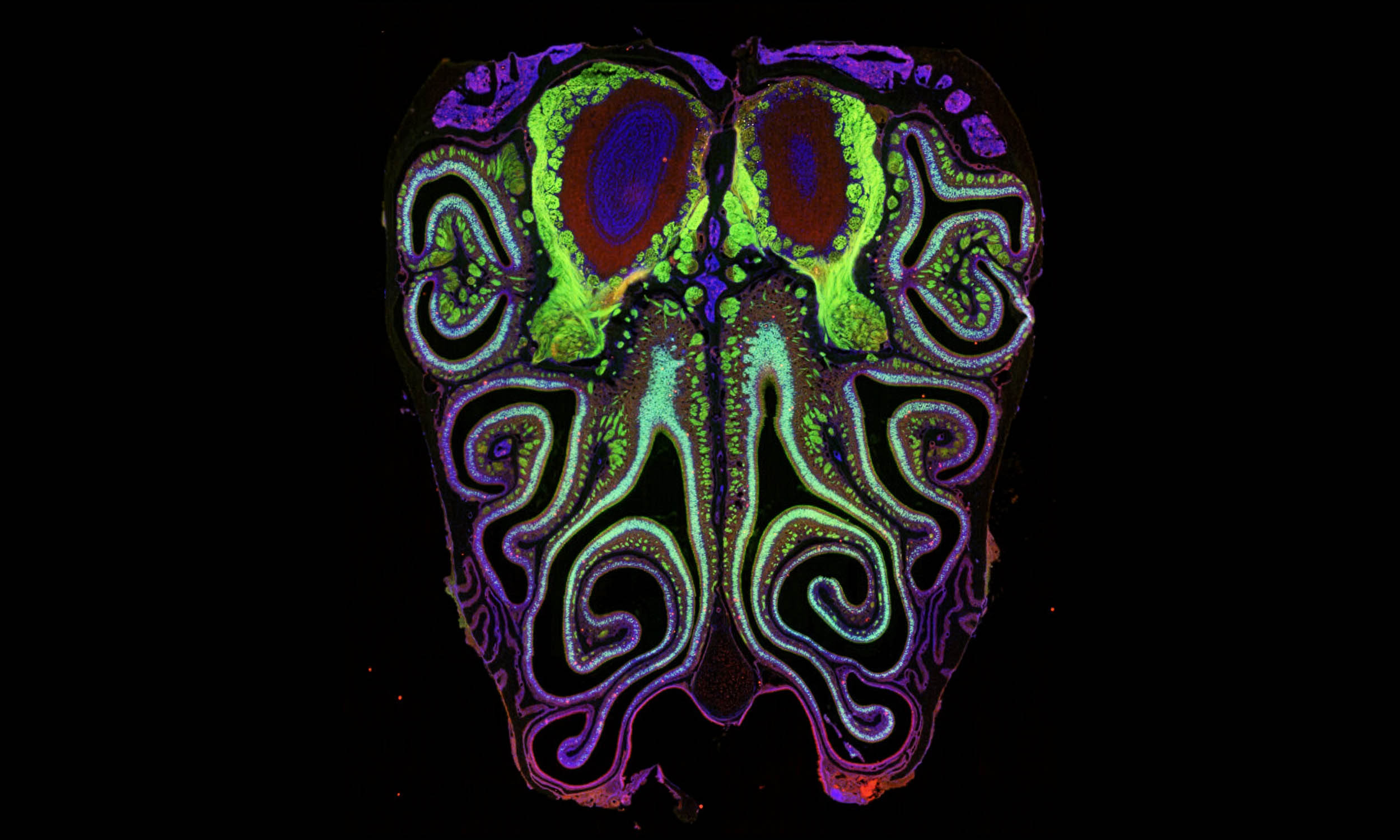 A microscope photo of a cross section of a mouse nose. The mouse was genetically modified to express green fluorescent protein in smell neurons. A small subset of dying neurons is labeled in red. Credit: Datta Lab. Click image to enlarge.Striking pattern that mirrors the brain
As genetic tools became much more powerful, the team decided to revisit the question with far more detail than had been possible before.
In the new study, the researchers combined single-cell sequencing and spatial transcriptomics to examine around 5.5 million neurons from more than 300 mice.
One method showed which smell receptors individual neurons were expressing. The other showed where those neurons were sitting in the nose.
“This is now arguably the most sequenced neural tissue ever, but we needed that scale of data in order to understand the system,” Datta said.
What the researchers saw was not randomness at all. The neurons formed tightly organized, overlapping horizontal stripes – running from the top of the nose to the bottom depending on which receptor they expressed.
The pattern was consistent from mouse to mouse. Even more striking, the layout in the nose mirrored smell maps already known in the olfactory bulb of the brain.
Smell may not be the exception
That shift may sound technical, but it changes the whole way researchers think about the sense of smell.
“Our results bring order to a system that was previously thought to lack order, which changes conceptually how we think this works,” Datta said.
The study brings smell more in line with vision, hearing, and touch that rely on ordered receptor maps that help the brain sort incoming information efficiently.
If smell does something similar, then it may not be the strange exception it once appeared to be.
How the map gets built
The researchers did not stop at describing the map. They also wanted to know how the body builds it.
Their work points to retinoic acid as a key part of the answer. This molecule helps regulate gene activity, and in the nose it appears to form a gradient that helps guide neurons toward the right receptor type depending on where they are located.
In other words, a neuron’s position in the nose helps determine which smell receptor it will express.
When the researchers increased or reduced retinoic acid, the receptor map shifted upward or downward. That gave them a much stronger sense that this was an actively built structure.
“We show that development can achieve this feat of organizing a thousand different smell receptors into an incredibly precise map that’s consistent across animals,” Datta said.
Why this matters beyond basic science
Loss of smell can have a surprisingly deep effect on people’s lives. It can make food less enjoyable, reduce warning signals from the environment, and increase the risk of depression.
The COVID-19 pandemic also made many more people aware of just how disruptive smell loss can be.
Datta himself has studied smell loss in COVID-19. That background helps explain why this new map matters so much.
“We cannot fix smell without understanding how it works on a basic level,” he said.
Future research directions
The team is now looking at why the receptor bands appear in this specific order. They are also studying human tissue to see how similar the map is across species.
That work could eventually help support efforts to build treatments, including stem cell therapies or even brain-computer interfaces for people who have lost their sense of smell.
“Smell has a really profound and pervasive effect on human health, so restoring it is not just for pleasure and safety but also for psychological well-being,” Datta said.
“Without understanding this map, we’re doomed to fail in developing new treatments.”
The research is published in the journal Cell.
—–
Like what you read? Subscribe to our newsletter for engaging articles, exclusive content, and the latest updates.
Check us out on EarthSnap, a free app brought to you by Eric Ralls and Earth.com.
—–