
For decades, a dinosaur mystery lingered in a quiet stretch of land in northern Mongolia called Saizhurakh. People knew something was there.
A short report from about 70 years ago mentioned dinosaur footprints, then the trail went cold. No maps, no follow-up, nothing solid to go on. The site slipped out of reach and into rumor.

Now it’s back on the map. And it’s telling a bigger story than anyone expected.
Researchers have confirmed that this long-lost site preserves footprints from both massive plant-eaters and large meat-eaters, all stamped into the same ancient surface.
That single detail matters. It shows that northern Mongolia, once thought to be less active for large dinosaurs during that time, supported a full ecosystem with giants on both sides of the food chain.
Dinosaurs leave tracks in Mongolia
The rediscovery didn’t happen overnight. A joint expedition in 2024 set out with one goal: to find the missing site.
Local residents helped guide the team across the Saizhurakh area. Their knowledge proved key. The footprints were there, just as rumored, pressed into layers of rock that had waited over a hundred million years.
A deeper study followed in 2025. The team confirmed 31 footprints in total. Some belonged to long-necked sauropods, plant-eaters that stretched over 49 feet in length.
Others came from theropods, meat-eating dinosaurs that reached more than 26 feet long.
Dr. Shinobu Ishigaki and Professor Masato Fujita presented the results at Okayama University of Science, bringing attention to a site that had once been nearly forgotten.
Window into ancient ecosystems
Mongolia has a strong reputation in dinosaur research. It ranks among the top five countries for fossil discoveries. But most of those finds come from a later period, around 70 to 90 million years ago.
This site is different. It dates back roughly 120 million years, placing it in the Early Cretaceous.
That time period is harder to study in Mongolia because fossils from it are rare. Most known species from that era are smaller dinosaurs, not the giants seen here.
That gap has made it tough to understand how ecosystems developed and shifted between Asia and North America.
During the Early Cretaceous, continents were arranged in ways that allowed animals to move between regions.
Scientists have long suspected connections, but solid evidence has been limited. This discovery starts to fill that gap.
Making Mongolia’s dinosaur tracks
The ground beneath the dinosaur tracks tells its own story. The area once held a large lake. Fine black clay settled at the bottom over time.
Every so often, the water level dropped. When that happened, thin layers of sand formed on the exposed surface.
Those sandy patches became temporary walkways. Dinosaurs crossed them, leaving behind footprints. Later, water returned, sealing the tracks under new layers of sediment.
Over millions of years, those layers hardened into rock. What’s left today is a snapshot of movement – not bones, but behavior.
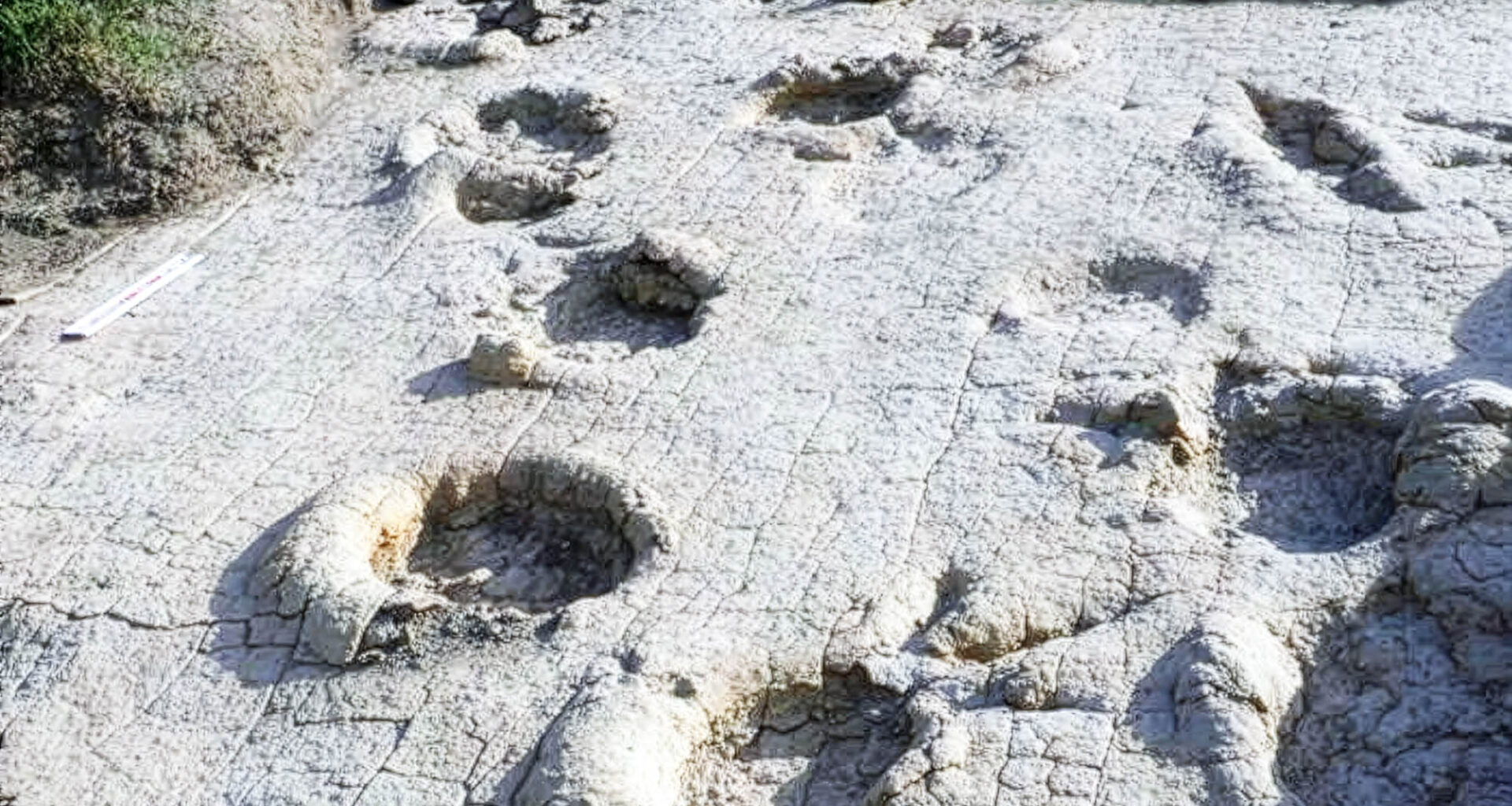
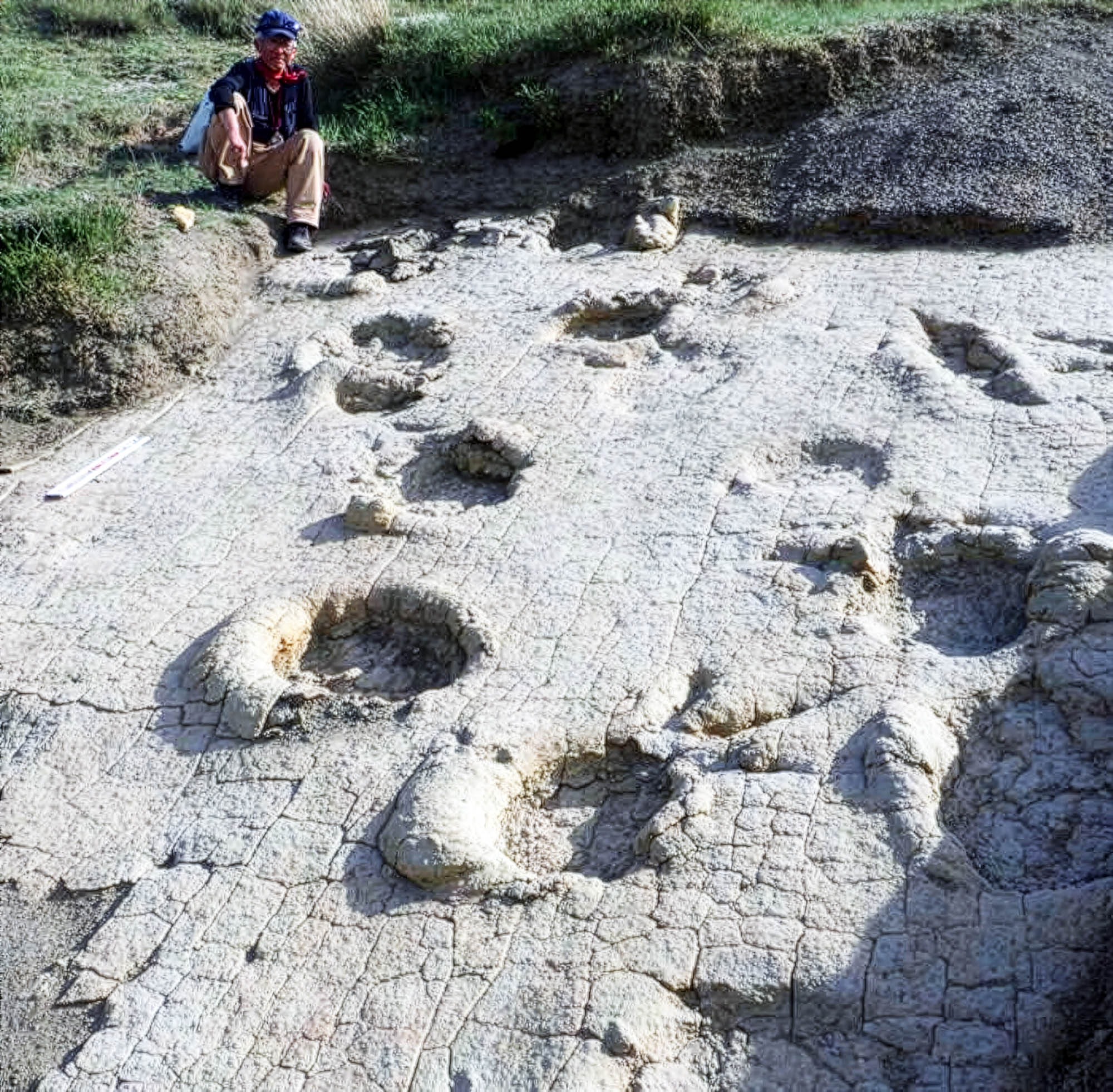 Two parallel dinosaur trackways in the Saizhurakh area of northern Mongolia of large sauropods overlap and extend toward the upper left of the image, forming a series of large, oval-shaped depressions. The overlapping pattern indicates that one individual followed the exact path of another. Credit: Okayama University of Science. Click image to enlarge.Following in each other’s steps
Two of the sauropods left nearly identical trackways. Their footprints overlap in a way that suggests one walked after the other, stepping along the same path at a slightly slower pace.
That kind of movement shows up in modern animals too. It hints at awareness and possibly shared routes through the landscape.
The dinosaur tracks themselves reveal more detail. The hind measure about 27 inches long. The front impressions show a mix of features, including a thumb claw and soft tissue pads.
The spacing of the tracks suggests a wide stance, pointing to a group known as titanosauriform sauropods.
Predators on the move
The theropod tracks tell a different story. The largest footprint measures about 22 inches. The toes spread widely, and the trackways head in different directions.
There’s no clear sign that these predators moved as a group. Each path stands on its own, cutting across the ancient surface without a shared pattern.
Evidence of large meat-eating dinosaurs from this time has turned up in places like China, South Korea, and Japan. Until now, Mongolia hadn’t offered much to match that.
These tracks change that picture, showing that big predators had reached farther north than previously confirmed.
A changing world 120 million years ago
The Early Cretaceous wasn’t a quiet time. The climate was warm. Flowering plants were spreading fast, reshaping landscapes and food sources. Dinosaurs were adapting and moving across continents.
Mongolia sat in a key position during all of this. It linked ecosystems across East Asia and into North America. But without enough fossil evidence, that link has been hard to trace in detail.
These tracks add a missing piece. They show that large dinosaurs lived and moved through this region, leaving behind clues about how life spread and evolved during a time of major change.
Next steps in the search
The story isn’t finished. Nearby layers contain gravel-rich sand, the kind of material that can sometimes hold bones.
The team plans to keep exploring the area, looking for skeletal remains that could match the tracks. More sites may be out there too. The landscape still holds plenty of unanswered questions.
For now, the rediscovered dinosaur tracks offer something rare: a clear record of movement from a distant past.
Not just who lived there, but how they walked, where they went, and how they shared the same ground.
The full study was published in the journal Ichnos.
—–
Like what you read? Subscribe to our newsletter for engaging articles, exclusive content, and the latest updates.
Check us out on EarthSnap, a free app brought to you by Eric Ralls and Earth.com.
—–