
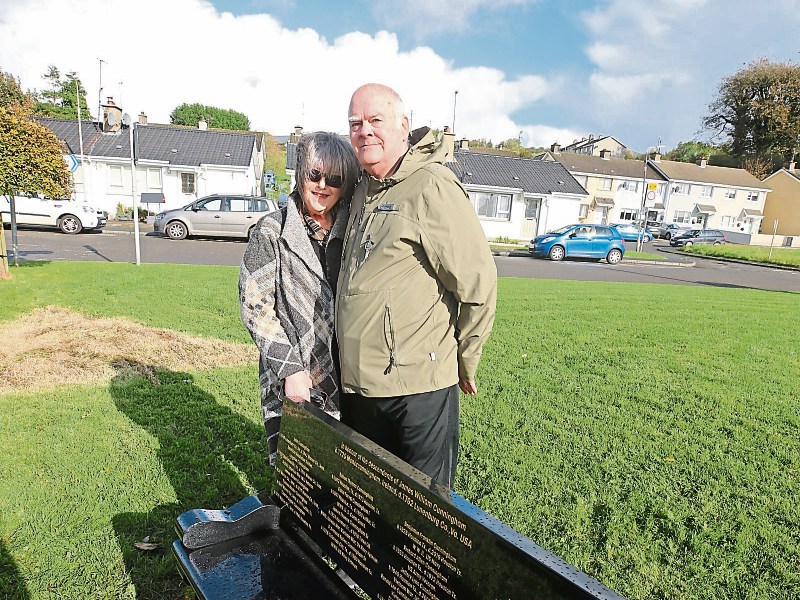
By Paul Bradley
THE Cunningham name is familiar in Donegal, particularly around the Laggan Valley. Before they arrived here, they were already a wealthy and powerful Scottish family. Based in Ayrshire, one branch of the family held the Earldom of Glencairn, and in the 1500s were major figures in both the Scottish Parliament and the Royal Court.
They were staunch supporters of the Scottish monarchy, and when King James VI of Scotland became King James I of England in 1603, they were among the men he trusted to “civilise” the north of Ireland: these men had to be loyal, wealthy, and have military experience.
They were sent to Ireland as “Undertakers” – agents of the King who “undertook” the risk of planting the land in exchange for vast grants.
The Crown’s confiscation of the lands of the Gaelic earls, following the Flight of the Earls in 1607, set The Plantation in motion. One region designated for plantation was the prime farmland of the Laggan Valley, which was divided into two precincts (Lifford and Portlough), further divided into parcels of 1,000 acres each, and awarded to the Cunninghams and Stewarts from Ayrshire.
Five Cunninghams were granted land in East Donegal, and you can guess from modern names where some of that land was. The most significant were brother John and Sir James Cunningham. James, already Laird of Glengarnock, was given 2,000 acres around what is now Manorcunningham (“Manor” here meant the whole estate, not just the “big house” in it).
He was a “Chief Undertaker,” responsible for building a substantial bawn and bringing over a large number of Scottish families. John was granted 1,000 acres that, as it was a deliberately planned town, became Newtowncunningham.
The others were: Cuthbert (granted 1,000 acres near Carrigans); another James (known as Gentleman, 1,000 acres in Moneymore); and Alexander (1,000 acres around Balleighan, where a ruined old Abbey probably still holds the remains of John Cunningham).
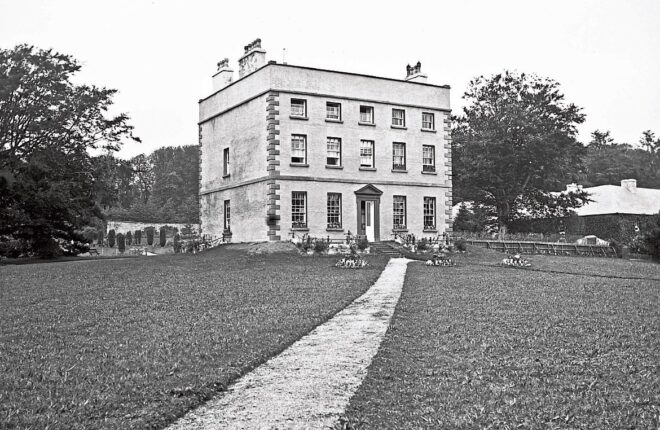
Back in the 1600s, Alexander Cunningham settled at what is now Mountcharles, in a home that was rebuilt a century later as Mountcharles Hall.
James was for a while the most industrious: by 1614 he had 29 tenant families on the land, including 80 armed men capable of defending the estate. But his old Scottish creditors finally caught up with him, and he lost his land in stages after 1623, selling it off to clear his debts.
James returned to Scotland financially ruined, dying in the 1620s. John managed his estate successfully until his death in 1644; his branch of the family became the “root” of the Cunninghams in the Laggan.
All these early settlements were tested during the 1641 rebellion. The men of the Cunningham and Stewart settlements formed much of what became known as the Laggan Army — mounted regiments commanded by Stewarts, who defeated the rebel forces at the Battle of Glenmaquin, protecting their settlements and others nearby (they also fought at Scarfihollis in 1650).
Meanwhile, a different strand of the family took root elsewhere in the county: Alexander did not come here as Undertaker but as a religious minister, and he changed the spelling to Conyngham, believing it to be more elegant.
He was appointed the first Protestant minister of Inver in 1611, and to the deanery of Raphoe in 1630. Alexander settled at what is now Mountcharles, in a home that was rebuilt a century later as Mountcharles Hall. His poor wife Marion (from the Murray family) gave birth to 27 children (that’s not a typo), of whom four sons and five daughters survived infancy.
One of those sons was Sir Albert, Lieutenant-General of the Ordnance in Ireland who fought for William III at the Boyne. It was Albert, knighted in 1666, who kickstarted the family’s social ascent here.
Along the way there were interesting figures. William Burton Conyngham (1733–1796) developed the fishing village of Burtonport (it’s named for him). Henry Conyngham was created Baron in 1753 and Earl in 1781. His nephew Henry was created Marquess Conyngham in 1816, and that Henry’s wife Elizabeth became the last mistress of King George IV, securing the family’s position in the British establishment – to the degree that, when the King died, it was Henry who told the young Princess Victoria that she was now Queen.
For people living on their lands (at their peak they owned over 120,000 acres in Donegal alone) the Marquesses were not beloved. The town of Glenties was developed as the first Marquess’s summer home, but he was rarely there; in 1845, The Times said the same about the second Marquess (Francis), describing Glenties as a place where “nothing is to be found but poverty, misery, wretched cultivation, and infinite subdivision of land.”
In 1846, hit by the Famine, Francis tried to halve the population and save money: he announced that only those who could prove they paid rent for their land could stay there; the rest could either go to America on a ship provided, or enter the new workhouse.
Still, their impact was not all bad: their house is still occupied, and the Courthouse and Market Hall are both still there (the Highlands Hotel is built over what was once their huntingfishing lodge).
Going back a little to trace another interesting line, it was Albert’s son Brigadier-General Henry Conyngham who bought Slane Castle in 1703. But they didn’t fully move in for over a century: they kept their wealth base in Donegal, and from roughly 1820 to 1830, the family essentially lived in Windsor Castle at the King’s expense, influencing political appointments (this was while Elizabeth Conyngham was famously the King’s “favourite”).
They were controversial, and sometimes accused of looting the Royal wealth. When George IV died in June 1830, his successor, William IV, soon kicked them out. That’s when they moved to Slane, prompting several famous cartoons mocking them: “A Moving Scene on the Road to Slane” shows them fleeing Windsor with wheelbarrows full of “stolen” royal treasures.
But the family still owns Slane Castle. In fact the Conyngham name survives chiefly through it – it’s currently owned by Alexander, the 9th Marquess, son of Henry who famously turned Slane into Ireland’s most celebrated concert venue.
Their family name is still Conyngham, but their title is still Earl Mountcharles (though they’re habitually called Lord Mountcharles) – and now we know why.
It’s also worth mentioning Gustavus Conyngham, another descendant of Alexander (the first Conyngham) who was born near Downings in 1747. He emigrated to Philadelphia in 1763, becoming a skilled-enough mariner that, during the American Revolution, Benjamin Franklin personally commissioned him as a Captain in the Navy.
Operating from France, Gustavus became known as “The Dunkirk Pirate,” capturing or sinking over sixty British vessels and paralysing trade in British waters.
Despite his success, he was captured, treated as a pirate, and narrowly escaped execution. He spent his final years in Philadelphia seeking government recognition for his service. He was unsuccessful while alive, but since 1900 three US battleships have been named in his memory.