
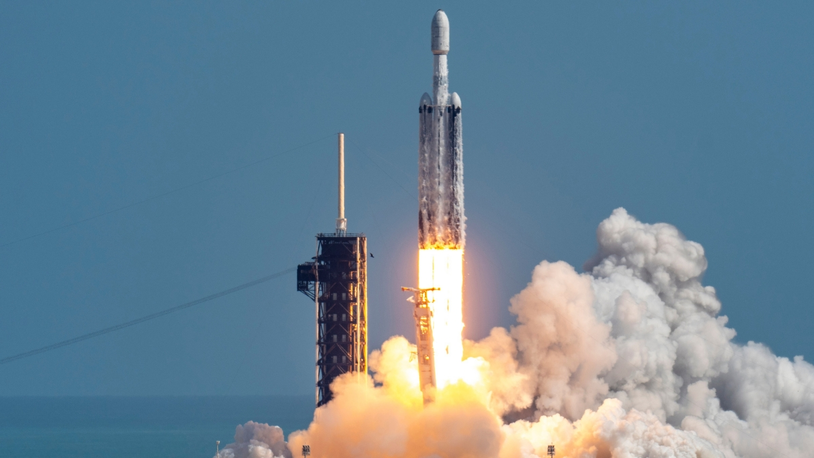
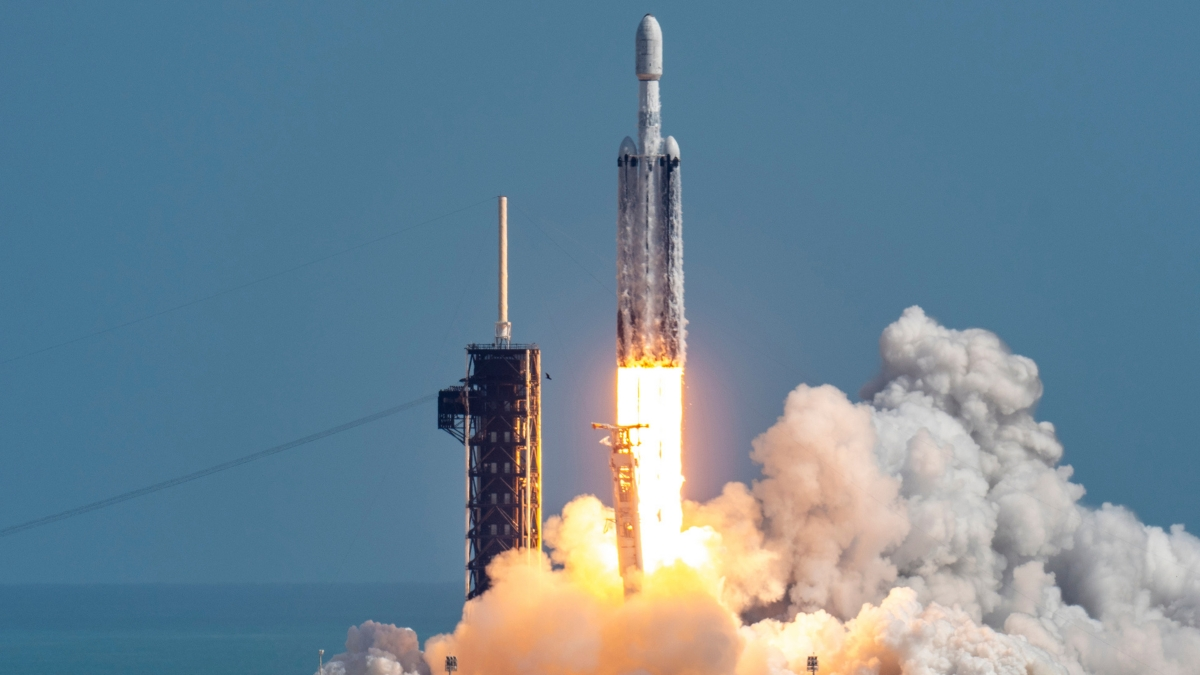
ViaSat-3 F3 was launched on a SpaceX Falcon Heavy rocket in April 2026 (source: Viasat)
05 May 2026by Martyn Wingrove
Elon Musk’s SpaceX launched the ViaSat‑3 F3 satellite from Florida, US, supporting Viasat’s drive to increase communications capacity over key shipping lanes and offshore areas
Inmarsat Maritime’s capacity to provide high-speed connectivity to ships in the Asia-Pacific (APAC) region will be enhanced in Q3 2026 when Viasat’s latest geostationary satellite enters service.
SpaceX launched the ViaSat‑3 F3 satellite on its Falcon Heavy rocket from the Kennedy Space Center in Florida, US, on 28 April to support Viasat’s drive to increase communications capacity over key shipping lanes and offshore areas in APAC.
ViaSat‑3 F3 is designed to deliver 1 terabits per second (Tbps) of throughput capacity for high-speed connectivity to ships via its subsidiary, Inmarsat Maritime’s NexusWave communications services.
NexusWave provides vessels with unlimited data, always-on connectivity and unlimited back-up over a secure, bonded network infrastructure that will be enhanced with ViaSat-3.
ViaSat‑3 F3 has an innovative Ka-band payload design and advanced beam‑forming technology to optimise and steer connectivity capacity in real time, enabling bandwidth to be concentrated where demand and returns are highest, said Carlsbad, California-headquartered Viasat.
When it comes online in September 2026, this will complete the ViaSat‑3 satellite constellation, which covers most of the world except the polar regions, with high-speed Ka-band connectivity.
ViaSat‑3 F1 has been in service since 2024, and ViaSat‑3 F2 will soon be ready after completing in-orbit testing.
“ViaSat-3 F3 will provide greater resilience for government and commercial mobility users, leveraging powerful beamforming capabilities to quickly deliver bandwidth in and around geopolitical and other hot spots,” said Viasat chairman and chief executive Mark Dankberg.
Following its successful launch, ViaSat-3 F3 will deploy its solar arrays and begin navigating to its final geostationary orbital location, undergo final deployments, including its reflectors, before in-orbit testing and network integration.
ViaSat 3 is part of Viasat and Inmarsat’s long-term investment to expand and enhance their constellations in geostationary orbit, with KA-Sat-1 and ViaSat-1 in service since 2012, and ViaSat-2 since 2018.
Inmarsat’s Global Xpress (GX) Ka-band satellites came online as the I-5 constellation between 2014 and 2020, followed by GX10A and GX10B satellites in highly elliptical orbits in 2025.
Its L-band satellites include four I-3 units providing maritime safety communications since 1996, and four I-4 satellites delivering back-up connectivity since their commissioning in 2005 to 2013.
The next investments are three more GX satellites and an I-8 constellation of geostationary satellites for higher-speed L-band services, with the launches yet to be scheduled.
Sign up for Riviera’s series of technical and operational webinars and conferences: