
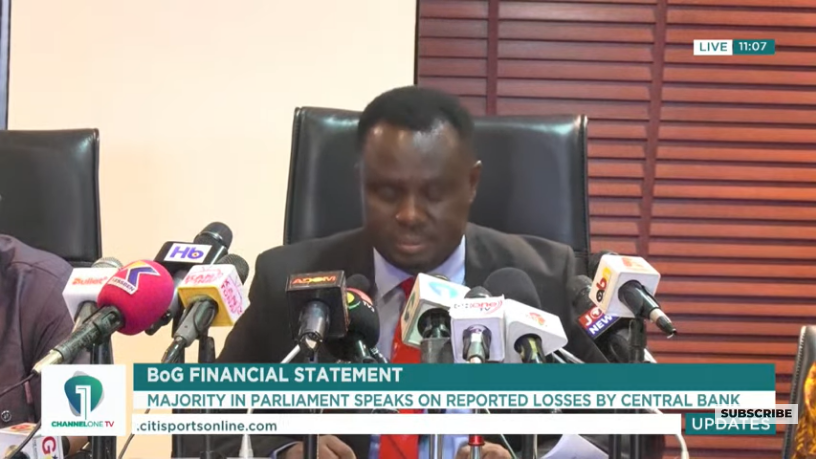
The Majority in Parliament has defended the Bank of Ghana’s 2025 financial results, insisting that the central bank’s reported losses reflect the cost of stabilising the economy rather than signs of financial weakness.
Addressing a press conference in Accra on Tuesday, May 5, the Member of Parliament for Amenfi West and Chairman of Parliament’s Economic and Development Committee, Eric Afful, said the Bank’s negative equity position should not be misconstrued as insolvency.
“Negative equity in central banking is an accounting condition, and does not imply insolvency. Central banks are not profit-maximising institutions like commercial banks; rather, they are stabilising institutions. Simply put, the Bank’s balance sheet reflects the cost of stabilising the economy during the period of severe economic distress,” he said.
The Bank of Ghana’s 2025 financial statements show a significant operating loss and a widening negative equity position, developments that have triggered intense public debate and criticism from sections of the opposition and policy analysts.
The Bank of Ghana (BoG) has posted a GH¢15.63 billion loss for the 2025 financial year. This is a sharp deterioration from the GH¢9.49 billion loss recorded in 2024. The roughly 65% year-on-year increase comes at a time when key macroeconomic indicators particularly inflation and exchange rate volatility have stabilised.
Consequently, the balance sheet of the Bank has weakened further, with negative equity widening to GH¢93.82 billion.
However, the majority maintained that such outcomes are not unusual in periods of aggressive monetary tightening, pointing to global precedents.
“Indeed global experience shows that major central banks including the European Central Bank, the United States Federal Reserve and the Reserve Bank of Australia have recorded losses during periods of aggressive policy tightening like what we had in Ghana whilst achieving their policy objectives. What matters most is the outcome of the policy,” Eric Afful said.
He argued that the effectiveness of the Bank’s interventions should be assessed based on macroeconomic outcomes rather than financial statements alone.
“On this front, the evidence is clear. In that inflation is down to single-digit, exchange rate has stabilised and strengthened, reserves have increased significantly, interest rates are easing, credit conditions are improving and economic growth is robust,” he added.
The Majority’s defence comes amid ongoing scrutiny of the central bank’s operations, particularly the cost of liquidity management, foreign exchange interventions, and gold-related transactions, which have contributed to the reported losses.
Mr Afful said while concerns about efficiency and transparency remain valid, the broader context of economic recovery must be taken into account in evaluating the Bank’s performance.
He emphasised that the primary mandate of the Bank of Ghana is to maintain price and financial stability, not to generate profits, and that recent policy measures have played a critical role in restoring confidence in the economy.
The press conference forms part of efforts by the Majority to counter what it describes as misinterpretations of the Bank’s financial position, as debate continues over the sustainability and long-term implications of current monetary policy choices.