
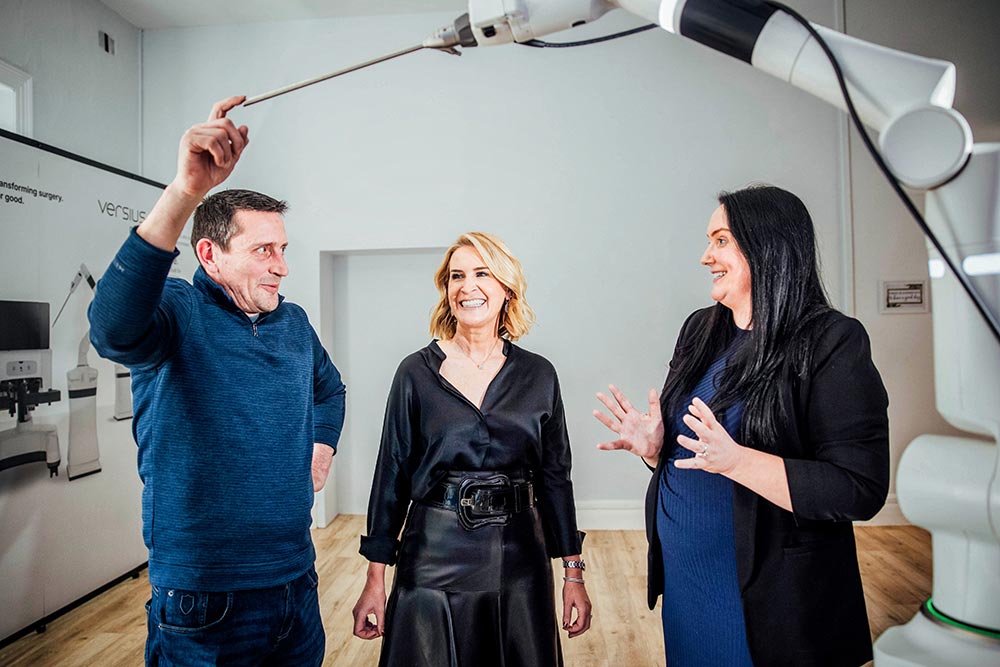
A well known Miltown Malbay Gaelic football referee hit the net in medical terms after becoming the first patient to undergo a robotic-assisted procedure at St John’s Hospital Limerick recently.
Barry Kelly, (49) has outlined the shorter recovery times as one of the main benefits of a robotic inguinal hernia repair, which was carried out by Professor Christina Fleming after he had received a general anaesthetic on January 28, 2026.
Mr Kelly was delighted to avail of this robotic surgery after being informed it would result in quicker recovery and less scarring on his stomach.
In an interview with the Clare Champion, Mr Kelly recalled robotic surgery is not as invasive as there was a much smaller incision of less than a half an inch on both sides of his stomach.
“The robot was used to do the whole operation. Christina Fleming was in the same room with a television screen and controlled the two operating arms from where she was sitting.
“There are three arms operating off the robot. The middle one goes into your belly button, which has a camera. The other two arms are used to do all the operating. The robotic arm can turn 360 degrees to tie up the knot, which a surgeon wouldn’t be able to do that way.
“The robotic arm can get into different angles where a surgeon wouldn’t be able to do. The arm can turn, move and pivot. It can tie up a knot straight away.
“My operation only took 50 minutes, it would normally take about 90 minutes. The operation took place at 9am and I was at home again at 7pm.
“I would recommend it and go back for a second one. It is great to get out of hospital quickly and free up beds for people who need them.”
Having watched how robotic surgery works at an open day in St John’s Hospital on Thursday, Mr Kelly described advances in modern technology as a bit “weird” but very effective. Working as a deputy manager at Aldi in Ennistymon, getting shorter recovery time was a key consideration in choosing robotic surgery.
“When I first met Christina, she explained to me the various options we had for surgery and ran me through the risks and complications. She recommended the robot as possibly the best way forward and I said: ‘We might as well have a go’. But once she said I would be the first one done in St John’s, I said ‘we’ll definitely have a go so’. The Clare lads like to get in first,” recalled Mr Kelly.
“Robotics and technology is the way forward. The main benefit for me was I was out quicker. I was actually home on the same day. That’s how good it is. I was back as a GAA referee six weeks later,” he said.
The Kelly family have made a huge contribution to Clare sport, with brothers Gordon and Graham lining out for the senior intercounty football team and sister Diane winning a Munster Ladies Football title in 2001 and an All-Ireland medal with St Joseph’s Secondary School in 1996.
With a Gaelic football career lasting 17 years, Mr Kelly recalled Kerry football legend David Clifford has described Gordon as one of his toughest opponents.
Graham Kelly’s daughter Abi lined out as a winger for the Ireland U-18 Ladies rugby team in the Six Nations.
Barry Kelly’s niece, Mia, won a gold medal in the All-Ireland 600 metres final recently.
St John’s is the first model 2 hospital in Ireland to offer robotic procedures and the first hospital in Ireland using this particular console/system.
Capital costs have been met through Mid-Western Hospitals Development Trust and JP McManus Pro-Am 2022.
Twelve patients have had procedures to date, with the hospital initially focusing on general surgery and colorectal patients and with plans in place to shortly expand to gynaecology and urology patients.
Designed to enhance surgeons’ capabilities by mimicking the human arm, Versius features fully wristed instruments that provide surgeons and surgical teams the freedom to perform complex procedures. Its compact, modular design makes it portable between operating rooms and flexible to set up. By enabling more procedures to be performed via keyhole surgery, Versius should enable a number of benefits including reduced pain, shorter hospital stays, and faster recovery times.
Prof J Calvin Coffey, Foundation Chair of Surgery at the University of Limerick School of Medicine and general and colorectal surgeon, has pioneered the delivery of robotic-assisted surgery for patients in the Mid-West since 2016.
“Until now, robotic surgery has largely been reserved for long, complex procedures in major university hospitals. However, the majority of operations are shorter and less complex. The introduction of Versius changes that. It brings the benefits of robotic precision—smaller incisions, faster recovery, earlier discharge—to a much broader group of patients. In practical terms, it means more people can return to their families and normal lives sooner.”

East Clare correspondent, Dan Danaher is a journalism graduate of Rathmines and UL. He has won numerous awards for special investigations on health, justice, environment, and reports on news, agriculture, disability, mental health and community.