
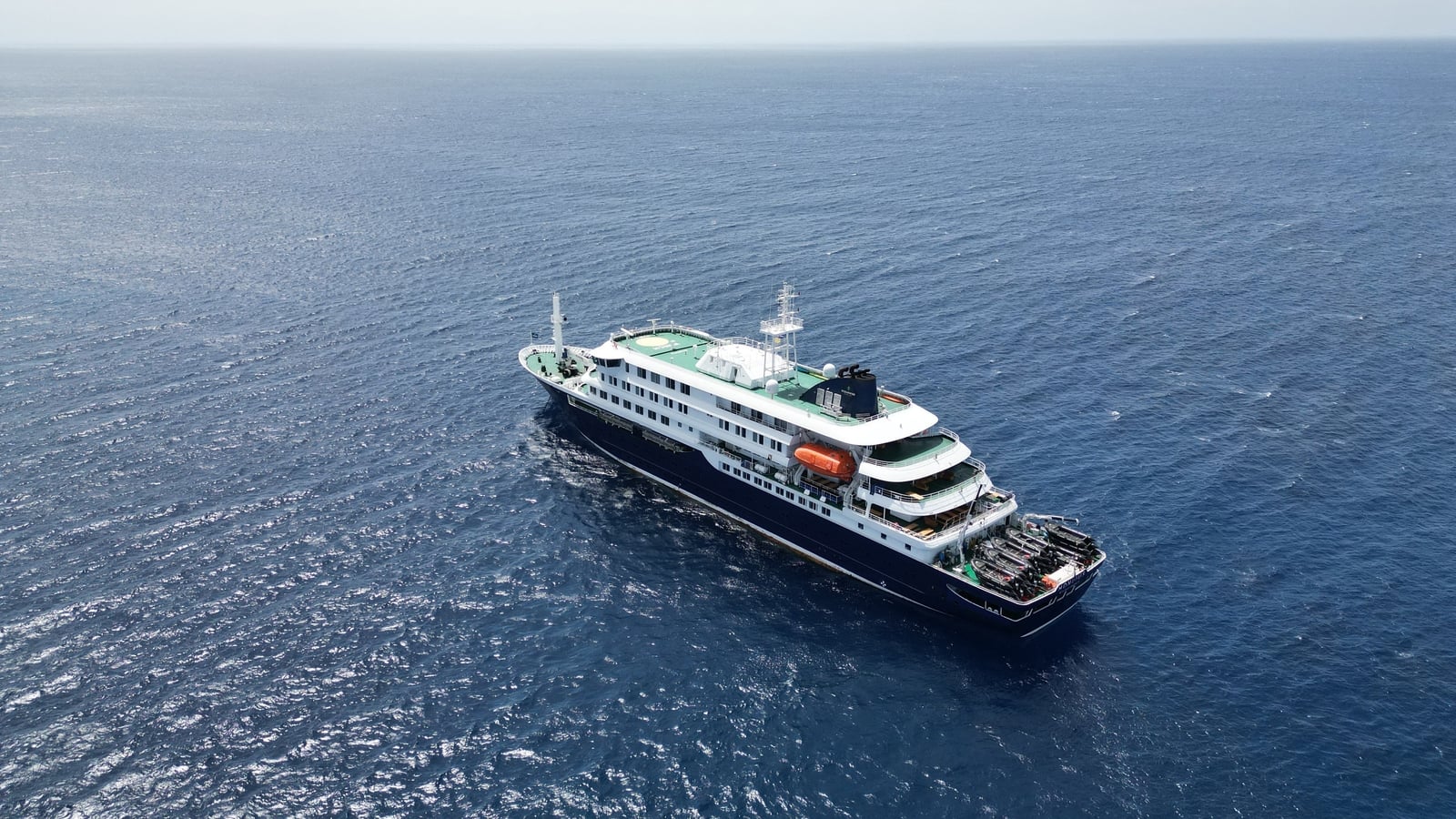
The regional government of Spain’s Canary Islands is opposed to allowing a luxury cruise ship that has been hit by an outbreak of the deadly hantavirus to dock on the archipelago, its leader Fernando Clavijo has said.
“This decision is not based on any technical criteria, nor is there sufficient information to reassure the public or guarantee their safety,” Mr Clavijo told radio station COPE.
He added that he had requested an urgent meeting with Prime Minister Pedro Sánchez to discuss the issue.
Mr Clavijo belongs to the conservative People’s Party, the main opposition to Mr Sánchez’s Socialists.
Earlier, Spanish state broadcaster TVE reported the cruise ship was set to dock at the Canary island of Tenerife, citing sources from the country’s health ministry.
The ship, the MV Hondius, was preparing to travel from Cape Verde towards Europe after the Spanish government gave permission for it to dock in the Canary Islands.
Read more:
What is hantavirus and how deadly is it?
Timeline of events on board MV Hondius
The MV Hondius has been at the centre of an international health scare since Saturday, when the WHO was informed that the rare disease, usually spread from infected rodents typically through urine, droppings and saliva, was suspected of being behind the deaths of three of its passengers.
As others fell ill, passengers and crew have been in isolation after Cape Verde authorities barred the ship from docking.
The ship is anchored just off the island nation’s capital Praia.
Two Irish people are among the passengers on board the ship.
Three people – two crew members and one other person – thought to be infected with the virus were being taken off the MV Hondius, the World Health Organization said.
“The three of them are stable, and one of the three is asymptomatic,” Ann Lindstrand, the WHO representative in Cape Verde, said.
The WHO was trying to work out how hantavirus had appeared on the ship, with the first person who died having developed symptoms on 6 April.
Human-to-human transmission has only been reported in previous outbreaks of one specific hantavirus called Andes virus, which circulates in South America.
Human-to-human hantavirus strain confirmed in cruise passenger – South Africa
The Andes strain of the hantavirus that is transmissible between humans has been confirmed in a passenger evacuated to South Africa from the cruise ship, the health minister has said.
“The preliminary tests show that, indeed, this is the Andes strain,” South Africa’s health minister Aaron Motsoaledi told a parliament committee. “And it happens to be the only strain out of the 38 that is known to cause human-to-human transmission,” he added.
Tests carried out by South Africa’s National Institute for Communicable Diseases (NICD) revealed that the Andes strain was the cause of infection in a Dutch woman who died in Johannesburg, and a British man who is still in hospital. Both had become ill on the ship.
“This is the only strain that is known to cause human-to-human transmission, but such transmission is very rare and as said earlier, only happens due to very close contact,” it said.
Other strains of hantavirus are more commonly transmitted to humans through contact with infected rodents or their urine, droppings or saliva.
Cruise ship passenger with hantavirus being treated in Zurich: ministry
Meanwhile, a former passenger on MV Hondius is being treated in a Zurich hospital for the virus, the Swiss health ministry said.
“One person has tested positive for hantavirus in Switzerland,” said a ministry statement, adding that the man was being treated at the University Hospital Zurich (USZ).
The ministry stressed that the hospital was “prepared to deal with such cases, is able to care for the patient, and guarantee the safety of staff and all patients”.
“There is currently no risk to the Swiss public.”
According to the statement, the man returned from a trip to South America with his wife at the end of April, “after travelling on the cruise ship on which there were a number of hantavirus cases”.
The Swiss ministry did not say when the man being treated in Zurich had left the ship.
It said he had “noticed symptoms” after returning, and had contacted his doctor and then had gone to the USZ for further assessment.
“A test that was carried out at the reference laboratory at the Geneva University Hospitals (HUG) revealed a positive result for hantavirus,” it said, adding that “it concerns the Andes virus” – the only strain of hantavirus that can be passed between humans.
It stressed that “transmission only occurs through close contact”.
The ministry said it “therefore considers the occurrence of further cases in Switzerland unlikely” and the patient’s wife had not shown symptoms, but was “self-isolating as a precaution