
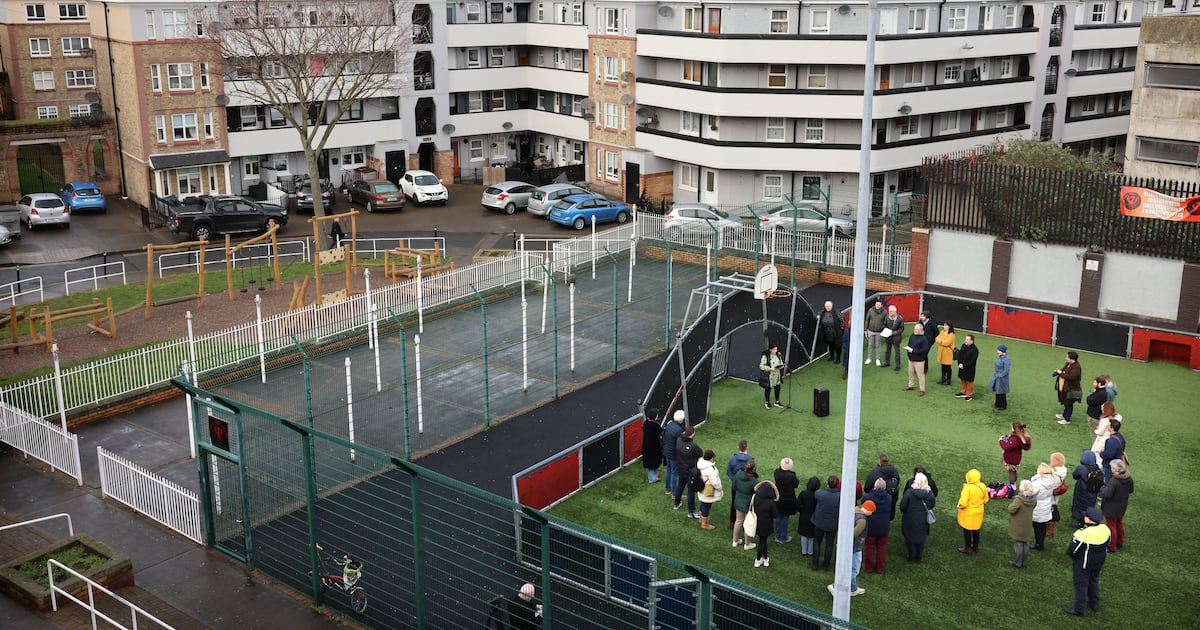
The regeneration of Oliver Bond House – one of the largest, oldest and most dilapidated flat complexes in Dublin city – has been stopped by the Department of Housing, councillors have been told.
Four years ago, Dublin City Council was sanctioned by the department to begin designing new homes for tenants of the near-400-flat complex. Smaller flats would be amalgamated to make larger homes.
There are 391 flats spread across 14 blocks in the southwest-inner-city complex, which was completed in 1936.
The flats have been plagued with social and structural problems for decades, with residents enduring damp, mould and sewage problems, as well as frequent rat infestations. Tenants have also persistently complained of open drug dealing in the complex.
The council was to submit a planning application for the first phase of redevelopment in October. It was envisaged that construction would start in 2028, with completion in 2030. However, it is understood tenants will be told on Wednesday that the Department of Housing has withdrawn approval for the scheme.
Oliver Bond House is one of a small number of flat complexes built in the 1930s by renowned city architect Herbert Simms. The complex, and others such as Pearse House and Markievicz House, are protected structures and cannot readily be demolished and rebuilt to modern living standards.
With this in mind, the council set about undertaking a “deep retrofit” and amalgamation programme where existing flats, which do not meet size standards, would be combined to make a smaller number of larger homes. The number of flats would be reduced by about a third, but there would not be a commensurate reduction in bed spaces as duplication of kitchen or bathroom facilities in the amalgamated flats would not be required.
Concerns emerged over the amalgamation programme last year when the department withdrew sanction for the Pearse House project because of the reduction in the number of flats. Earlier this year, the department approved a scaled-down project involving the upgrade of the Pearse House flats without increasing their size.
Labour councillor Darragh Moriarty said this approach would not be suitable for Oliver Bond House as it would leave the complex with large numbers of single-person flats that were unsuitable for families.
“This is a devastating and cruel decision,” he said. “These flats are tiny and in horrendous condition. The residents have been promised a full regeneration and the Taoiseach himself has committed to that.
“This is disgusting and gut-wrenching, just because the Minister [for Housing] James Browne wants to maintain the optics of delivering more housing units. We will be working cross-party in the council to bring about a reversal of this decision.”
[ Oliver Bond House residents more than twice as likely to have asthmaOpens in new window ]
Sinn Féin housing spokesman Eoin Ó Broin said it was an “appalling and unacceptable” decision.
“For the Minister to refuse this on the spurious grounds that it will lead to a reduction in units completely misunderstands the problem. The only way this flat complex can be brought up to legally required minimum standards is through deep retrofit and amalgamation. There is no other way,” he said.
“The consequence of this decision, if it stands, is that this complex will not see adequate refurbishment and regeneration for a very long time.”
The department and the council have been asked for comment.
Dublin City Council was the subject of a ruling from the European Committee of Social Rights in 2017 over the poor condition of some of its older flat complexes. The Strasbourg-based committee found the human rights of tenants had been breached because of a failure to provide them with adequate housing.