
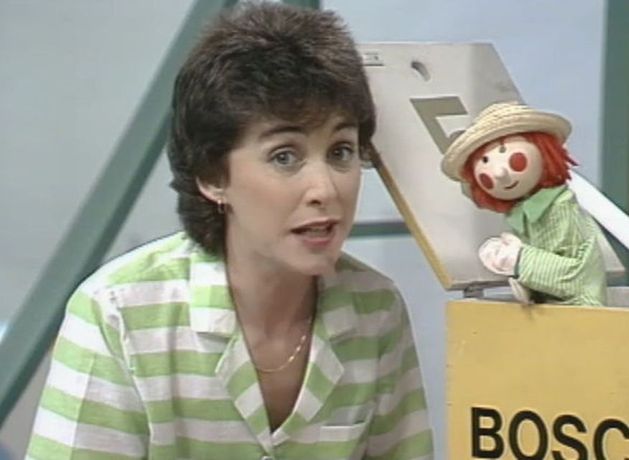
Seán Bán Breathnach, the host of the Irish-language SBB ina Shuí, described her as a “natural”, saying “we were a match made in heaven”.
Gráinne Ní Eifearnáin was one of a family of four, reared in an Irish-language speaking household in Drumcondra, Dublin.
After attending Maryfield College, she studied at the College of Marketing and Design.
She met her future husband, teacher and historian Séamas Ó Maitiú, on hill walks with an Irish language club based in Wicklow.
In the summer of 1973, she went to New York with her friend, Una O’Keeffe, and they found work in a restaurant near Central Park. The two young women were planning a tour of the country before returning home and were offered the same by a very drunk customer one night.
They said they might consider it if he returned “sober and with flowers”, which he did. By then, their colleagues had informed them he was singer- songwriter Harry Nilsson.
Her television career started by accident when Ó Maitiú was invited on SBB ina Shuí, but asked her to go instead
The pair took off with him in a hired car and Ó Maitiú got a call from her one evening from the presidential suite in Washington’s Watergate Hotel. With Nilsson, the women visited John Denver’s home in Colorado and flew over the Grand Canyon in a plane. When they got to Las Vegas, Nilsson rang Elvis Presley. He was away, so they stayed in Liza Minelli’s apartment.
When Uí Mhaitiú returned home, she left one of her travel bags with O’Keeffe in the US. O’Keeffe took it with her to London when she and Nilsson stayed at Ringo Starr’s apartment. The next morning, the Beatles drummer spotted the bag, was alarmed at the Irish name and address on the name tag, and called the police.
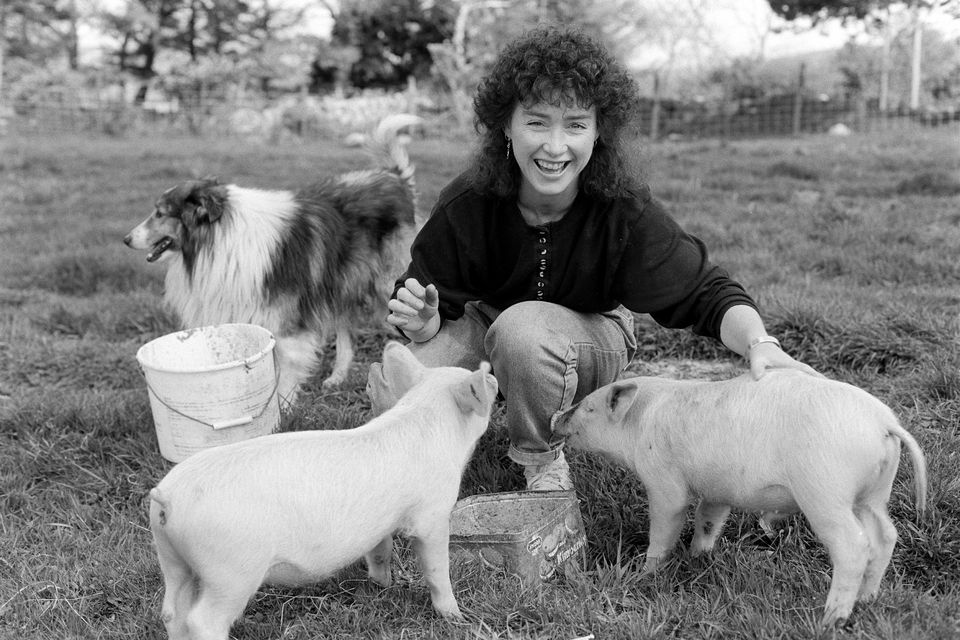
Gráinne Uí Mhaitiú feeding piglets on her Co Wicklow farm in May, 1993. Photo: RTÉ
After graduation, Uí Mhaitiú used her artistic talents, designing book and album covers. She also helped Ó Maitiú produce Mahogany Gaspipe, an Irish-language magazine for teenagers that he launched in 1980.
Her television career started by accident when Ó Maitiú was invited on SBB ina Shuí, but asked Uí Mhaitiú to go instead.
Producer Brian Eustace spotted her talent and offered her an opportunity to present the programme with Breathnach, who would go on to introduce her as “Gráinne Gleoite”.
We never fluffed our lines, we enjoyed it, and Gráinne had no ego
“When we were upgraded to a 6.30pm slot, we hit an audience of 600,000 and Liam Ó Murchú, then editor of Irish-language programmes, came in with a big box of chocolates,” Breathnach said.
“We never fluffed our lines, we enjoyed it, and Gráinne had no ego.
“Some senior management decided to watch us one night and asked where our autocue was. Gráinne had to explain to them the autocue was in our heads.”
He remembers how worried she was about him when they had a stunt team on the programme.
“I had to lie between a bed of nails and a plank, and stuntman Paschal Whelan drove over me on a motorbike,” he said. “Gráinne said she couldn’t bear to watch it.”
When Uí Mhaitiú moved to Bosco, she starred alongside the five-year-old pint-sized puppet as one of a roster of presenters.
Uí Mhaitiú made headlines for reasons apart from her television career when a waitress asked her to stop breastfeeding her baby daughter, Aoife, in the RTÉ canteen. This prompted letters of support to her from women all over the country.
She was said to love nothing more than curling up with a good book by the stove
In 1985, she and Ó Maitiú bought a derelict cottage with 20 acres near Valleymount in Co Wicklow. As Aoife recalled at her mother’s funeral, the “pair of hippies from Rathmines and Drumcondra” had a four-year-old and a newborn at the time.
They lived initially in a mobile home, acquiring pigs, goats, ducks, geese, a pony, a donkey, two beehives, and a Jersey cow from the Bewley family herd. They opened an educational farm, and Uí Mhaitiú made butter, jam and bread for visiting schoolchildren.
An Bóithrín Cam, as it was called, featured on the RTÉ Irish-language current affairs television programme Cúrsaí in May 1993.
Her home became a “colourful work of art”, in her daughter’s words, and she took up and taught basket-making — a skill that was in her family. One of her baskets was encased in bronze for the famine memorial created by sculptor Éamonn O’Doherty in Westchester, New York.
Remembered for her independence, creativity, sense of humour, and grá for adventure, she was said to love nothing more than curling up with a good book by the stove.
Gráinne Uí Mhaitiú is survived by her husband Séamas, son Connla, daughter Aoife, sisters Bríd and Aislinn, brother Cillín, son-in-law Jarlath, and grand-daughters Bláithín and Sadhbh.