
Plants have been cloning themselves for millions of years. Strawberries send out runners, potatoes sprout new shoots, and mosses spread across damp ground without ever producing seeds.
Yet scientists still could not pinpoint the single genetic switch that tells a plant when to start making a copy of itself.

Now, researchers studying a humble liverwort growing on sidewalks and garden walls say they have finally found that switch.
By turning one gene off, the plant stopped cloning entirely. By turning it back on, scientists could trigger the whole process on command.
Studying liverwort plants
A team led by Yuki Hirakawa, a professor at Hiroshima University in Japan, zeroed in on a small green plant most people walk past without a second look.
The common liverwort, Marchantia polymorpha, sprawls across damp sidewalks and shady garden corners throughout the Northern Hemisphere. Its body, called a thallus, hugs the ground and looks like flattened green ribbon.
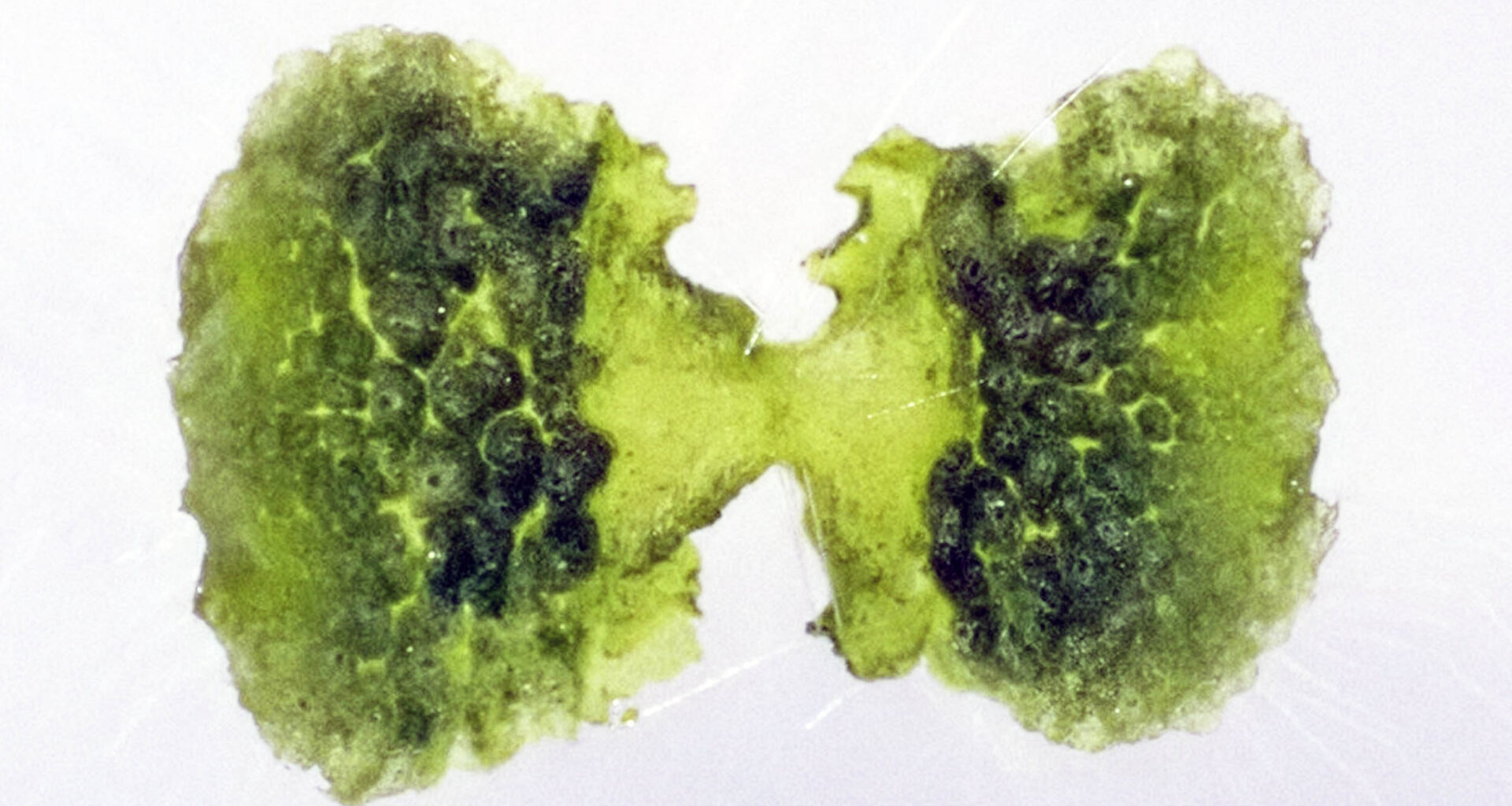
Tiny disc-shaped clones grow inside small green cups along its surface. These are gemmae. A raindrop hits a cup, splashes one out, and a whole new liverwort takes root inches away.
Why other plants failed
Most plant studies use Arabidopsis thaliana plants, which are small mustard relatives that has been the field’s lab favorite for decades. One thing it has never done: clone itself. That left a gap.
Asexual reproduction, or cloning, happens across the plant kingdom – in potatoes, strawberries, ginger, dandelions, and the sucker shoots from a maple stump.
A recent paper describes its reach. Yet the standard genetic toolbox could not pry the process open.
Hirakawa’s team picked liverwort precisely because the plant clones itself in plain view, on a regular schedule. It also carries a small, well-mapped genome, which makes targeted experiments straightforward.
Plants and their GEMMIFER gene
Earlier work from the same group had pointed at a hormone-like signal called CLE peptide, which seemed to suppress cloning in the liverwort. Useful, but indirect.
When the team looked at which genes changed activity in response to that signal, a short list of candidates emerged.
One stood out, and they named it GEMMIFER, after the gemmae it appeared to control. Plain biology, plain naming.
To test whether GEMMIFER does the work, Hirakawa’s team used CRISPR-Cas9 genome editing to knock the gene out.
They followed up with a different gene-silencing approach, using RNA molecules to suppress it a second way.
Both routes gave the same result: the plants stopped producing gemma cups entirely. No cups, no clones, no spread.
Without GEMMIFER, the liverwort still grew normally as a single body, but it had lost the ability to copy itself.
Turning cloning back on
Knocking the gene out was only half the question. The team next built a modified strain of liverwort with a chemical trigger – a steroid called dexamethasone that flips GEMMIFER on whenever researchers choose.
A short, strong pulse of the steroid produced a striking change at the meristem, the small region of dividing cells at the plant’s growing tip. Specialized appeared where ordinary tissue had been a day before.
A separate study mapped how those cell identities normally organize in gemma tissue.
Here, the new cells matured into gemmae, detached, and grew into fresh plants on their own – the entire cloning sequence run by a single gene.
 Induction of gemma (clonal propagule) formation via the activation of the plant’s GEMMIFER gene used for asexual reproduction, or cloning. (left) Whole plant image. (right) Magnified view of gemmae forming on the plant surface. Credit: Yuki Hirakawa / Hiroshima University. Click image to enlarge.Plant cloning pathway
GEMMIFER does not work alone. It works together with a second gene that earlier research had linked to gemma formation. Switch on GEMMIFER. That partner gene fires up in response, apparently launching the cloning process.
The chain now runs end to end – from the suppressing hormone, through GEMMIFER, into GCAM1, and on to a new individual.
Hirakawa’s group worked with collaborators at the University of Cambridge and other institutions to fill in the picture.
“The precise way this gene reprograms cell fate is still not fully understood,” Hirakawa said, noting that other plants carry similar genes whose functions remain unclear.
Plants, GEMMIFER, and future study
The GEMMIFER findings come from liverwort alone, and whether similar genes in crop plants perform the same function remains untested.
That question, along with the exact molecular steps connecting GEMMIFER to new clone formation, remains open.
Until this study, no one had identified a single plant gene that could both start and stop asexual cloning on its own. GEMMIFER does both: switch it off and cloning stops; switch it on and the whole sequence runs.
That has real implications for crop science. Farmers rely on cloning to grow bananas, sugarcane, and fruit trees. A switch like GEMMIFER – or its counterparts in food crops – gives breeders a concrete genetic target to study.
It also closes a longstanding blind spot in plant biology. Liverwort is no longer a curiosity tucked into a corner of the field. A review of the species tracks its quiet rise as a model organism over the past decade.
“The fact that we couldn’t observe this in traditional model plants didn’t mean it wasn’t happening elsewhere in nature,” Hirakawa said. “This discovery reminds us of the vast biological secrets still waiting to be uncovered.”
The study is published in Current Biology.
—–
Like what you read? Subscribe to our newsletter for engaging articles, exclusive content, and the latest updates.
Check us out on EarthSnap, a free app brought to you by Eric Ralls and Earth.com.
—–