
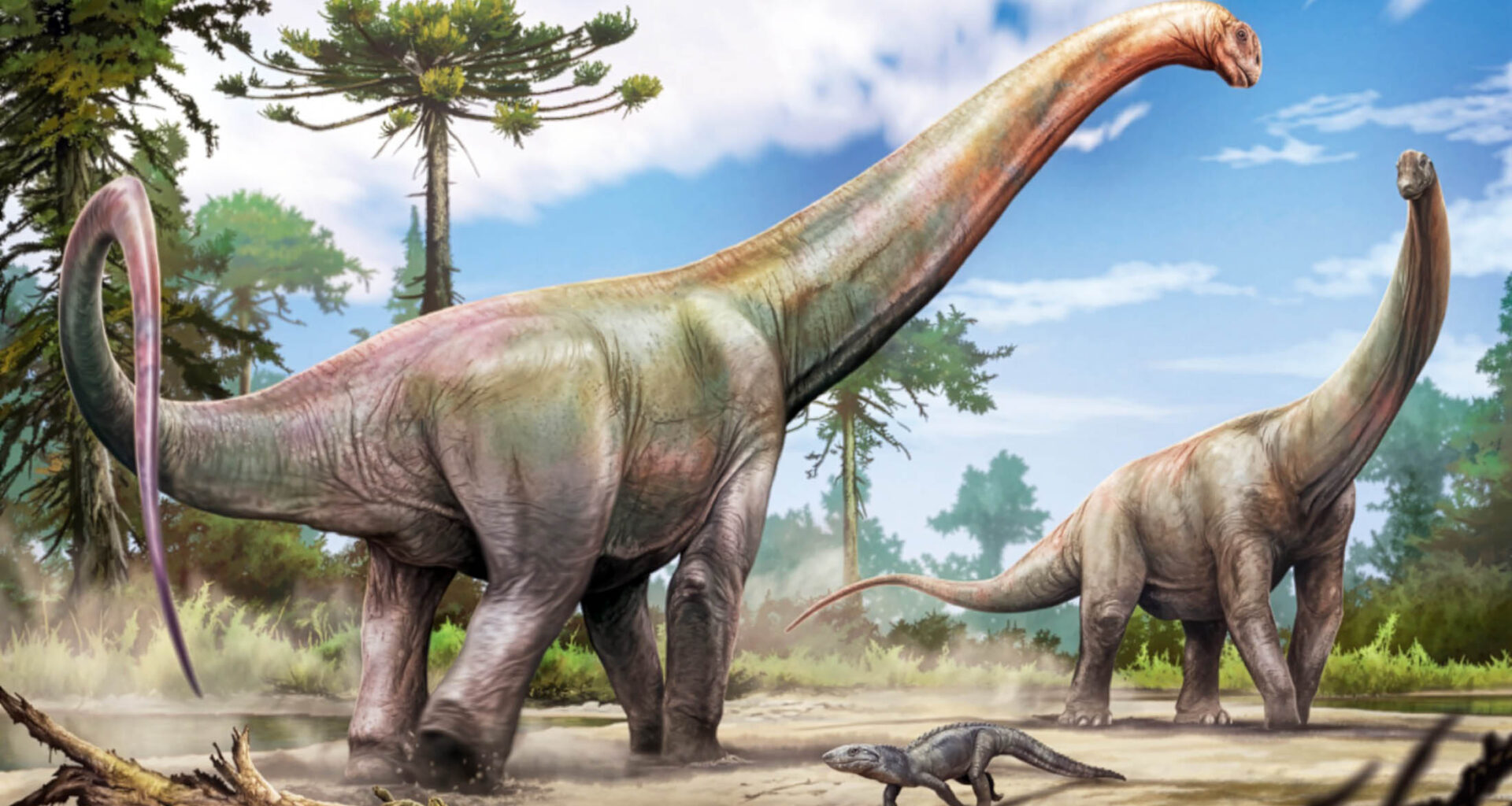
Workers building a road-rail terminal in northeastern Brazil never expected to uncover the fossils of a massive dinosaur beneath the dirt and concrete.
The fossils were discovered nearly 26 feet underground.

At first, the archaeologists wondered whether the bones could have been those of a huge prehistoric animal that roamed Earth at the time as early humans.
However, the depth of the fossils suggested otherwise.
These bones dated from an era much more ancient than that of either mammoths or humans. It was the time when dinosaurs existed.
A dinosaur that stands out
The dinosaur is now known as Dasosaurus tocantinensis, a newly identified species described as stretching about 65 feet long.
Elver Luiz Mayer is a professor at the Federal University of the São Francisco Valley (UNIVASF) in the state of Bahia.
“It’s the largest known dinosaur for Maranhão, which has other species, but not sauropods like this one; rather, it has smaller ones, such as the diplodocid Amazonsaurus maranhensis, which was about 10 meters long,” said Professor Mayer.
An ancient traveler between continents
Dasosaurus tocantinensis belonged to a group called sauropods, the long-necked plant-eating dinosaurs that included some of the biggest animals to ever walk on land.
These dinosaurs had small heads, thick legs, and tails powerful enough to balance their enormous bodies.
What makes this discovery especially interesting is where the dinosaur’s closest known relative lived.
According to researchers, the nearest match comes from what is now Spain. That detail points to a much bigger story.
Continents connected by land routes
During the Early Cretaceous period, the continents looked very different.
South America, Africa, Antarctica, Australia, and India were still connected as part of Gondwana. Europe was a chain of islands.
Scientists believe the ancestors of Dasosaurus tocantinensis likely moved from Europe into Africa and eventually into South America between 140 and 120 million years ago.
The fossil helps support the idea that dinosaurs traveled across connected land routes long before the Atlantic Ocean split the continents apart.
A giant dinosaur emerges from the rock
The discovery began during legally required environmental monitoring at the construction site in Davinópolis, Maranhão.
Brazil often requires archaeologists and researchers to inspect major building projects because construction can uncover fossils and ancient artifacts.
“Given its depth of about eight meters, I realized that it was much older. The age of the geological formation was already known from previous research and indicated that it was material from the transition from the Lower to the Upper Cretaceous, about 120 million years ago,” said Mayer.
After that realization, Mayer contacted specialists from several fields to study the remains.
A relatively complete skeleton
The fossil preparation process took time because the bones were fragile and buried deep inside dense rock.
Researchers uncovered a surprisingly complete set of fossilized bones from the dinosaur.
Max Langer is a professor at the Ribeirão Preto School of Philosophy, Sciences, and Letters at the University of São Paulo (FFCLRP-USP).
“Because it includes tail vertebrae, a 1.5-meter femur, ribs, foot bones, and arm and leg bones, this is considered a relatively complete specimen. We believe there are more fossils from this same specimen yet to be excavated at the site,” said Langer.
The fossil is now housed in São Luís, the capital of Maranhão, at the State Center for Natural History and Archaeology Research.
New clues about giant dinosaurs
The skeleton did more than reveal a new species. Tiny details inside the bones gave researchers clues about how giant dinosaurs grew.
Scientists studying the bone microstructure found growth patterns linked both to older sauropods and to titanosaurs – another famous group of giant dinosaurs.
Titanosaurs became some of the largest animals in Earth’s history during the Late Cretaceous period.
The findings suggest that certain bone growth features evolved earlier than scientists once believed.
That may help explain how some dinosaurs reached extreme sizes while still supporting their own weight. Large sauropods likely needed fast growth rates to survive.
Young dinosaurs had to grow quickly enough to avoid predators, while adults needed strong but lightweight skeletons capable of carrying bodies that weighed many tons.
 The new dinosaur discovered in Brazil, named Dasosaurus tocantinensis, was approximately 20 meters long and lived about 120 million years ago. Credit: FAPESP/UNIVASF. Click image to enlarge.A dinosaur named after forests and rivers
The name Dasosaurus tocantinensis carries local meaning.
“Daso” comes from a word meaning forest, linked to the dense woodlands that once covered the Maranhão region. Early Portuguese settlers reportedly described the area as a tangled mass of forest, or “maranhão.”
The second part, “tocantinensis,” refers to the nearby Tocantins River, one of the major waterways in northern Brazil.
The dinosaur’s name connects it directly to the landscape where it rested underground for millions of years.
Construction can destroy fossils
The discovery also highlights a strange reality in paleontology. Construction projects sometimes damage fossil sites, but they can also expose areas scientists would otherwise never reach.
“Brazil is a tropical country with dense vegetation. Geologists and paleontologists rely heavily on human activity to excavate, expose the rocks, and reveal the fossils,” said Langer.
“If we map Brazil’s fossil sites, we’ll see highways and quarries. These projects are important for understanding our heritage. But it’s obvious that specialized monitoring and artifact recovery are necessary, which doesn’t always happen.”
“That’s why it’s urgent to foster closer cooperation between the parties to reconcile construction projects with federal legislation on fossils and promote new discoveries while ensuring the proper preservation of our heritage,” noted Mayer.
The research team is now negotiating with the construction company to continue digging at the site. More bones may still be buried there, waiting to reveal new details about one of Brazil’s biggest dinosaurs.
The full study was published in the journal Journal of Systematic Palaeontology.
—–
Like what you read? Subscribe to our newsletter for engaging articles, exclusive content, and the latest updates.
Check us out on EarthSnap, a free app brought to you by Eric Ralls and Earth.com.
—–