
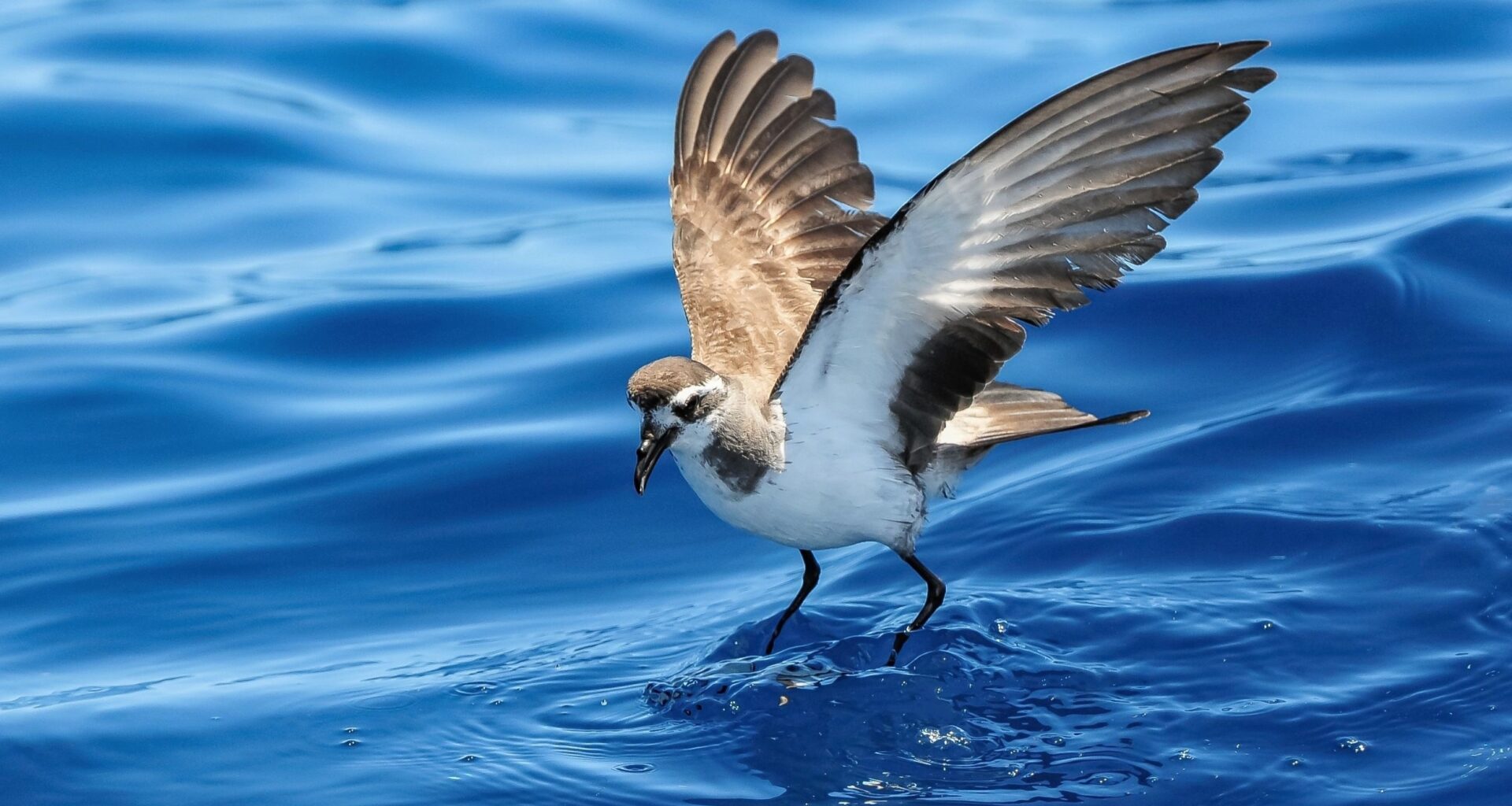
Getting from A to B across the open ocean is hard for a bird the size of a sparrow. Wind makes it manageable – most long-distance seabirds time their flights around it, riding tailwinds and beating back home.
Storm petrels seem to work against that logic. These tiny birds cross hundreds of miles of open ocean to find food.

New tracking data from storm petrels nesting in Sardinia shows them deliberately angling into the wind from the side, even when it costs them speed.
A secretive seabird
The Mediterranean storm petrel weighs about an ounce. Yet it crosses hundreds of miles of open ocean to forage, and then returns to the same dark sea cave to feed a chick.
For centuries, sailors built myths around these birds. Some believed they carried the souls of drowned mariners. Others saw them as warnings of approaching storms.
The legends followed storm petrels from port to port across the Mediterranean.
The new study was led by Federico De Pascalis, a movement ecologist at the Italian Institute for Environmental Protection and Research (ISPRA).
“Storm petrels are among the most secretive seabird species, yet they have long captivated sailors, giving rise to numerous myths and legends surrounding them,” said De Pascalis.
The challenge of tracking small birds
Tracking technology has always favored bigger birds. GPS gear sized for an albatross would crush a one-ounce petrel.
Scientists studied larger species and tried to infer what the smallest ones might do. That left a real gap.
Larger members of this bird family ride wind shear in long arching glides – a technique called dynamic soaring – and decades of research has mapped how albatrosses pull it off.
Storm petrels can’t do that. They’re too small to glide on wind shear. These birds have to flap their wings, mile after mile over open water.
Advanced trackers that are lightweight
Lightweight biologgers have changed what is possible.
De Pascalis and colleagues attached tiny GPS units to 25 storm petrels during the 2020 and 2021 breeding seasons in Sardinia, where the birds nest in coastal sea caves.
The trackers weighed 3.3% of each bird’s body mass and showed no measurable effects on weight gain, hatching success, or trip duration.
Regular outings covered hundreds of miles over open water.
When researchers matched each GPS position to real-time wind data, the birds were not riding tailwinds or pushing into headwinds. They were seeking out crosswinds.
The pattern held at every scale researchers examined – from tens of miles to hundreds. The routes were consistent and deliberate, not random detours caused by shifting gusts.
A harder route with a bigger payoff
Why pick the harder route? Storm petrels and their relatives have an extraordinary sense of smell. For them, olfaction appears to be a navigational tool as much as a foraging aid.
These birds can detect compounds like dimethyl sulfide, a chemical released when ocean plankton is grazed upon by zooplankton.
That smell tends to mark productive feeding patches. To a petrel hundreds of miles from land, it means food.
A bird flying downwind follows scents already carried away. One flying into a headwind detects only what drifts directly toward it. Flying crosswind cuts across far more odor plumes with every mile.
Researchers suspect this explains the crosswind preference, though they can only infer it from the flight data.
What a petrel actually experiences while flying hundreds of miles from land cannot be measured directly.
A tradeoff between energy and information
Crosswind flight has a real cost. The birds drift sideways and have to constantly correct course toward home. Ground speed drops. Wing beats add up.
Earlier work on petrel flight confirmed that flapping is the most energy-intensive movement mode among vertebrates. These birds pay that cost on every mile, in every direction.
Crosswinds slow them further – which looks like the wrong call on paper. This study suggests the birds are not optimizing for speed. They’re optimizing for what the wind can tell them.
“These findings indicate that storm petrels face a trade-off between movement efficiency and information gain,” said Francesco Ventura, a postdoctoral investigator at the Woods Hole Oceanographic Institution (WHOI).
Broader implications of the study
Until this study, the smallest seabirds were effectively untrackable. Larger seabirds have been tracked for decades, allowing researchers to map their wind-use patterns in detail.
Storm petrels remained poorly understood. The Sardinia data finally fills that gap.
Flapping seabirds actively seek crosswind angles, and the pattern reflects a sensory strategy rather than an accidental flight path.
Storm petrels read the ocean by reading the wind. That insight also raises new concerns.
If Mediterranean wind patterns shift with the climate, the crosswind angles these birds rely on may become harder to find. Foraging trips could grow longer, leaving chicks with less food.
The wind angle chosen by a one-ounce bird becomes a measurable signal of ocean change – and a reason to keep watching one of the smallest fliers crossing the sea.
The study is published in the journal Biology Letters.
—–
Like what you read? Subscribe to our newsletter for engaging articles, exclusive content, and the latest updates.
Check us out on EarthSnap, a free app brought to you by Eric Ralls and Earth.com.
—–