
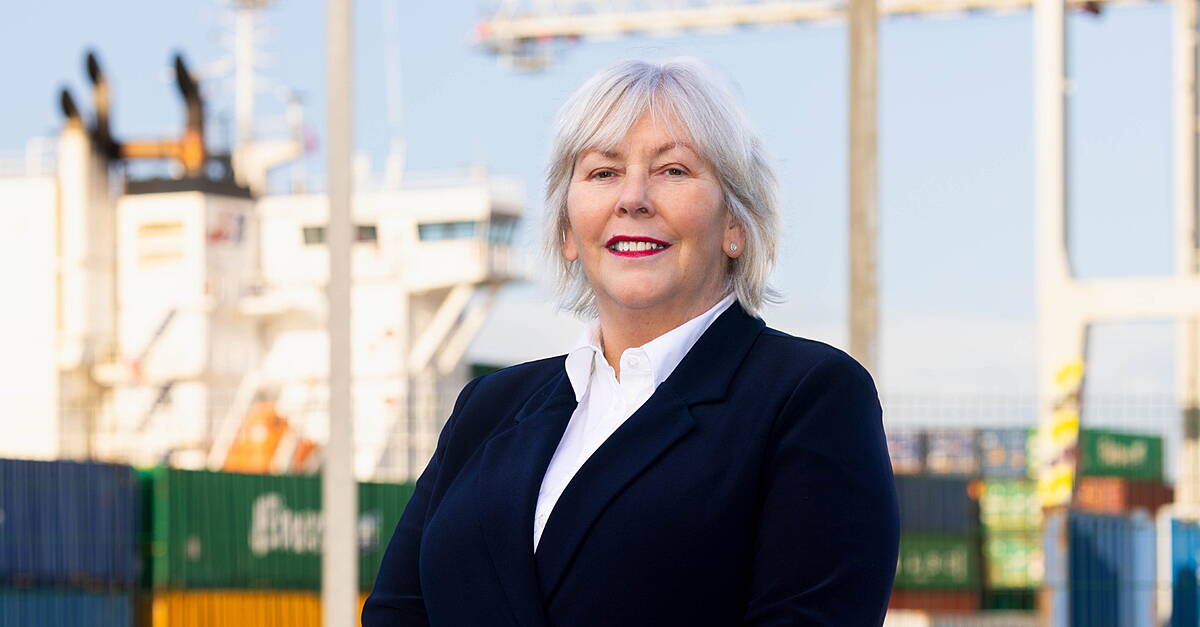
As CEO of Port of Cork and Chair of Cruise Ireland, Ann Doherty is helping shape the future of Ireland’s maritime economy at a pivotal moment for the industry.
From expanding port infrastructure and strengthening global trade links to positioning Ireland as a leading cruise destination, her leadership sits at the intersection of commerce, tourism and sustainability.
In this interview, she discusses the evolving role of Irish ports, the opportunities and challenges facing the cruise sector, and why Cork continues to play a strategic role on the international stage.
As CEO of the Port of Cork and Chair of Cruise Ireland, how do you balance national and regional priorities?
I balance national and regional priorities by treating them as interconnected rather than competing. Cork is a regional port, but it plays a national role in Ireland’s supply‑chain resilience, offshore wind ambitions, and cruise tourism offering. So, for me, the starting point is always understanding how local strengths can support national objectives, and how national policy can, in turn, unlock regional growth.
At a regional level, my focus is on ensuring that Cork Harbour and Bantry Bay continue to deliver real economic value for the communities and businesses they serve. That means supporting exporters and importers, strengthening our cruise tourism footprint, and progressing the Port’s long‑term masterplan so we can meet the needs of a growing region. These are day-to-day priorities that have a very tangible impact on Cork and West Cork.
Nationally, my role is to make sure that the Port of Cork and Cruise Ireland contribute to Ireland’s wider strategic goals, whether that’s enhancing trade connectivity, supporting the energy transition, or presenting a coordinated national offering to the global cruise industry. I work closely with government, industry partners and other ports to ensure that what we do locally aligns with the country’s long‑term economic and sustainability agenda. In practice, that means constant collaboration, clear communication and a commitment to decisions that serve both the southern region and wider Ireland.
The 2026 cruise season has begun with strong momentum. What are your key strategic priorities for the Port of Cork Company this year?
The 2026 cruise season has started very strongly, and that momentum reflects the wider direction of travel for the Port of Cork this year. My priorities are centred on delivering the next phase of our long term masterplan and progressing the investments that will support sustainable growth across the region.
The strong start to the cruise season also highlights the importance of tourism to Cork and to the wider south west. We are continuing to enhance the experience for cruise lines, passengers and crew while promoting Cork and Bantry Bay as key gateways to Ireland. This includes ongoing work to strengthen the visitor experience on shore and to support the local businesses and communities that benefit from cruise tourism each year.
This year is also significant from a collaboration point of view. We recently signed a Memorandum of Understanding with Belfast Harbour, which creates a new opportunity for joint marketing and coordinated promotion of Ireland as a cruise destination. This agreement supports an all island approach that showcases the range of experiences available across both regions and strengthens our collective presence in international markets. It is an important step in ensuring that Ireland continues to compete strongly for high value itineraries.
Cruise tourism is estimated to generate €17 million annually for the region. How do you see this impact evolving, particularly for local restaurants and hotels?
I expect that impact to continue growing in a very steady and sustainable way. What we’re seeing is not just an increase in passenger numbers, but a shift in the type of visitor coming to Cork and Bantry Bay. Cruise lines are scheduling longer calls, passengers are spending more time ashore, and even crew spending has become a significant contributor for local businesses. All of that directly benefits restaurants, cafés, hotels and visitor attractions across Cobh, Cork City and West Cork.
For local hospitality businesses, the pattern is changing in a positive direction. Passengers are increasingly looking for authentic, local experiences, whether that’s food, culture or outdoor activities, and that aligns very well with what this region offers. We’re also seeing more pre and post‑cruise stays, which is a real opportunity for hotels in particular. As we continue to work with Cruise Ireland and our tourism partners, my focus is on ensuring that the region is positioned to capture that additional value by promoting Cork as a high‑quality destination with a strong food and hospitality offering.
Looking ahead, we want to manage the growth of the cruise sector in a responsible and balanced way. It is important that the economic benefits continue to reach local businesses and that the experience for residents and visitors remains positive. Collaboration is central to this. We are working closely with local authorities, tourism bodies and the business community to ensure that Cork and Bantry Bay continue to offer a high quality welcome to international visitors.
Bantry Bay is also preparing for increased superyacht activity ahead of the 2027 Ryder Cup, which will bring a significant global audience to the region and create new opportunities for local hospitality providers. Bantry has a natural advantage in this space. Its deep and sheltered inlet on the Atlantic seaboard can accommodate superyachts of all sizes without capacity limits, and its location offers direct access for vessels arriving from the United States and Europe. The harbour is only a 25 minute helicopter journey from Adare Manor, which gives owners and charter guests a fast and seamless transfer to the event while avoiding road congestion. We are engaging with international charter companies and service providers to position Bantry as a high quality base for visitors attending the Ryder Cup, and the early interest has been very encouraging. By strengthening these partnerships and focusing on the visitor experience, we can continue to grow cruise and marine tourism in a way that delivers real value for the region.
Can you tell me a little about your background?
I’ve spent most of my career in senior public‑sector leadership roles, and that experience shapes how I approach my work today. Before joining the Port of Cork Company, I served as chief executive of Cork City Council, where I led the city through the largest boundary extension in the history of the State. That period taught me a huge amount about strategic planning, stakeholder engagement and managing complex, long‑term projects that have a real impact on communities.
Prior to that, I held senior management roles in the HSE and the Southern Health Board. Those roles gave me a strong grounding in strategic planning, organisational leadership and the delivery of complex public services. Across my career, my focus has always been on building effective partnerships and ensuring that decisions support both immediate needs and long-term growth.
That background is central to how I now lead the Port of Cork Company. Ports must be visionary as they operate on long timelines and play a critical role in regional and national development, so the combination of strategic planning, collaboration and public‑sector experience has been invaluable. It’s also why I’m so committed to ensuring that the Port continues to deliver economic, social and environmental value for Cork, for the wider region and for the State.
What do you love most about your job?
What I love most about my job is the people I get to work with every day. Ports are incredibly complex environments, and nothing we do happens in isolation. I’m surrounded by teams who are deeply committed to the region, to our customers and to the long‑term future of the Port of Cork. Their expertise, their pride in the work and their willingness to solve problems together is something I value enormously.
I also love the engagement with the wider community, from local businesses and hospitality partners to cruise lines, government agencies and international stakeholders. Every conversation gives me a sense of how important the Port is to people’s livelihoods and to the identity of Cork and Bantry Bay. Being able to support that, and to see the impact of our work on the ground, is genuinely rewarding.
And finally, I enjoy the long‑term nature of the work. Ports shape regions for generations, and leading an organisation with that kind of responsibility means you’re constantly thinking about people, the teams who deliver today, the communities who rely on us, and the future workforce who will inherit what we build. That sense of purpose, rooted in people, is what I enjoy most.
Looking ahead, what is your long-term vision for Cork’s role in the global cruise industry?
Looking ahead, my long‑term vision is for Cork to continue strengthening its position as one of the most attractive and reliable cruise destinations in Northern Europe. We already have a strong foundation, a world‑class natural harbour, a reputation for excellent service, and a region that consistently delivers a warm, authentic visitor experience. My focus is on building on those strengths in a way that supports sustainable growth and enhances Ireland’s overall cruise offering.
A key part of that vision is deepening our partnerships with cruise lines and tourism bodies so that Cork remains a preferred port of call for both established itineraries and new routes. We’re seeing increasing interest in longer stays, themed voyages and more immersive shore experiences, and Cork is exceptionally well placed to meet that demand. By continuing to invest in our infrastructure and working closely with local businesses, we can ensure that the region is ready to welcome larger vessels, more diverse itineraries and higher‑value passengers.
I also see Cork playing a bigger role in Ireland’s collective presence on the global stage. I’m committed to promoting the country as a unified, high‑quality destination, with Cork and Bantry Bay acting as key gateways. The long‑term opportunity is not just to grow passenger numbers, but to position Ireland, and Cork in particular, as a standout destination known for its hospitality, its landscapes and its cultural depth. That’s the direction I want to take the sector in the years ahead.
What do you like to do when you are not working?
When I am not working, I am happiest when spending time with my family and friends. I enjoy good food, great conversation and the chance to switch off and reconnect with the people who matter most to me. I have three wonderful children, a fantastic husband and a grandson who brings huge joy to all of us.
I also give some of my time on a voluntary basis. I chair the Board of the Mercy University Hospital and the Board of UCC Campus Accommodation. Both organisations are led by dedicated teams who deliver important services every day, and it is a privilege to support that work.
My values have always guided me, fairness, honesty and the belief that people generally want to do the right thing. Those principles shape how I work and how I try to contribute outside of work too.
Do you have a favourite holiday destination?
I am very fortunate to live in a beautiful part of Ireland, known for its food, hospitality and strong sense of place. Being based between Kinsale and Cork City means I am surrounded by great restaurants, fresh local produce and a vibrant cultural scene, so I never have to travel far to enjoy something special.
I also spend time in West Kerry, particularly around Ballinskelligs. It is a remarkable part of the country, almost mystical, and even a short stay there leaves you feeling refreshed and re‑energised.
I do enjoy travelling further afield as well. I am drawn to places with a strong public realm, where you can move around safely and sustainably, take in the atmosphere and enjoy the everyday rhythm of local life. One of my favourite things to do on holiday is to sit with a morning coffee, watch the world go by and chat to the people I meet along the way.