
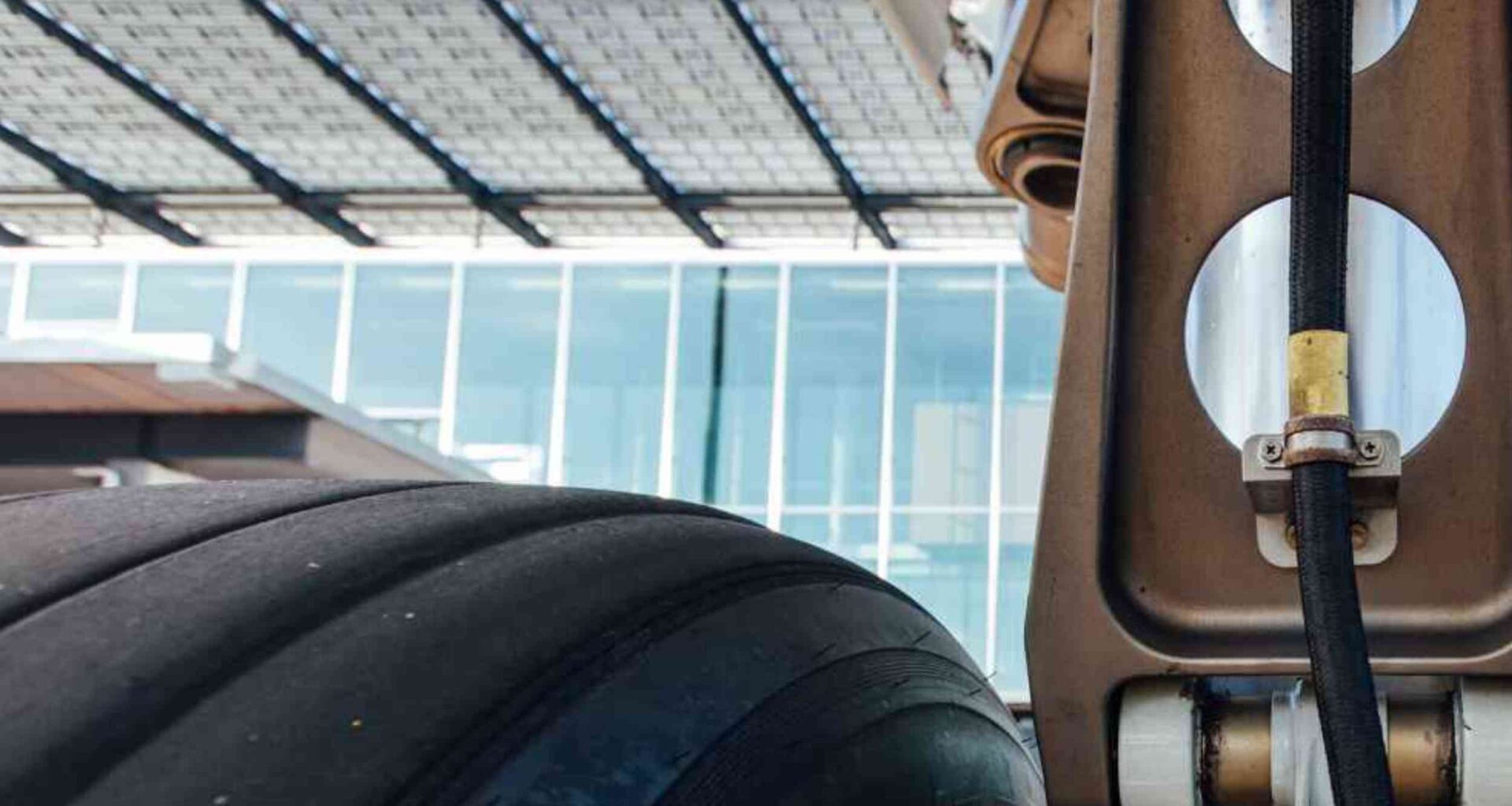
Every airplane tire has to absorb the impact of a fully loaded jet, then do it again, hundreds of times.
Engineers learned early on that mixing a fine black powder into rubber made it tough enough for the job. For nearly a century, that recipe has remained unchanged.

The powder is called carbon black. Until very recently, engineers did not have a proper scientific explanation for why adding more of it makes rubber stronger.
The main ingredient
Pure rubber on its own is soft, stretchy, and springy, but it is not very durable and becomes unreliable under heavy loads.
The standard fix for this is carbon black, a fine soot produced by burning oil or natural gas in low oxygen.
Manufacturers blend microscopic particles of it into rubber, which is why nearly every tire is black.
The formula has changed little since the 1920s. When soot is added, rubber gets tougher.
Tire companies buy dozens of carbon black grades and figure out which ones work by testing them on real tires.
A century of guessing
There are three theories as to why. One argues that the particles are linked into chains running through the rubber, carrying the load.
Another argued that polymer chains cling to each particle and stiffen like glue.
A third claim focused on space, arguing that the particles took up room, and the rubber around them was forced to deform more sharply than ordinary rubber would.
None of the three options fully proved what reinforced rubber actually does under real strain. Each model explained part of the behavior but missed the full picture.
Professor David Simmons at the University of South Florida (USF) wanted a clear answer. The problem, however, was nobody could watch the mechanism in action.
This is because the process is too small to see directly, and too fast to film. The rubber itself is a tangle of long chain molecules wrapping around each particle.
Inside the simulation
Simmons and his team rebuilt the inside of a tire on a computer to draw a conclusion.
Alongside Dr. Pierre Kawak and doctoral student Harshad Bhapkar, he ran 1,500 separate molecular dynamics simulations.
Each one tracked hundreds of thousands of atoms moving the way they do inside a real piece of reinforced rubber.
An earlier paper by the same group had hinted at where the answer might be found. This time, however, the team gathered enough data to support the theory.
Rubber fights itself
The key turned out to involve a property called Poisson’s ratio. This is a measure of how material changes shape in one direction when you pull it in another.
When you stretch an ordinary rubber band, it gets thinner in the middle while keeping roughly the same overall volume.
When carbon black is added, the rules change. The hard particles don’t compress sideways the way the rubber would, which prevents the usual thinning.
Only one option remains: the whole composite has to expand in total volume as it stretches.
In doing so, the rubber resists strongly. Simmons describes it as the material fighting against itself.
“How is it that we’ve been using this for 80, 90, 100 years and haven’t really known how it works?” Simmons said.
Three theories merge
The new explanation does not throw out the old ones. Particle networks and sticky polymer layers around each particle still contribute to the effect.
The simple geometry of taking up space all contribute to the same effect. The rubber maintains a growing resistance to changing its overall volume.
An earlier study from the same group had laid groundwork for combining the theories. Until this test, no one had shown all three pointing in the same direction.
The Magic Triangle
Tire engineers have long talked about something they like to call the “Magic Triangle.”
This is where fuel efficiency, traction, and durability all pull against one another. Selecting one usually costs you another.
When you try to improve a tire’s grip on a wet road, you tend to lose mileage benefits. When tires are made to last longer, they loosen their grip on the road.
With a model of what carbon black is actually doing at the atomic level, engineers can start picking particle sizes and rubber chemistry on purpose.
Going beyond the tire
The same physics show up wherever a rubber part is needed. This includes power plant seals, aircraft hydraulics, medical devices, and more.
The 1986 Space Shuttle Challenger broke apart after a cold-stiffened rubber O-ring failed at launch.
If the new theory holds, manufacturers in those fields can design parts with greater confidence.
It is important to note that the data comes from computer models, not physical experiments.
The simulations are built to match real rubber, but any mechanism the model identifies still needs experimental confirmation.
The future of rubber
The study may have solved the mystery. Carbon black makes reinforced rubber stronger because it forces the material into a state where stretching demands volume expansion.
Rubber resists volume expansion strongly, an answer that has been needed since the 1920s.
What changes from here is design. Tire companies no longer have to treat carbon black grades as a black box.
“With these findings, we’re laying a new foundation for rationally designing tires,” said Simmons.
The same approach can be aimed at other composite materials with stubborn, unsolved mysteries.
The study is published in Proceedings of the National Academy of Sciences.
—–
Like what you read? Subscribe to our newsletter for engaging articles, exclusive content, and the latest updates.
Check us out on EarthSnap, a free app brought to you by Eric Ralls and Earth.com.
—–