
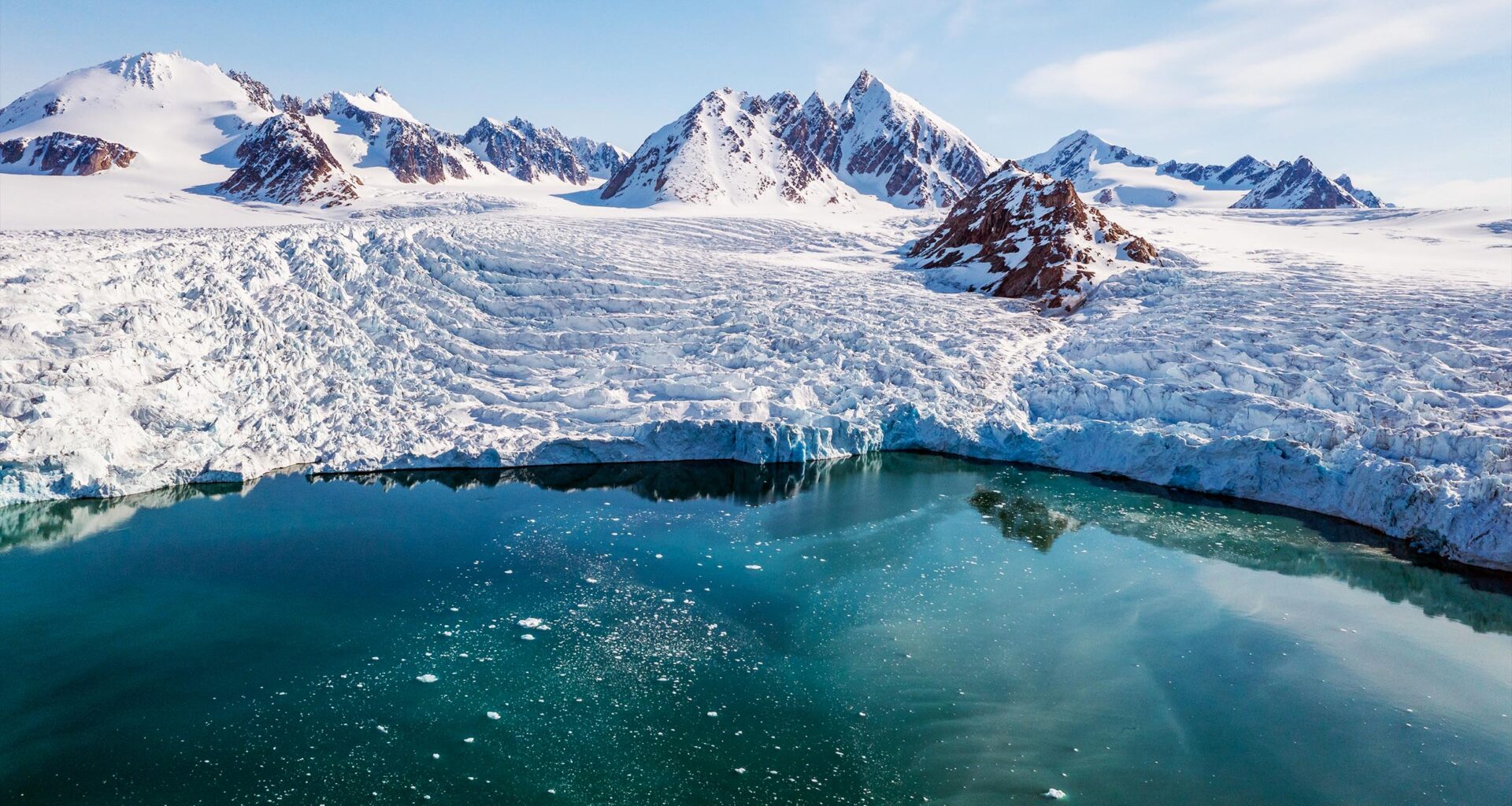
Current projections of sea level rise from Antarctic ice melt may be significantly underestimating the threat.
A new study has found that when ice melts into the ocean, it triggers changes in ocean circulation that then cause even more ice to melt.

This is a self-reinforcing cycle that existing climate models largely ignore.
That feedback loop, the researchers found, could contribute just as much to rising seas as the direct effects of a warming atmosphere.
The missing Antarctic feedback loop
The Intergovernmental Panel on Climate Change (IPCC) currently treats Antarctic ice shelf melt as a fixed input. Melt happens, water enters the ocean, and sea levels rise.
What the models don’t account for is what that meltwater does to the ocean itself, and how the ocean then responds.
“Most current climate models that inform international policy don’t consider this feedback loop at all,” said the study’s lead author, Madeleine Youngs, an assistant professor at the University of Maryland.
The researchers said the IPCC currently treats ice shelf melting as a fixed process instead of one that interacts with other climate systems.
They argue that future sea level rise estimates will be more accurate if climate models include feedback loops linked to ice shelf meltwater.
Melting speeds up more melting
The mechanism comes down to the physics of water temperature and density. Under normal conditions, cold, dense water sinks and settles near the ocean floor, forming a barrier layer that keeps warmer deep-ocean currents from reaching the underside of ice shelves.
When ice melts, the freshwater it releases dilutes and weakens that barrier. Warmer water from the deep ocean pushes through and reaches the base of the ice, accelerating melting.
More melt produces more freshwater, which weakens the barrier further, allowing in still more warm water. The cycle feeds on itself.
“It’s a positive feedback loop where more melt leads to warmer water reaching the ice, which causes even more melt,” Youngs said.
“If we [humans] continue to do business as usual, it’s distinctly possible that we reach the climate tipping point sooner rather than later, especially as we consider this positive feedback loop.”
 Top: A diagram illustrating the Antarctic ice shelf meltwater interactions between a floating glacier and warm water. Bottom: A heat map depicting the temperatures of the Antarctic ice shelf. Credit: Madeleine Youngs. Click image to enlarge. Antarctic melting is not uniform
One of the more nuanced findings is that this dynamic plays out differently depending on where in Antarctica the melting is occurring.
In regions like the Weddell Sea, the feedback is straightforwardly dangerous. As upstream ice melts and freshwater pours in, the cold-water barrier erodes, warm water floods through, and melting accelerates further.
In other regions, including the West Antarctic Peninsula and the Amundsen Sea, the picture is more complicated.
There, meltwater flowing in from upstream actually forms a cold freshwater barrier that temporarily shields the ice from warmer ocean currents, creating a negative rather than positive feedback.
“Our study suggests that these regions – usually regarded as the most at-risk – are actually more protected than we thought, at least in the short term, because of this negative feedback loop,” Youngs said.
“But this protection depends on massive upstream melting happening first, and that upstream melt has its own severe consequences on sea levels.”
What rising seas could mean
More than 680 million people worldwide live in low-lying coastal zones that are vulnerable to sea level rise.
The IPCC currently estimates that Antarctic meltwater could contribute up to 28 to 34 centimeters (11 to 13 inches) of additional sea level rise by 2100 under high-emissions scenarios.
Even a modest increase beyond that range would meaningfully expand the reach of storm surges and permanent flooding from Miami to Mumbai and hundreds of cities in between.
If the feedback loops identified in this study are as significant as the research suggests, those estimates may need to be revised upward.
“This is really just a first investigation into this topic,” Youngs said.
“What we’re showing is that the feedbacks in the Antarctic region are real, extremely impactful, and vary depending on where they take place on the continent. We can’t just consider the direct impact of a warming atmosphere.”
Tracking Antarctica’s tipping points
The research team is already working on the next phase.
Youngs and her colleagues are developing higher-resolution simulations that incorporate meltwater feedback processes and trace projected trajectories from today through 2100.
The focus will be on identifying which ice shelves are closest to the point of no return.
“The next step is understanding exactly when and where things tip – and what that means for all of us,” Youngs concluded.
The study is published in the journal Nature Geoscience.
—–
Like what you read? Subscribe to our newsletter for engaging articles, exclusive content, and the latest updates.
Check us out on EarthSnap, a free app brought to you by Eric Ralls and Earth.com.
—–