
Five weeks ago, the Artemis 2 astronauts splashed down in the Pacific after looping around the Moon – the first humans to travel there since 1972. That mission proved the systems needed for deep-space travel still work.
The next step is less visible but just as essential: preparing the systems that future lunar missions depend on.

Before astronauts can land on the surface of the Moon, hardware has to get there. Blue Origin’s uncrewed Moon lander, MK1 (nicknamed Endurance), just cleared the biggest test standing between it and a launch later this year.
Inside Chamber A
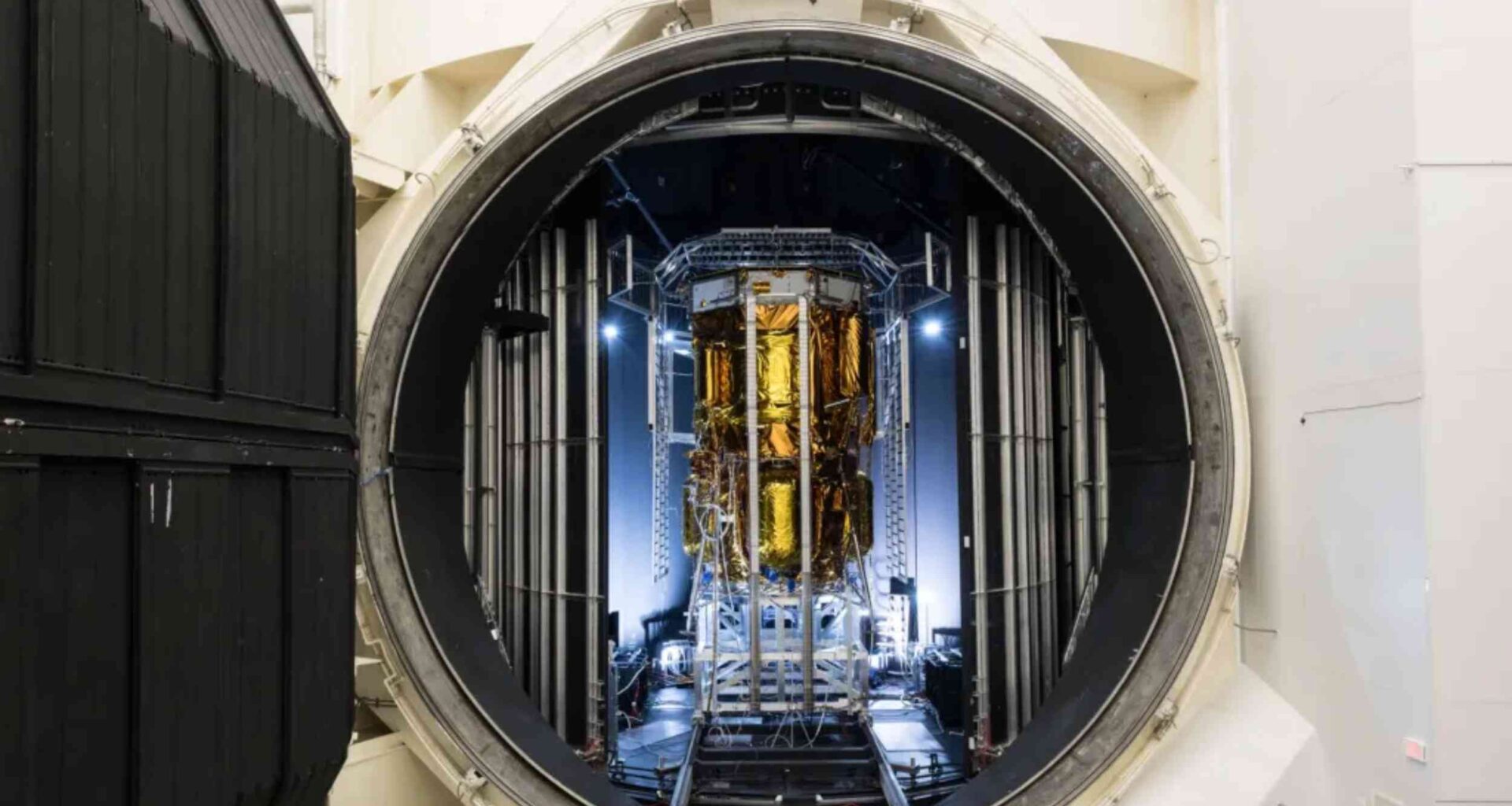
Testing happened at NASA’s Johnson Space Center (JSC) in Houston, inside Thermal Vacuum Chamber A.
One of the world’s largest facilities of its kind, the chamber can fit an entire spacecraft and pull out almost all the air.
Engineers there can drop pressure to near-space levels and swing temperatures to the extremes that a vehicle faces during flight and on the lunar surface.
Passing the test gives engineers confidence the spacecraft will hold together once it reaches space.
Chamber A has a long track record. It vetted Apollo-era spacecraft in the 1960s, then held the James Webb Space Telescope for cold-soaking before its launch. The most recent occupant was from Blue Origin.
Moon lander called Endurance
Blue Moon Mark 1, better known as MK1 and officially nicknamed Endurance, is an uncrewed cargo lander built by Blue Origin – the space technology company founded by Jeff Bezos.
MK1 stands about 26 feet (7.9 meters) tall and carries gold-tinted thermal insulation around its exterior. Engineers designed the spacecraft to ferry equipment rather than people on its first trip. Crewed missions come later.
MK1 is scheduled to fly experiments and gear to the Moon’s south pole as early as late 2026. It will test three capabilities in the process: precision landing, engines fueled by super-chilled liquid propellant, and autonomous touchdown.
Trial by extremes
Daytime on the lunar surface can reach above 250 degrees Fahrenheit (120 degrees Celsius). After the sun drops, that same ground plunges toward minus 250 degrees Fahrenheit (minus 157 degrees Celsius).
Engineers had to prove that Endurance could survive both extremes – plus the hard vacuum in between.
Teams pulled the air out of the chamber and cycled temperatures across the full range that the spacecraft will face in flight and on the Moon’s surface. Space offers no atmosphere to soften the temperature swings.
The test verified that the structure holds and the thermal controls work – on the actual flight hardware, not on a scale model. It is better to find a flaw while the Moon lander is inside a chamber in Texas.
Payloads for the Moon
MK1 will carry two NASA payloads on its first trip. One payload uses an array of high-resolution stereo cameras to film what happens when the lander’s engine plume hits the Moon’s surface during touchdown.
Engine plumes blast lunar dust at high speed and can scatter grit across the surface, threatening nearby equipment.
How a larger crewed vehicle behaves during touchdown is still an open question – and these cameras will add real data.
The other payload is a small reflector array. Spacecraft passing overhead can bounce laser light off it to fix the lander’s exact spot on the surface – a navigation aid for future missions that will try to land nearby.
NASA and Blue Origin
Work in the chamber runs on a reimbursable Space Act Agreement: Blue Origin pays NASA to use the facility and the team that runs it.
NASA calls this its “front door” approach for commercial partners.
Safety oversight stays with NASA. Blue Origin gets access to test infrastructure that would cost billions to replicate.
Both sides gather data and experience that will support future Moon missions.
Toward crewed missions
Endurance is a stepping stone, not the end goal. Blue Origin is also building Blue Moon Mark 2 (MK2), a much larger crewed lander designed to carry astronauts from lunar orbit down to the surface and back.
MK2 is larger in every direction – with more propellant, more cargo capacity, and life-support systems needed for multi-day surface missions.
What engineers learn from MK1’s design and testing rolls forward into MK2 and the coming rounds of missions under the Artemis program.
The road ahead
Until this testing campaign, Endurance had never faced a full simulation of the temperature swings and vacuum conditions it will encounter beyond Earth. Now it has. Structure and systems remain intact.
That clears one of the biggest unknowns before launch. MK1 moves toward final integration and a planned flight to the Moon later this year.
A successful mission would hand NASA hard data on how a commercial cargo lander handles the lunar surface – information that can only come from an actual landing. Those results feed directly into what comes next.
Next steps after MK1
For Blue Origin, what comes next is the heavier, crewed lander – and the goal of returning American astronauts to the Moon by 2028.
Endurance has now shown it can hold together in the cold, airless environment it was built for.
The real test won’t come in a chamber in Houston. It will come on the Moon.
—–
Like what you read? Subscribe to our newsletter for engaging articles, exclusive content, and the latest updates.
Check us out on EarthSnap , a free app brought to you by Eric Ralls and Earth.com.
—–