
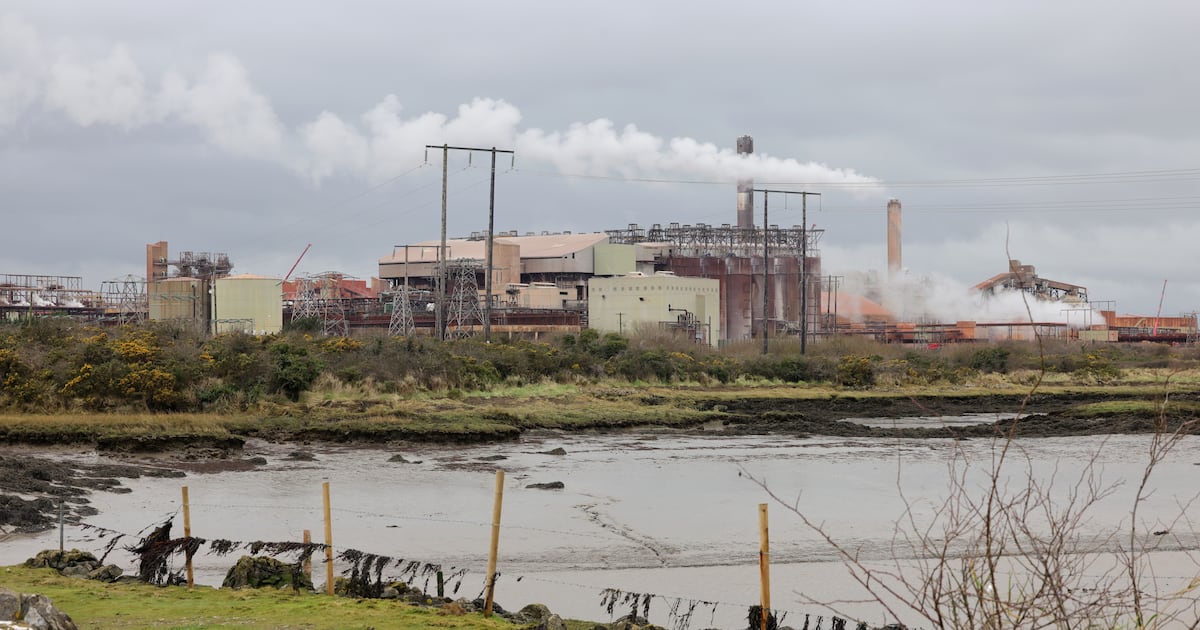
Aughinish Alumina has warned the Government of the “potential unintended consequences” of the EU applying a trade restriction on alumina.
The Co Limerick plant is owned by the Russian metals giant Rusal.
In a letter to the Government on Thursday, the plant warned the possible “unintended consequences” of a sanction included a tightening of alumina supply across Europe and the potential loss of 1,000 jobs in the midwest.
The plant said its cost base would “materially deteriorate” and it would lose 45 per cent of its customer base if a sanction were imposed.
It also said Ireland would lose “vital electricity generation” from the national grid, as the plant generates and exports enough electricity to power about 200,000 Irish households.
However, the European Commission has no plans to propose sanctioning alumina supplied to Russia by Aughinish Alumina, due to the knock-on effect such a move would have on European industry.
An Irish Times investigation, carried out in co-operation with the Organised Crime and Corruption Reporting Project, found that the Aughinish Alumina plant in Co Limerick is shipping vast amounts of alumina to smelters in Russia, where it is used to make aluminium, which is then sold to a trading company, ASK, that supplies dozens of Russian arms manufacturers.
Rusal has deep connections to the Kremlin and Moscow’s arms industry.
The revelations about the downstream role the Limerick plant plays in the supply chain of the Russian military effort has led to calls for its exports to Russia to be targeted in EU economic sanctions.
However, Aughinish Alumina is not expected to be targeted in a fresh package of sanctions being drawn up by the commission in Brussels. The commission’s decision not to include Aughinish in the next round of sanctions was first reported by RTÉ News on Thursday night.
Niall Collins, the Fianna Fáil TD for Limerick county and junior minister at the Department of Agriculture, told The Irish Times on Friday he “could not overestimate” the impact that Aughinish had as a direct employer and as an indirect contributor to the wider economy in the midwest.
The plant employs almost 1,000 people, with another 1,000 working in supporting companies.
Collins, who said he has been in regular contact with Aughinish and with the Taoiseach about the issue, said he was concerned about the impact a sanction would have on both jobs and electricity supply in Ireland.
“We have been saying this as a Government and the EU recognises this as the basic principle of any sanction arising from the war … that the sanction shouldn’t have unintended consequences – particularly here in Ireland,” Collins said.
“Sanctions have to have an impact where the aggressor originates, not here in Ireland.”
EU officials are concerned about the knock-on impact of a decision to levy economic sanctions on alumina or the Rusal-owned plant, due to its role as a major supplier of European smelters and heavy industry.
The Government has argued that sanctions aimed at hindering Russia’s ability to continue its war in Ukraine cannot be allowed to hurt the EU more than they would harm Moscow.
National governments are to begin debating the scope of the EU’s next bundle of sanctions on Russia, the 21st round of measures since the 2022 full-scale invasion of Ukraine.
Belgium’s foreign minister Maxime Prévot has said he would push for sanctions on the Co Limerick plant at EU level.
The commission has also come under pressure from a sizeable number of MEPs in the European Parliament who want the EU executive body to propose action to cut off Aughinish Alumina’s ability to export to Russia.
That call has been backed by MEPs from Renew and the European People’s Party (EPP), the European political groupings of Fianna Fáil and Fine Gael.
It is understood Fianna Fáil has argued within the Renew group that the Co Limerick plant should not be hit in future rounds of EU sanctions.
The European Parliament has no role in setting sanctions, which are proposed by the commission and then have to be unanimously approved by all 27 member states.
The Government would have the power to veto any EU drive to sanction alumina or target the Co Limerick plant.
European Parliament vice-president Pina Picierno wrote to the commission a number of weeks ago, asking for alumina to be included in the next sanctions package.
“It is unacceptable that, while the EU funds Ukraine’s defence, a Russian-owned company operates undisturbed within a member state, supplying the Kremlin’s military industry,” Picierno wrote.
Over the past decade the Government has lobbied in Washington and Brussels to exempt the Russian-owned plant from sanctions targeting Moscow.