
Locals in the rainforests of northern Australia and New Guinea give one bird a wide berth. It can stand as tall as a grown adult, sprint through dense brush, and lash out with a dagger-shaped claw on each foot.
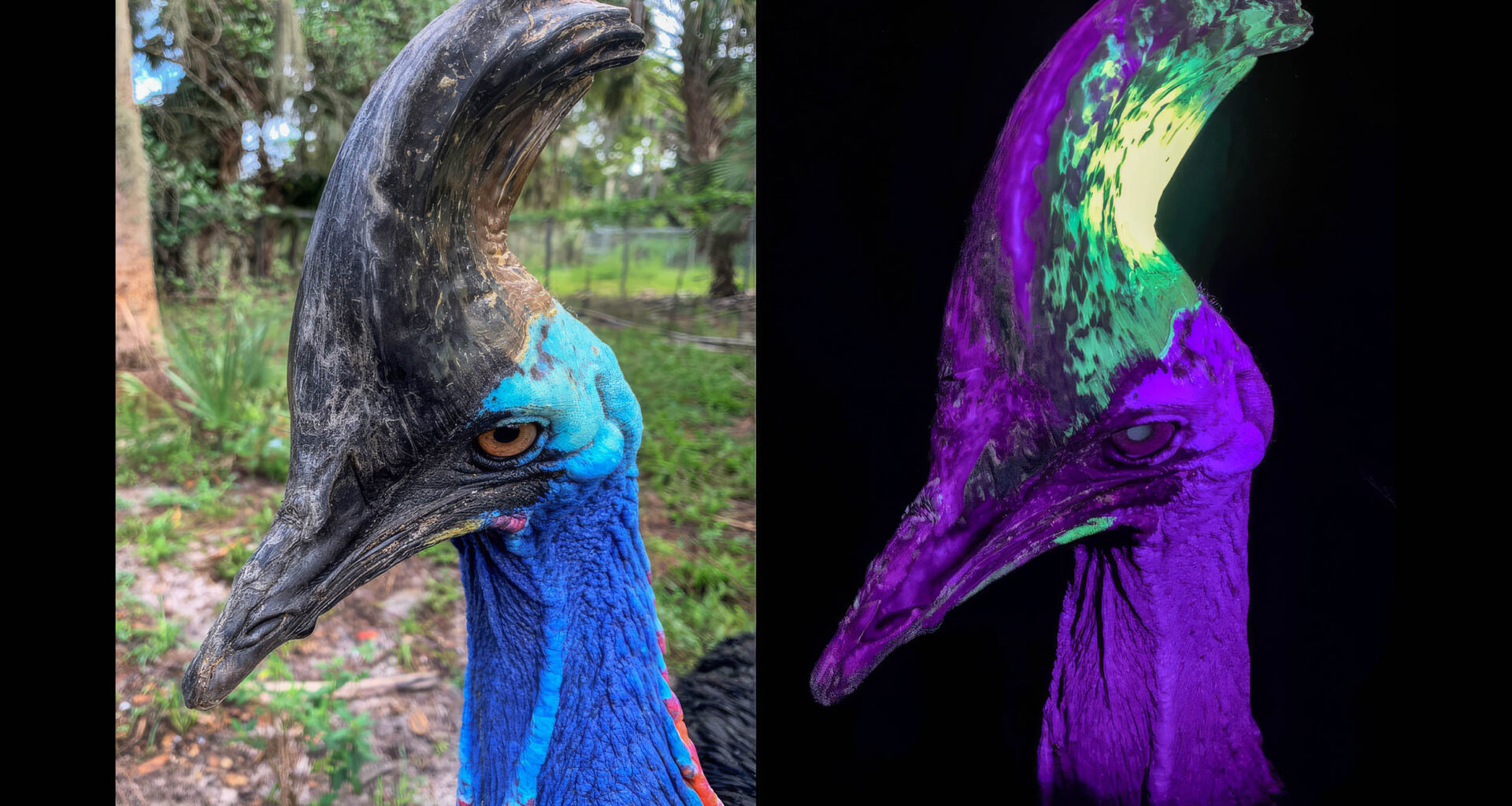
Crowning its head is a tall, helmet-like crest the color of wet bark, dull enough that most people barely give it a second look.
Switch off the lights and aim an ultraviolet flashlight at that crest, and something odd happens.
The mystery of the cassowary casque
The crest is called a casque, a tall ridge of bone wrapped in keratin, the same tough substance found in your fingernails. All three living species of cassowary wear one, and biologists have argued over its purpose for two centuries.
Anatomist Todd L. Green of the New York Institute of Technology College of Osteopathic Medicine (NYITCOM) has spent years on the question.
Researchers had suggested that the casque helps shove rivals, shed body heat, or amplify the deep calls these birds make through thick forests.
The leading hypothesis was that the casque serves as a visual display, a signal flashed between birds, much like their brightly colored neck skin.
But the casque itself appears plainly drab, with shades of brown, gray, and black, which made the signaling idea difficult to accept.
Colors beyond human vision
Birds don’t see the world the way we do. Many of them, cassowaries included, can detect ultraviolet light, a band of the spectrum that sits just beyond violet and remains completely invisible to human eyes.
When ultraviolet light shines on certain materials, they absorb it and re-emit it as a visible glow. Scientists call this biofluorescence, and it appears throughout the animal kingdom, even in the fur of some rodents, as one study found.
That gave Green’s team a hunch. If birds can see ultraviolet light, and the casque really is a signal, then maybe the dull helmet isn’t dull at all in the light cassowaries actually use. So they tested the idea.
Helmets glow under UV
Green and his colleagues gathered the heads of 95 adult cassowaries, most of them museum specimens, along with nine living birds, then aimed handheld ultraviolet lamps at the casques. The dull helmets blazed electric blue-green.
No one had documented that glow in cassowaries before.
As a check, the team shone the same light on ostriches and emus, flightless relatives that lack a casque, and their bills stayed dark. The glowing keratin appears to belong to cassowaries alone.
Not every species lit up the same way. The southern cassowary and its northern cousin blazed across most of the casque, while dwarf cassowaries, with their near-black helmets, showed almost nothing.
Fluorescent markings sort species in other animals too, like frogs, as earlier research shows.
 Structures on cassowaries’ skulls fluoresce under UV light, hinting at a hidden visual signal. (a, b) Casuarius casuarius (rostrolateral), (c, d) Casuarius unappendiculatus rothchildi (right lateral), and (e, f) Casuarius unappendiculatus rufotinctus (left lateral) under (a, c, e) visible and (d) 365 nm and (b, f) 385–395 nm ultraviolet light with regions of keratin biofluorescence evident in light blue and green. Credit: Scientific Reports. Click image to enlarge.Can cassowaries see it?
A glowing helmet only works as a signal if other cassowaries can actually see the glow. So the team pushed further, asking whether a bird in the forest could detect these patterns in ordinary daylight, not just under a laboratory lamp.
Glowing and simple reflection are not the same thing. A surface can absorb ultraviolet light and re-emit it as a glow, or it can simply reflect the light directly.
The casque did bounce ultraviolet light that cassowary eyes can pick up, but the bounced pattern didn’t match the glowing one. Same helmet, two mismatched signals.
That mismatch is the real puzzle. Out in the forest, the laboratory patterns may simply vanish from a bird’s view.
The glow might be a side effect of how the keratin grows, pure coincidence, or a genuine signal that the experiment could not detect. Either way, ultraviolet coloration remains hidden in many other animals, as one study shows
Finding cassowaries more easily
Even with the signaling question unresolved, the glow still has practical value. Those fluorescent patterns survive in long-dead specimens, so a curator can shine ultraviolet light on an unidentified cassowary head and determine its species, even after the skin has faded with age.
It could help in the wild as well. Cassowaries are rare and short-tempered, so counting them in dense rainforest is difficult and potentially dangerous.
Each bird’s glow looks slightly different, so researchers might one day identify individuals from a distance, much as they distinguish humpback whales by their tails.
Dense, shadowy forests obscure the fine detail that ordinary cameras depend on. The glow cuts through that gloom.
Researchers have even proposed trail cameras fitted with ultraviolet flashes, ready to capture images of the birds when no one is there to watch.
Eerie glow of cassowary skulls
The casque once appeared to be a failed signal, too drab to carry any message.
Now there is strong evidence that it holds a hidden layer of color, one that varies between species and exists in a band of light our eyes cannot detect. What looked dull to us was never dull to a cassowary.
For scientists tracking these elusive birds, that discovery opens a new set of tools.
A handheld ultraviolet light could become a standard way to distinguish species in museum collections or identify an individual wild bird from a safe distance, without approaching an animal capable of seriously injuring a person.
The finding even reaches into deep time, since cassowaries serve as stand-ins for crested dinosaurs in many studies, hinting that some extinct animals may have carried colors that fossils cannot preserve.
The next step is determining whether cassowaries truly respond to one another’s glow, and answering that question will require observing how they behave under the right lighting conditions.
The study is published in the journal Scientific Reports.
—–
Like what you read? Subscribe to our newsletter for engaging articles, exclusive content, and the latest updates.
Check us out on EarthSnap, a free app brought to you by Eric Ralls and Earth.com.
—–