

The Public Only Consultant Contract (POCC) was introduced by the Government in March 2023 and it signalled the coming end of private practice in public hospitals.
A key element of it is that hospital consultants who signed up to the deal can only perform private work away from their main hospital and in their own time.
This is the only contract that is on offer for new and replacement consultant posts in the public system funded by the Health Service Executive.
Most consultants are signed up to it – over 67% now – and the salary and requirements reflect the increased commitment to the public system.

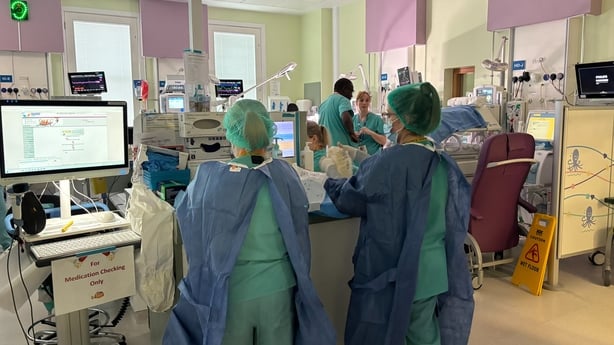
Fourteen of the Rotunda’s 32 consultants have signed up to the POCC (Pics: Collins)
The key aim of the contract has been to phase out private work in public hospitals in line with the policy of universal healthcare.
The transition date for consultants who signed the new contract before December 2023 was the end of last year and, after that, they could not perform private work in public hospitals.
Specialists in maternity care claim it will mean that private maternity care will gradually disappear in the Irish health system.
Currently, around one in four women choose to have private maternity care, not public care. That is a substantial number.
Decline of private maternity care
One of the peculiarities of the Irish health system is that there are currently no standalone private maternity hospitals.
The Mount Carmel private maternity hospital in Churchtown in south Dublin closed in 2014. It was the only private maternity facility in Ireland.
In 2006, before the economic crash, the Beacon Hospital in Sandyford in south Dublin had plans to build a private maternity, women’s and children’s facility at its site.
So, what are women who wish to go private with childbirth to do?
It is still possible some healthcare entity will build a private maternity hospital, but there are no signs of that yet.
The Rotunda maternity hospital in Dublin has run into controversy because it has been allowing some consultants there, who have signed the POCC, to perform private work on-site.
Listen back: Minister doubles down on order to Rotunda to adhere to POCC
We need your consent to load this rte-player contentWe use rte-player to manage extra content that can set cookies on your device and collect data about your activity. Please review their details and accept them to load the content.Manage Preferences
The hospital has 32 consultants, of which 14 have signed up to the POCC. It is not known how many of these are performing private practice at the hospital.
The Rotunda is seen as an outlier as a result, on a big Government policy issue, along with significant investment, to ensure a strengthened public-only service.
Speaking on RTÉ’s Today with David McCullagh yesterday, Minister for Health Jennifer Carroll MacNeill said she wants confirmation from the Rotunda that the practice has ended.
She also suggested that women who had paid for the service be recompensed.
For the Government, the Department of Health and the HSE, the Rotunda’s approach goes directly counter to the requirements of the new contract and has placed the hospital in conflict with the health authorities.
Other hospitals will also be watching closely to see how it works out. The HSE said it is engaging with the Rotunda on the matter.
In March, Ms Carroll MacNeill personally informed Professor Seán Daly, the Master of the Rotunda, that any consultants on the POCC should not continue to treat private patients in the hospital, as it was contrary to the terms of the contract.
The hospital said yesterday its Board met to discuss the September 2024 Board decision to continue to allow private practice for POCC holders, and to consider the merits, risks and consequences of that decision.
It said this discussion was also informed by current Department of Health and HSE direction and correspondence on the issue.
The Board has now written directly to the Minister for Health to seek a meeting to explain the rationale and impact of this decision, and to seek a way forward to resolve the issue for the common good of all patients.
Service Level Agreement
The Rotunda is the biggest maternity hospital in Ireland and the busiest in northern Europe.
It cares for around 10,000 babies each year and has a proud history in the centre of Dublin.
It is a voluntary hospital and so it receives around 90% of its funding from the HSE, under a Service Level Agreement.
There is a danger this could be threatened, or partially withheld, if consultants continue to do private work onsite.
The Rotunda Hospital told RTÉ News that it received the HSE circular issued last week on the matter and a request for additional information in relation to its operation of the Service Level Agreement.
The hospital said it is currently reviewing the contents and requirements as part of a formal response to the HSE by Monday, 8 June.
The hospital insisted that it has implemented the POCC compliantly since 2023 and has been compliant with its requirements, including the agreed transition arrangements.

The Rotunda has said the HSE requested more information about its Service Level Agreement
It said the hospital’s priority remains the ongoing provision of safe and dignified service to the over 8,500 women and their families who attend the Rotunda for pregnancy-related care, whether public or private.
Until the POCC changes, private antenatal and maternity care has been available in most maternity hospitals, and the patient pays the consultant and the hospital fee – or this is paid by their health insurance. It represents important income for a hospital.
However, from this year, private health insurers will not process claims for private activity in a public hospital where the consultant has completed their transition to the POCC.
Some have argued that if all private maternity care ends it would raise issues for patients, in terms of choice.
At the recent Oireachtas Committee on Health, chairperson and Social Democrats TD Pádraig Rice asked Prof Daly if he had informed Ms Carroll MacNeill of the hospital’s policy regarding private practice.
Prof Daly said he explained it to the minister when she came to the hospital last year and “suffice to say she wasn’t happy”.
Two-tier system
The Green Party has said that any decision by the minister regarding funding for the Rotunda must not compromise the care of women.
It said that there is trust in the care that can be delivered in maternity services, but that care cannot be less for mothers who choose to go through the public system.
The party pointed to the Sláintecare model of care and said that it was unacceptable that the Rotunda was operating a two-tier system within a public hospital.
However, it also pointed out that the HSE needs to examine and engage with women who have experience of both tiers and look at what continues to drive the demand for private care.
In a statement, the Department of Health said that women should never feel they should have to pay for high-quality, safe maternity care.
The Green Party said any decision should not impact on the care of women
“Any suggestion that private care now is necessary to ensure quality care runs counter to that commitment.
“This is not a question of choice. It is a question of delivering care based on clinical need, not the ability to pay,” the department said.
Green Party chairperson and north inner city councillor Janet Horner is a Board member of the Rotunda.
She said that any proposition to withhold funding from the Rotunda must not lead to a reduction in care.
The HSE has asked the Rotunda for the names of the consultants performing this private care and the number of babies delivered privately, plus the amount of money the hospital has received for this care.
While the private practice issue affects all consultant specialties, it appears especially acute for maternity care.
The HSE reminded all hospitals last week of the rule in relation to private work.
At this point, no other facility has come to light as allowing consultants on the POCC to perform private work on site.
It seems unlikely the Government will permit extensions, or exemptions in the case of maternity care.
Consultants who are still on the pre-2023 contract can still practise private maternity care in their hospital, so some private work will continue.
However, over time inevitably these numbers will decline, and private maternity care is likely to all but disappear.