
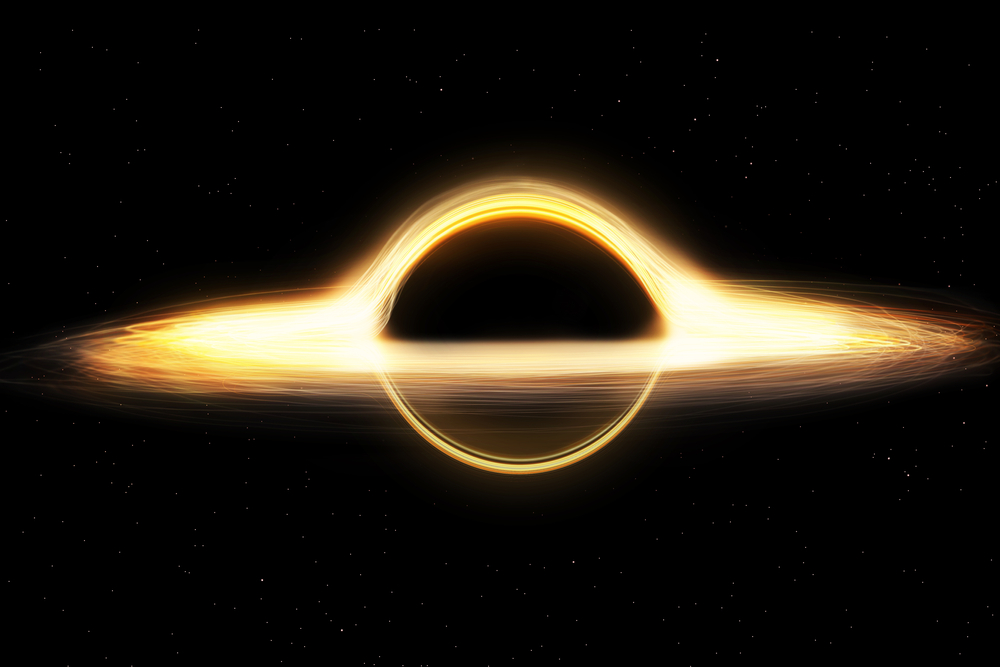
A new theoretical study suggests that Little Red Dots observed by the James Webb Space Telescope (JWST) could be black holes in rare, short-lived – but extremely volatile – nuclear bursts.
A paper by Yangyao Chen of Nanjing University and Houjun Mo of the University of Massachusetts reexamined a phenomena that has intrigued scientists since the JWST’s debut.
Astronomers have observed nearly 350 faintly-red objects that are particularly unusual for their apparent lack of x-ray, radio and infrared emission. They have a V-shaped spectrum, being bright in ultraviolet and optical light, but dim in between, as well as the broad emission lines associated with black hole activity.
Current theories posed that that the Little Red Dots – or LRDs – are primordial galaxies, or non-metallic primordial stars(also known as Population III stars), or even quasi-stars. The majority seem to have been formed 600 million years after the Big Bang, or 13.2 to 12.2 billion years ago.
Chen and Mo created a galaxy formation model built on the ΛCDM cosmological framework reported in a previous study. Using this model to trace back over 13 billion years ago to what could have created the LDRs, black hole seeds were presented as a possible source.
Frantic feeding during the universe’s infancy
Most of the black hole seeds observed in the model form at redshifts above 20 inside tiny “mini-halos” from the universe’s first generation of stars, less than 200 million years after the Big Bang. However, these seeds are too small to power a LDR on their own.
But growth through super-Eddington accretion- where the seeds are feeding at up to ten times the theoretical maximum rate- during “episodic nuclear bursts” as the researchers term it, could explain the origin of the LDRs.
“Our model suggests that it is post-seeding growth, mainly through episodic nuclear bursts, that raises BH seeds to supermassive status,” the researchers write in the paper.
These bursts are fast, violent periods of activity triggered by gravitational disturbances such as two galaxies merging. This leads to runaway black hole growth and intense star formation in a compact nuclear star cluster, producing the unique V-shaped spectrum. Younger stars produce blue UV light and super-Eddington black holes produce the red optical glow.
Around a billion years after the Big Bang at redshift 5, the black holes have grown to between 100,000 and 1 million solar masses through repeated nuclear bursts and can be visually identified as Little Red Dots.
There are likely many more LRDs, just out of JWST’s range
Researchers were keen to highlight that the population emerged out of the framework independently: “Our model is among the first to self-consistently include the formation of seeds and the BH-galaxy-halo co-evolution within a cosmological context, allowing the emergence of the LRD population as a natural outcome of the ΛCDM paradigm, rather than a result of fine-tuning.”
The future of the LRDs was found to be highly variable- some will have been swallowed into cluster galaxies by now. Others that developed in isolation will eventually resemble compact dwarf galaxies, or globular cluster-like objects. The model also predicted that there is a much larger population of less visible black holes in the violent growth phase, simply beyond JWST’s current scope.
“We will present a detailed analysis of the connection between LRDs and present-day compact dwarf galaxies in a forthcoming paper,” they conclude.