

Every week we take a look in the RTÉ Guide archives to check out the stories from years gone by. On this week in 1978, the cover was devoted to a new documentary series looking at international investment in Ireland entitled Ireland Tomorrow.
“The opening of the giant Asahi plant in April was one stage in a process of transformation probably more radical than any Irish village has yet known,” wrote journalist John Walsh. “Producer Peter Canning took it as the focus of Ireland Tomorrow. This three-part series, which starts this week, examines in detail what has been happening in Mayo over the last few years, and uses it to raise questions about the problems involved in this sort of undertaking anywhere in the country.”
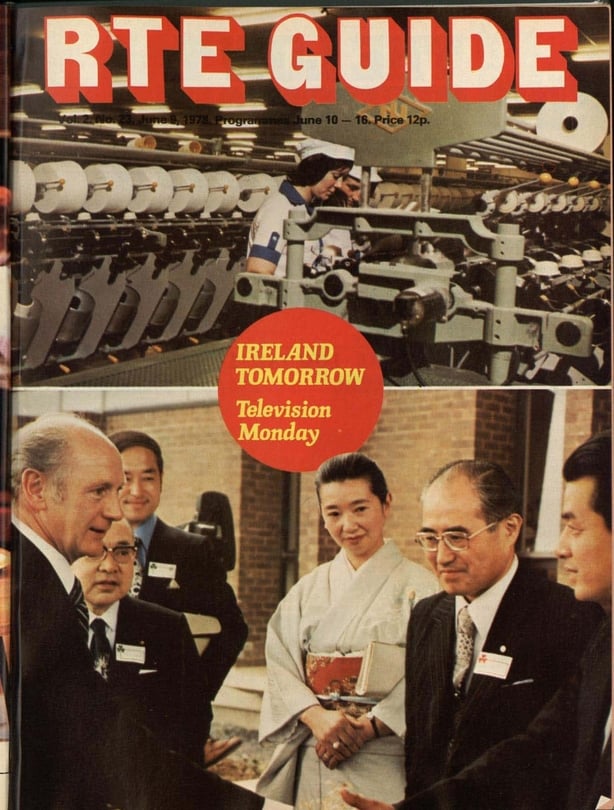
The cover of the RTÉ Guide on this week in June 1978
“Let’s be clear: it’s neither an anti-Asahi diatribe nor an apologia for the complex,” Walsh continued. “It’s a serious and extremely workmanlike study, undertaken with the help of experts such as John Martin (the UCD economist), Cormac O Grada (of Dublin Corporation’s Planning Office) and Ms Kane herself. Given its educational slant, it doesn’t draw conclusions, nor argue a particular point of view. What it does is give viewers the fruit of interviews with dozens of people of all points of view. In the process, it asks a lot of questions. A few years ago, RTE made a television documentary about the region, taking the river Moy as its focus. At that time, the makers were conscious that they were providing a record which would one day be of rare value, given the probable effects of Asahi. That day is almost here.”
According to the RTÉ guide piece, this was how reporter Michael Ryan describes pre-Asahi Killala:
Once a major ecclesiastical centre, a cathedral town, by 1971 Killala had been whittled down to 368 souls. Emigration was established as a normal, acceptable way of life. To school children the town where the French landed in 1798, to archaeologists the birthplace of modern Irish farming… but to many of its own people in the Sixties, a town with a proud past but no future.
“The changing of all that could be described as a giant success story — if you’re not one of the categories of people for whom Asahi spells trouble,” Walsh wrote. “Some would give the trouble a more complicated spelling: acrylonitrile.That’s the chemical they use as raw material for what they make. They used to call it vinyl cyanide, but that sounded too alarming by half. Whatever the name, it scared hell out of everyone who thought they’d be coming in contact with it on its way from Dublin docks by rail to he plant at Killala, and through to the dumping of the waste in the sea…In any case, the Killala Community Council did not falter. It attracted Asahi (it was to be sited at Ballina, but they couldn’t get enough land there) and stuck to its guns through thick and thin.”
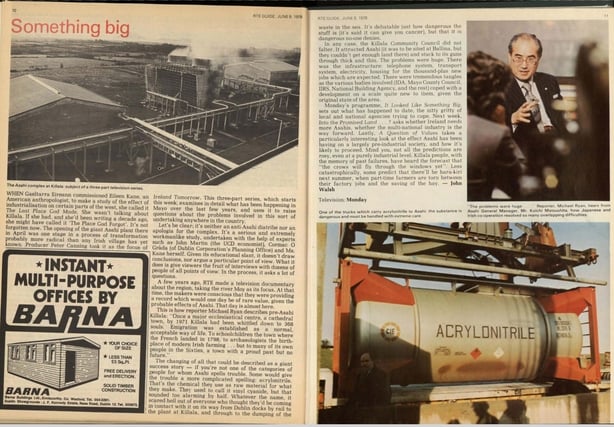
Two pages of this issue of the RTÉ Guide were devoted to the documentary
Setting up an industrial plant in this location wasn’t easy. “The problems were huge. There was the infrastructure: telephone system. transport system, electricity, housing for the thousand-plus new jobs which are expected, There were tremendous tangles as the various bodies involved (IDA. Mayo County Council, IIRS, National Building Agency, and the rest) coped with a development on a scale quite new to them, given the original state of the area.”
Nearly fifty years later, with foreign investment having become a key part Ireland’s economy, and with many examples of towns in Ireland that were transformed by international businesses only to be abandoned years later, this series sounds eerily prophetic. “Monday’s programme, It Looked Like Something Big, sets out what has happened to date, the nitty gritty of local and national agencies trying to cope,” wrote Walsh. “Next week, Into the Promised Land? asks whether Ireland needs more Asahis, whether the multi-national industry is the way forward. Lastly. A Question of Values takes a particularly interesting look at the effect Asahi has been having on a largely pre-industrial society, and how it’s likely to proceed. Mind you, not all the predictions are rosy, even at a purely industrial level. Killala people, with the memory of past failures, have heard the forecast that ‘the crows will fly through the windows yet;. Less catastrophically, some predict that there’ll be hara-kiri next summer, when part-time farmers are torn between their factory jobs and the saving of the hay.”
The Asahi plant closed in 1997, with the loss of 315 jobs. In 2025 planning permission was granted for the construction of a hydrogen plant and energy centre on the site.