
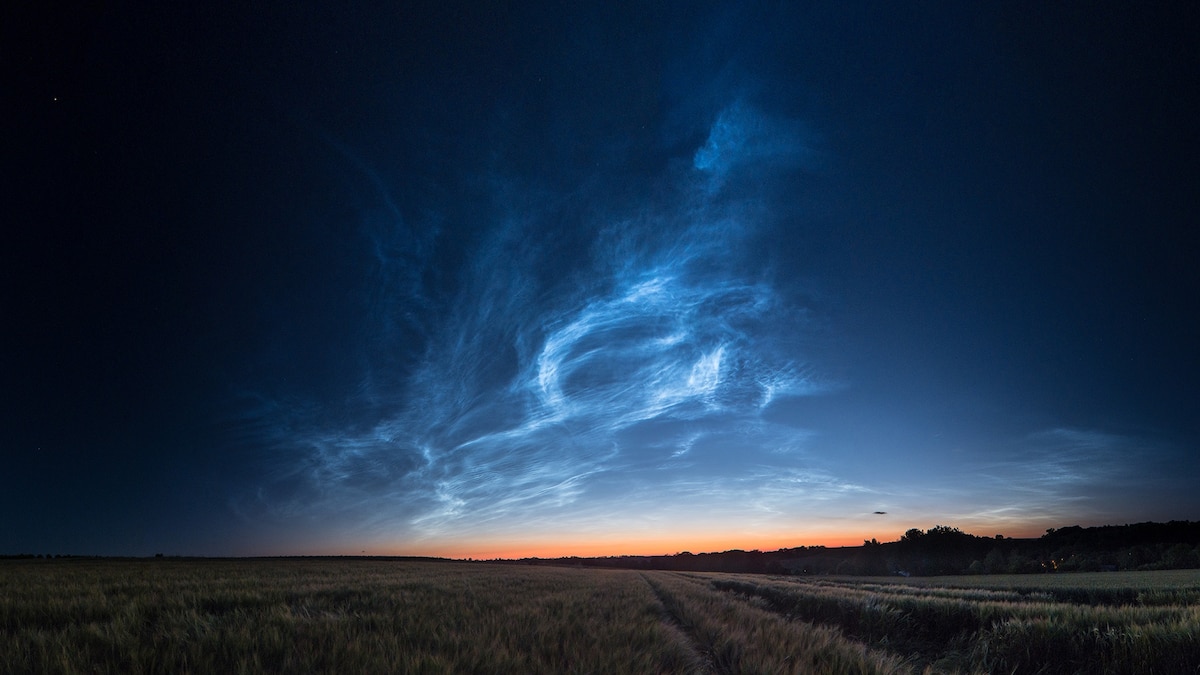
“Think of it like being in a dark valley while a mountain peak nearby is still lit up by a setting sun,” says Makens. “Your sky is dark, but the clouds 50 miles up are still in full sunlight.”
On occasion, you might spot noctilucent clouds outside of the summer season. “If a rocket launch happens a little before sunrise or after sunset, there is a chance you will see the exotic ‘jellyfish’ cloud! These are actually noctilucent clouds,” says Carfagno.
How atmospheric changes might affect noctilucent clouds
Scientists are also investigating whether noctilucent clouds are becoming more common—and what that might reveal about changes in Earth’s upper atmosphere.
Both observations and satellite data suggest the clouds are appearing more frequently and at lower latitudes than they once did. Researchers suspect several factors may be contributing to the trend, though the exact cause remains unclear.
“It probably is a combination of factors,” says Carfagno. Greater public awareness through social media has likely increased reporting, she says. But “there is more water vapor in our atmosphere due to a warming climate, and prolific rocket launches likely transport both dust and water vapor to higher latitudes,” she says. Because they form at the edge of space, they could serve as visible indicators of changes occurring high above Earth’s surface.