
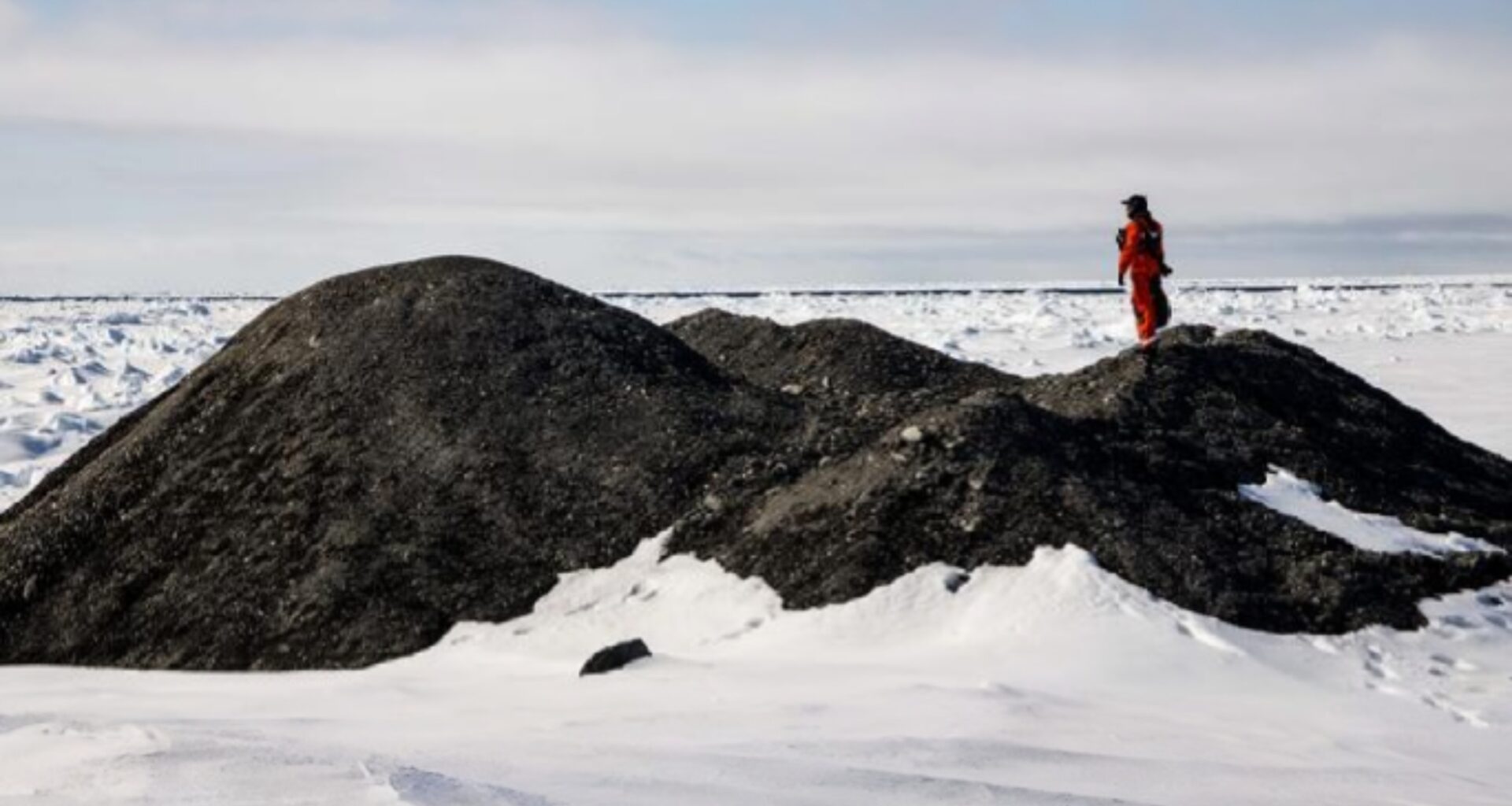
Icebergs are telling a new story about a changing Arctic. Melting glaciers, shrinking sea ice, and rising temperatures often grab the headlines.
Now, researchers have uncovered another surprising development.

Dark, debris-filled icebergs are carrying huge amounts of rock across the Arctic Ocean and dropping it onto the deep-sea floor.
The mystery of the nearly black icebergs
Most Arctic icebergs carry traces of the land where they formed. As glaciers move, they scrape up rocks, gravel, and sediment.
When chunks of glacier ice break off and become icebergs, some of that material remains trapped inside.
In 2021, researchers aboard the Polarstern research icebreaker spotted something different while flying over the Fram Strait, a major passage between Greenland and the Arctic Ocean.
Several icebergs appeared unusually dark because they contained enormous amounts of rock and debris.
Dr. Melanie Bergmann, a biologist at the Alfred Wegener Institute Helmholtz Centre for Polar and Marine Research, immediately recognized that something unusual was happening.
“Some of the icebergs were carrying unusually large amounts of debris and looked almost black from above.”
The expedition team collected samples and documented the icebergs. What they found raised even more questions.
“We immediately realised that tonnes of rock were drifting through the Arctic Ocean, hundreds of kilometres away from any glacier.”
A trail of stones deep below
About 8,200 feet below, images from the long-term observatory known as AWI-Hausgarten revealed growing clusters of stones scattered across the seafloor.
These rocks had fallen from melting icebergs as they drifted through the region.
Dr. Kirstin Meyer-Kaiser of the Woods Hole Oceanographic Institution analyzed deep-sea photographs collected over several years and noticed a clear shift.
“Where previously there were only isolated stones of various sizes, we are now finding much larger accumulations, frequently in small groups,” said Dr. Meyer-Kaiser.
“And with each new stone, a permanent settlement is created on the seabed. Sponges, anemones and other animals that favor hard substrates can settle there. As a result, biodiversity in the deep sea is increasing.”
Scientists compared rocks collected from icebergs with those found on the seabed. The match was striking.
“The stones show a clear match in both size and mineralogical composition.”
Climate change leaves a fingerprint
The discovery raised an important question. Was this simply a local event, or was climate change driving the increase?
To find out, researchers from several scientific fields worked together. They needed evidence that more icebergs were passing through the Fram Strait than in previous decades. That proved difficult.
Dr. Thomas Krumpen, a sea ice physicist at the Alfred Wegener Institute and co-lead author of the study, explained the challenge.
“In order to prove that climate change is intensifying the process, we had to show that the frequency of icebergs in the region has changed because smaller icebergs and their fragments in the pack ice can hardly be recognized by satellite,” he noted.
“That’s why no one has been able to say whether there are more icebergs today than in the past.”
Forty years of observations tell the story
For roughly 40 years, crews aboard the Polarstern have recorded observations from the ship’s bridge.
These records were originally gathered alongside routine weather data, but they also documented the presence of nearby icebergs.
“This data set is actually a by-product of the regular weather records, but it turned out to be crucial for this issue,” says Krumpen.
The records revealed a clear pattern. Since the early 2000s, increasing numbers of icebergs have moved through the Fram Strait, often traveling in larger groups.
This suggests that the growing deposits of stones on the seafloor are part of a broader trend linked to a warming climate.
Researchers traced many of these icebergs back to northeastern Greenland and parts of the Russian Arctic.
The glaciers in northeastern Greenland have become less stable over the past two decades and are calving ice at a faster rate. The timing closely matches the rise in iceberg traffic farther south.
Faster melting, faster transport
Scientists also used computer models to examine the role of disappearing Arctic sea ice.
The results showed that as sea ice becomes thinner and retreats, icebergs can move more quickly through the Arctic.
They also spend more time in open water, where melting happens faster.
This combination increases the amount of rock released into the ocean and eventually onto the seabed.
New risks in a changing Arctic
“An increasing presence of icebergs in certain regions of the Arctic harbors considerable risks, for example for cruise ships and cargo ships, which are travelling in ever greater numbers in the ice or near the ice edge, as well as for exploration activities for oil and gas,” said Dr. Krumpen.
The newly deposited rocks could also create future challenges for commercial fishing operations.
“As fishing moves further north, newly deposited stones in shallower areas could also become a risk for bottom trawling in the future.”
The dark icebergs drifting through the Arctic are doing more than carrying frozen water. They are transporting pieces of the Arctic landscape itself, leaving lasting changes on the ocean floor.
The research offers another reminder of how deeply climate change is reshaping one of Earth’s most sensitive regions.
The full study was published in the journal Nature.
Image Credit: Alfred Wegener Institute / Mario Hoppmann
—–
Like what you read? Subscribe to our newsletter for engaging articles, exclusive content, and the latest updates.
Check us out on EarthSnap, a free app brought to you by Eric Ralls and Earth.com.
—–