
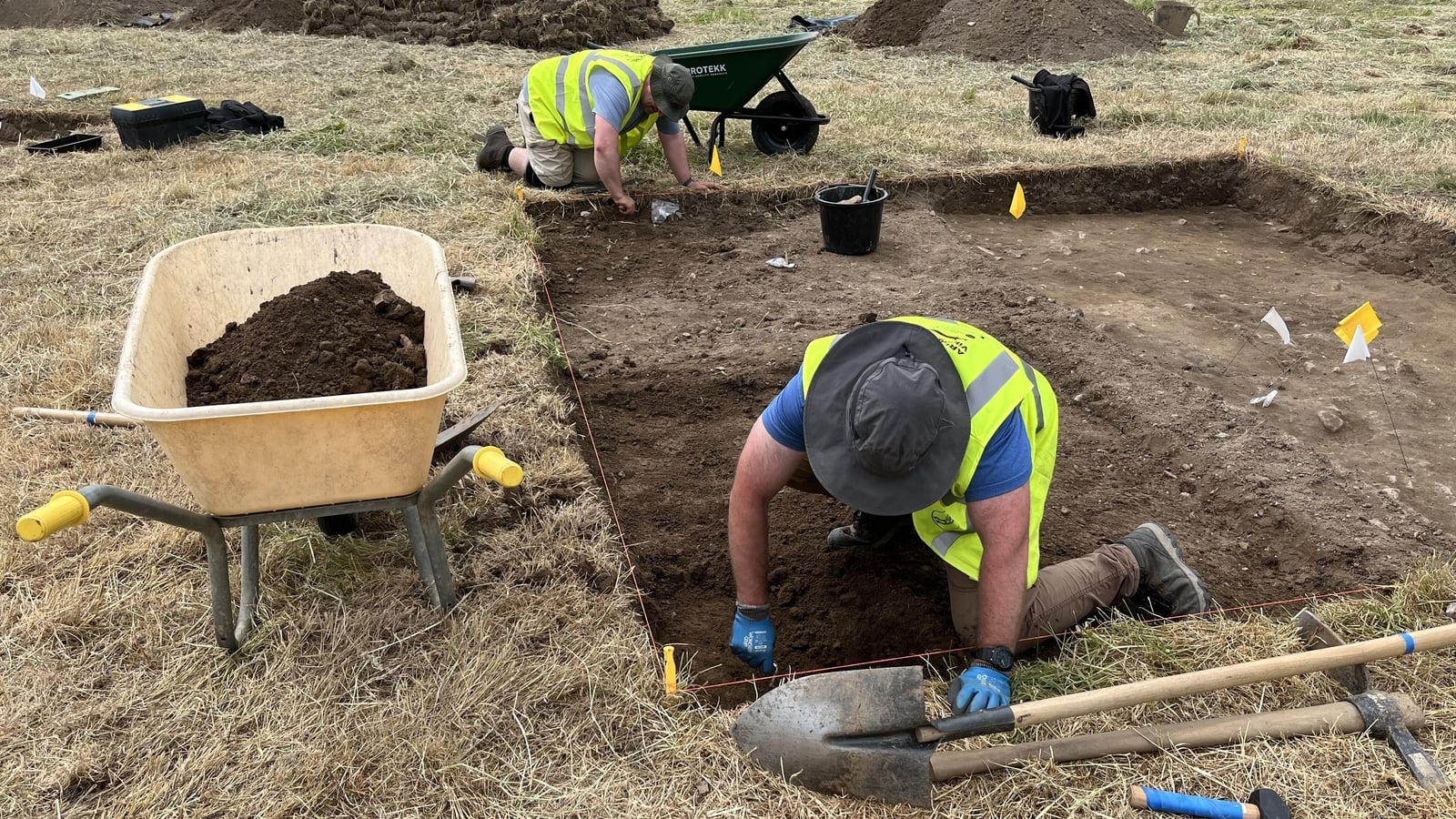
A team of archaeologists from Ireland and Norway are aiming to unearth more of the two countries’ shared Viking past at an archaeological dig near Waterford city.
The excavation is taking place in a field in a townland called Woodstown on the banks of the River Suir, just west of the city.
The Woodstown Viking site was first discovered in 2003, by a small team of archaeologists, in advance of the construction of the N25 Waterford City Bypass.
They found a Viking settlement that had been forgotten for over a millennium.
The discovery was deemed so significant that the route for the planned bypass was changed to preserve the site.
Now, over 20 years later, what has been described as a “targeted excavation” is taking place at the heart of the site that researchers believe will uncover the foundations of a significant structure, possibly the remains of a Viking longhouse or hall.
If confirmed, it may turn out to be the largest Viking structure identified in Ireland to date.
This week, the dig has already turned up several items believed to be from the Viking Age, including a lead weight used for trading, a small gaming piece, and a piece of copper alloy or bronze that was likely taken during a raid on an Irish church, monastery or shrine, dating back around 1,200 years.
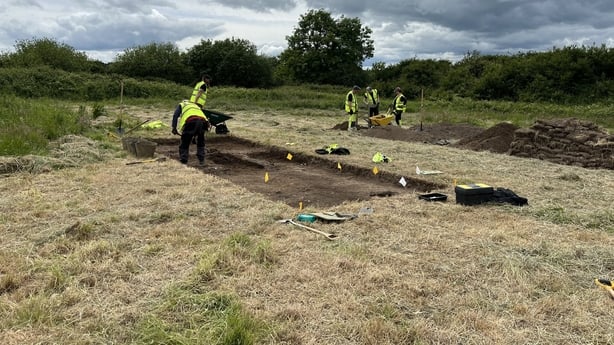
The dig is taking place in Woodstown on the banks of the River Suir
Archaeologist Dr Susan Curran from The Discovery Programme, one of several research bodies involved in the project, said the current dig came about after the structure was revealed during geophysical surveys.
She said: “The site was discovered back in 2003. There were test excavations at the time and there was some survey work done.
“In 2018, thanks to the Woodstown Conservation Management Plan, there was a few further campaigns of geophysical survey. Geophysical surveys map what lies underneath the ground’s surface. You can see at Woodstown, it is just flat fields, you wouldn’t think there is anything here.
“But, since 2018, we have introduced three different survey techniques, and each of them kind of looks for different kind of responses in the soil, can tell us a little bit more about what lies underneath the ground, and a bit more about the settlement itself.”
Dr Curran said that through these different techniques, the research team was able to identify more structures and more possible buildings at the site.
“We know then, when we come here to excavate, the questions that we want to ask and the answers that we want to try and find out,” she said.
“It gives us a much better idea of where we want to put our trenches and how best to approach the excavation to answer the questions that we want to know.”
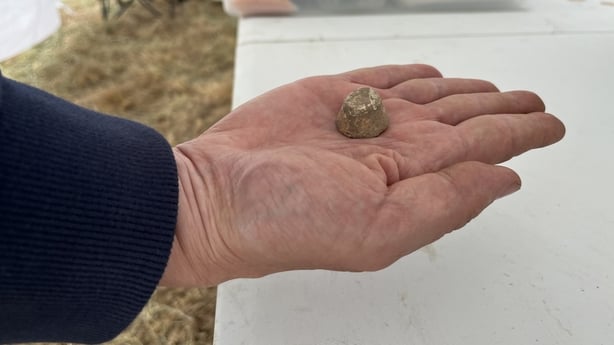
A probable lead weight used for trading
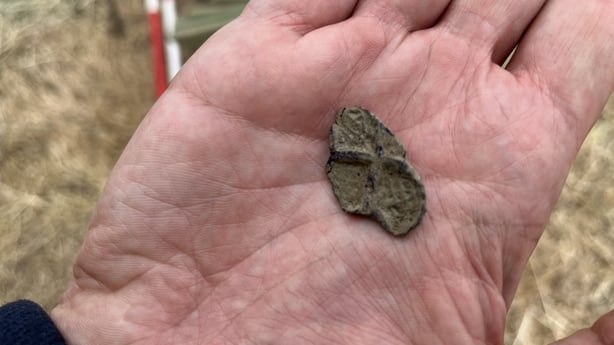
An archaeologist holds what is likely to be a piece of copper alloy or bronze
Archaeologist with the Clonmel-based Abarta Heritage company, Neil Jackman, is another one of the project’s co-directors.
Mr Jackman said items discovered so far are believed to be Viking artefacts and further evidence that the Norse seafarers from Scandinavia were both “traders and raiders”.
He said: “We are only just coming down onto the main archaeological levels right now, but we have already found a number of artefacts that tell you about life here in the past, and the story of the Vikings.
“When we think of Vikings, we think of trading, and some of the things we found include lead weights. They were used to measure silver.
“Even before the Vikings came along, Ireland was largely a capital-based economy. They brought in silver in great quantities, and that is how they measured it.
“So, we are getting an insight into Woodstown as being a really important trading hub, but we are also getting evidence as well of what people might be more familiar with, the Vikings in terms of raiders.
“We have got a beautiful piece of copper alloy or bronze, which has a cross on it and insular Irish art. It has clearly been taken from an early Irish monastery or church site, so that is giving you a bit of a picture of what the raiding was like.
“But that is one of the magical things about archaeology, you know, the person who found that, the last person who handled it before him or her was probably a Viking raider here around about 1,200 years ago give or take.”
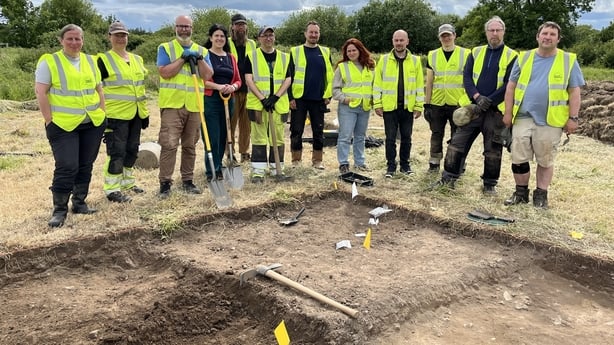
The team carrying out the archaeological dig are pictured at the site
The pilot project, which is being supported by the Royal Irish Academy as well as Waterford City and County Council, also has an international element.
Kristin Armstrong-Oma is a professor of archaeology in Norway and the director of Stavanger University Museum.
Prof Armstrong-Oma, who is also involved in the dig at Woodstown, said that collaboration between experts from both Ireland and Norway is important to uncover the full picture of the shared past of both countries.
She said: “In our museum, in our collection, we have the greatest collection of Irish artefacts from the Viking Age in all of Scandinavia.
“Clearly, there was a special connection between our part of Norway, southwestern Norway, and Ireland in the Viking Age, and this is something that we want to explore here together.
“For us, we tend to focus on the objects in Norway, but we are also very interested in what happened when the Vikings went to other places.
“We are now excavating what will probably be the largest long house found in all of Ireland from this period”
“Who did they meet? What kind of liaisons did they form, and where did they settle? What did those settlements look like, and what kind of ideas did they bring back with them to Norway?
“That is one of the things that we are exploring here, and we are now excavating what will probably be the largest long house found in all of Ireland from this period, and the Vikings back in back home in Rogaland, they built houses just like this.
“So, with bringing over archaeologists who are used to digging these particular kinds of settlements and structures, we are also bringing something to Irish archaeology, and that collaboration and learning from each other is very important to us as well.”
A number of public tours of the excavation site took place at the weekend.
Mr Jackman said the overall goal of the project is to bring what they have unearthed about the past to future generations.
He said that the site is very accessible as it is right beside the Waterford Greenway.
“With continued support, what we are hoping to do is to carry on doing more surveys, more research excavations, and eventually perhaps, doing things like reconstructing, using Viking techniques, some of the structures that we found here, which will hopefully become educational resources, and also for tourism as well that people can come along and see that right on the doorstep of the city,” Mr Jackman said.
“They have got one of the most important Viking sites in the world here, and it is a wonderful opportunity to do good things with that,” he added.
The dig takes place until 19 June before the excavation site will be back filled.