
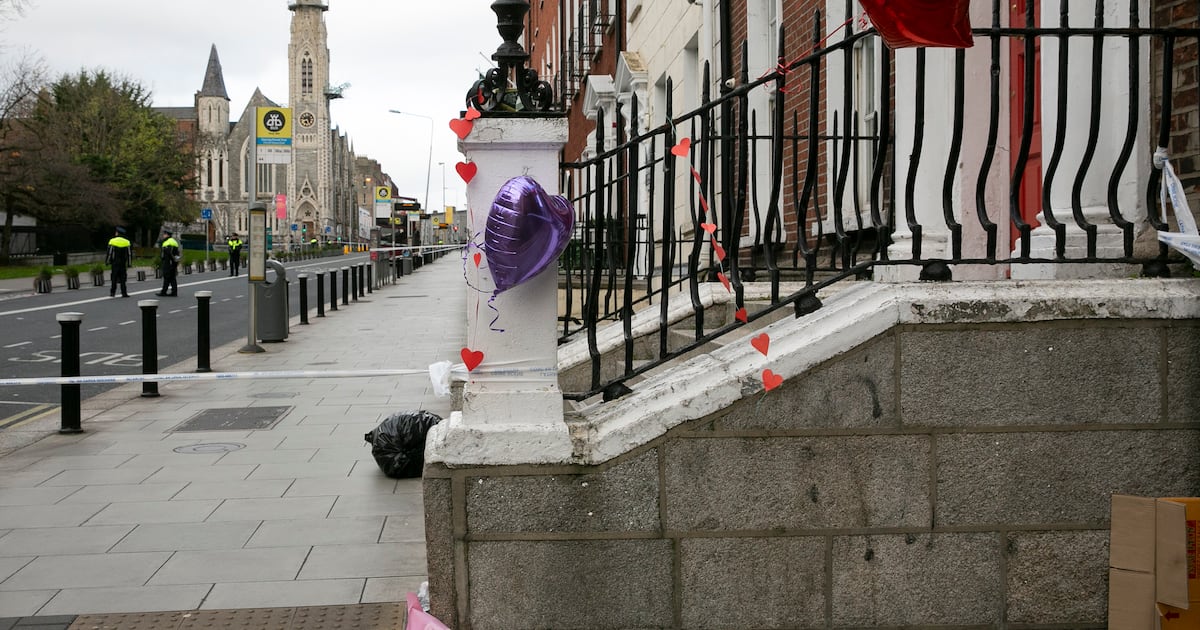
A consultant has told the Central Criminal Court that doctors “went against protocols and just ran with things” as they tried to save the life of a five-year-old girl with no pulse who had been stabbed in the heart on a Dublin city centre street.
Dr Michael Boyle, the head of the neonatal department at the Rotunda Hospital, said he believed the little girl was dead when he saw her “grey” skin and failed to find a pulse despite the attempts of paramedics to revive her using CPR.
Boyle was giving evidence in the trial of 52-year-old Riad Bouchaker, who denies the attempted murder of the little girl and two other children. He also denies causing serious harm to a creche worker and assault on two other children and a teenager.
Boyle told prosecuting counsel Carol Doherty that he came upon the scene after hearing about a stabbing on Parnell Square East, close to the Rotunda where he was working. He found lots of people there and his own neonatal transport team attending to the girl after they were flagged down on their way to the Rotunda.
The child, he said, looked grey and paramedics had placed drains in her chest and were doing CPR to try to massage the heart. He said Dr Peter Harper, a paediatric anaesthetist from Temple Street hospital, “fortuitously” happened upon the scene and helped to put a breathing tube into the girl’s airways.
When paramedics paused their chest compressions, Boyle said he checked for a pulse at the girl’s femoral artery but found nothing.
Another doctor from the Rotunda had ordered blood to be sent immediately and the decision was taken to carry out a transfusion in the ambulance. He said they “went against protocols and just ran with things” because they wanted to act as quickly as possible. They decided to take the girl to the nearest hospital, at Temple Street, even though they knew there was no cardiothoracic surgeon there. “She didn’t have time to go anywhere else,” he said.
Boyle said he needed to bypass the emergency department because that would have delayed her getting to the operating theatre. While the ambulance transported the little girl, Boyle ran to Temple Street hospital and told the emergency staff that the patient was not to come to them. He then ran to the operating theatre to make space and asked a colleague to call the Mater hospital to get them to send a heart surgeon immediately.
Doherty asked what Boyle thought when he couldn’t find a pulse at the girl’s femoral artery. “I thought she was dead,” he said.
The court also heard that a Garda presence was needed when Riad Bouchaker was taken to hospital because staff knew that he was alleged to have been involved in the stabbing of a child and they were nervous.
A 24cm carving knife that was recovered from the scene of the stabbing was also shown to the jury on Friday.
Det Sgt Padraig Cleary told prosecutor Karl Finnegan that gardaí attended the Mater hospital during a 28-day period following the alleged attacks. The detective said officers were there partly to gather Bouchaker’s belongings or evidence samples but also as “reassurance for staff at the hospital”.
He added: “They knew the incident he was alleged to have been involved in and people were nervous. So we retained a Garda presence at the hospital for that purpose.”
Cleary said he later learned that the accused had post-traumatic amnesia which required a 28-day assessment.
On December 20th, a consultant psychiatrist assessed Bouchaker and said told gardaí he was being discharged.
Det Sgt Cleary went to Bouchaker’s room and, with the help of the translator, explained to him that he was arresting him for attempted murder and was going to take him to Mountjoy Garda station, where they arrived at 7.15am.
Cleary also told Finnegan that on the day of the alleged stabbings, he and other gardaí were able to watch CCTV footage of the incident within 30 minutes of it happening. He said he noticed in the footage that the suspect had removed a backpack moments before the attack and left it at a bus stop. He sent gardaí to photograph the backpack and other items, including a knife, that were found nearby.
The trial has previously heard that a member of the public removed the knife from the scene and put it over a railing into the Garden of Remembrance, across the street from where the incident had happened.
Det Gda Ian Walsh told Finnegan that after the knife had been photographed, he placed it in a protective tube.
Walsh on Friday removed the knife from the tube and showed it to the jury.