
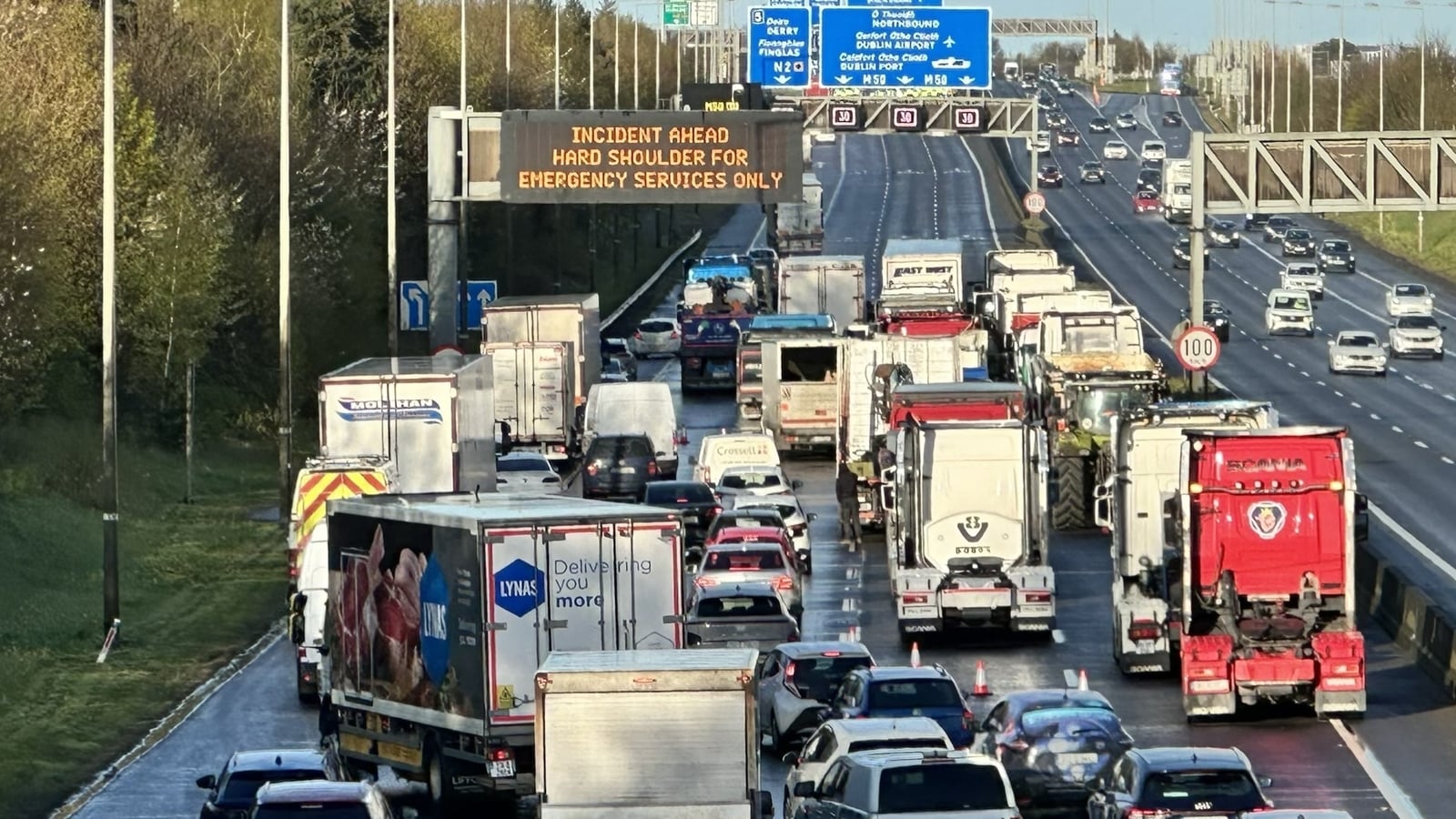
Analysis: A new study shows the severe social, economic and wellbeing impacts that congestion is having on the motorway’s users
By Brian Caulfield and Matthew Wood, TCD
At the end of April, the Centre for Transport Research at Trinity College Dublin launched an M50 user survey to ascertain the impacts congestion is having and what the public think the potential solutions could be. The survey was open for over a month, and almost 2,000 M50 users completed it.
The main findings of this study demonstrate the severe social, economic, and well-being impacts that congestion is having on the motorway’s users. The results also demonstrate that public transport improvements are heavily favoured as the key solution to alleviating congestion.
The last 12 months on the M50
One of the first questions asked to the respondents was whether their travel time on the M50 had increased over the past 12 months. Unsurprisingly, 85% of the sample indicated that their journey times had got worse.
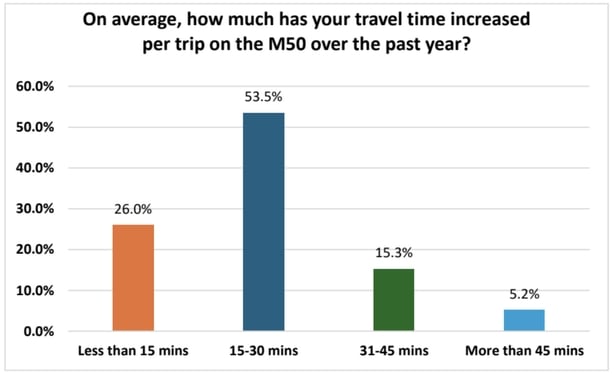
When asked how much longer they were spending per trip on the M50, 53.5% of respondents indicated they were spending an extra 15 to 30 minutes. When looking at those living outside of Dublin, we see a higher percentage (20%) saying the delays are between 31 and 45 minutes, compared to 10% for those who live in Dublin.
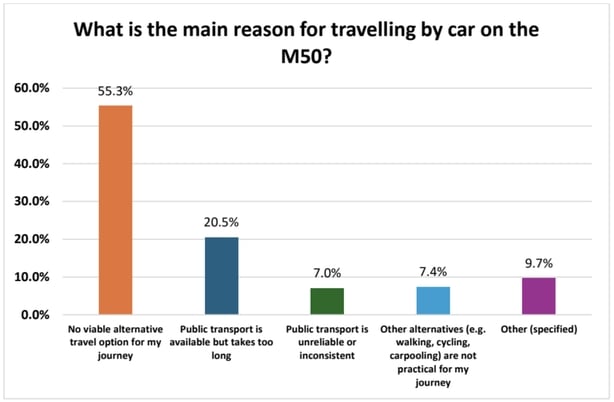
Given this increase in congestion, we asked why users took the M50 in the first place. Over half (55%) of respondents indicated that they had no other viable alternative, while 20% indicated that public transport was an option but would take too long. A further 7% indicated that public transport was unreliable, leaving them with no real alternative.
Impacts of congestion
While many metrics exist on the economic impacts of congestion, one being that it could cost the capital over €1.5 billion a year by 2040, less information exists on the real human impacts. Loss of time due to congestion was cited by 52% of respondents, and a third indicated that leaving earlier to avoid traffic was one of the main time impacts of travelling on the motorway.
The impacts upon individual well-being were also significant: 42% said using the motorway negatively impacted their stress levels, and 18% said it caused them anxiety. Exhaustion was also highlighted by 34% of the sample as a daily consequence of the gridlock.
When considering the financial strain of M50 congestion, 47% said the economic cost of increased fuel usage was the largest impact, and 21% of respondents indicated that it was impacting their work performance. A further 18% of respondents said they had to work longer hours due to time lost in traffic.
We need your consent to load this rte-player contentWe use rte-player to manage extra content that can set cookies on your device and collect data about your activity. Please review their details and accept them to load the content.Manage Preferences
From RTÉ Radio 1 Drivetime, Prof Brian Caulfield on how you solve a problem like the M50
When asked about the social impacts, 43% said they had less time at home, 28% said it had substantial impacts on hard deadlines (such as collecting children from school and activities), while 25% said it was reducing their personal leisure time. When drilling down into the results, we can see that parents with young children at home indicated that a reduced amount of time at home was having a substantial negative impact on their well-being and quality of life.
What are the potential solutions?
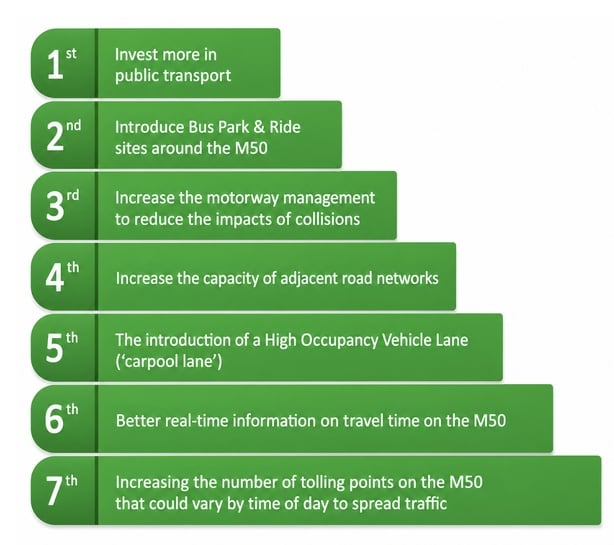
When asked to rank solutions to potentially reduce congestion on the M50, investing in more public transport in the Greater Dublin Area emerged as the top preference. This was followed closely by the introduction of bus park-and-ride sites around the M50 corridor.
The third most popular solution was to increase motorway management to reduce the congestion impacts of incidents, followed by a desire to increase the capacity of adjacent road networks to alleviate the problem. The fifth most popular solution was to introduce a high occupancy/carpooling lane, and the sixth was to provide better real-time information regarding congestion delays. The least popular solution by far was to introduce multiple tolling points on the motorway.
The results from this study are clear. The users who engaged with the survey indicated that one of the most effective solutions to congestion on the M50 would be an increased investment in public transport. Recently, it was reported that the Minister for Transport is to bring forward a strategy aimed at reducing congestion in the Greater Dublin Area in the short term.
Given the long lead-in times for the planning and construction of major infrastructure, any meaningful alleviation of the current problem is likely to take time. However, the option of bus park-and-rides along the M50 is something that could be introduced relatively quickly. As evidenced by our results, current users of the motorway would be heavily in favour of such an intervention.
The current chronic congestion issues are the result of decades of underinvestment and stagnation in delivering public transport projects
While this was a study of the busiest motorway in the country, one cannot ignore the identical problems that exist on roads and motorways right across Ireland. The results and solutions provided by this study could easily be replicated in our other towns and cities. Equally, the negative impacts of congestion, be they economic, social, environmental, or psychological, are being felt by citizens nationwide.
The current chronic congestion issues are the result of decades of underinvestment and stagnation in delivering public transport projects. While there are some quick fixes that could be achieved today, focus must also be intensified on delivering a nationwide public transport service that is truly fit for purpose.
Follow RTÉ Brainstorm on WhatsApp and Instagram for more stories and updates
Prof Brian Caulfield is Professor in Transportation and Director of the Trinity Centre for Transport Research at TCD. He is a Research Ireland awardee. Matthew Wood is a Research Assistant at the Trinity Centre for Transport Research at TCD.
The views expressed here are those of the author and do not represent or reflect the views of RTÉ