
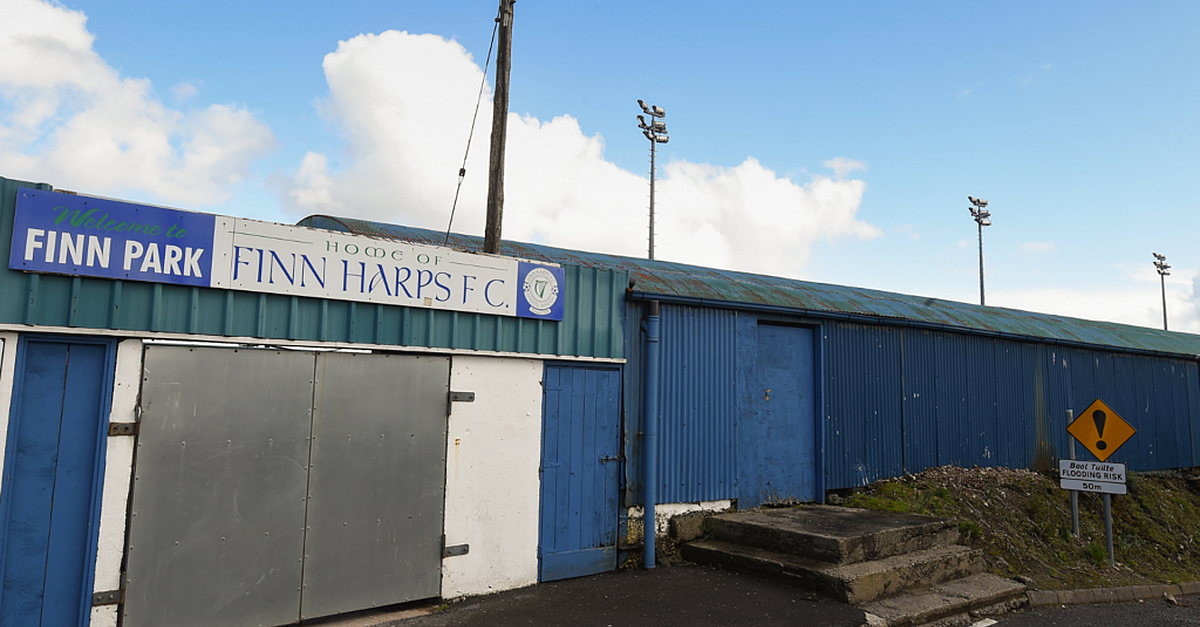
On Sunday-week, Finn Harps members will convene for what feels like the most important meeting in the club’s 72-year history.
A south-east Asian businessman, whose identity has not yet been disclosed, has tabled a formal offer to buy the club.
Members will be asked to vote at two separate meetings in the next month as the Harps Board of Directors look to conclude what would be a seismic deal.
Donegal Daily can reveal that the man has committed to providing a total of €1.6m to cover Harps’ total contribution to the development of the new stadium in Stranorlar. He will also put forward €213,000 to acquire the parcel of land in Stranorlar that the new stadium sits on.
The prospective buyer has been in Donegal for extensive talks with Harps lately and has also attended a game at Finn Park.
He will take on the club’s creditors – which stood at €511,325 in the last set of audited accounts, covering the 12 months to the end of December 2024 – and cover legal and commissioning fees.
An as-yet-undisclosed seven-figure sum is committed in annual payments for the operational running of the club over an initial contracted period of three years.
It is believed that, if the transaction gets the green light, Harps will begin to move towards a full-time model. There will be new full-time roles for some football and administrative staff.
The prospective new owner is understood to have committed to making additional full-time hires to oversee the day-to-day running of the club, including a full-time CEO and a Head of Football.
There are protections included in the terms of the deal that will preserve the club’s name, colours and location in the Twin Towns.
On July 5 at a special general meeting, Harps members will be asked to vote on whether or not to change from a Co-Operative Society model to a private limited company. Provided that initial vote is carried, they will be asked to vote on the possible sale of the club two weeks later. The first vote would need the go-ahead from 75% of the attendance to pass while the second requires a simple majority of attendees.
“We really need a high participation level at the special general meeting so we urge everyone to attend,” a club spokesperson has told Donegal Daily. “This is a monumental phase in the club’s history and we believe that this is a massive opportunity that has been presented in front of us.”
While the businessman – who has played football at a professional level in Asia – would assume 100% ownership of Finn Harps, he plans to appoint a Board of Directors to run the club. It is understood that the current Board has been asked to stay on in some capacity, while the prospective owner is also said to be keen to retain Harps’ loyal volunteers.
“He very much wants it to be a community club,” the Finn Harps Chairman Ian Harkin says. “What he is doing here is to pay for new hires.”
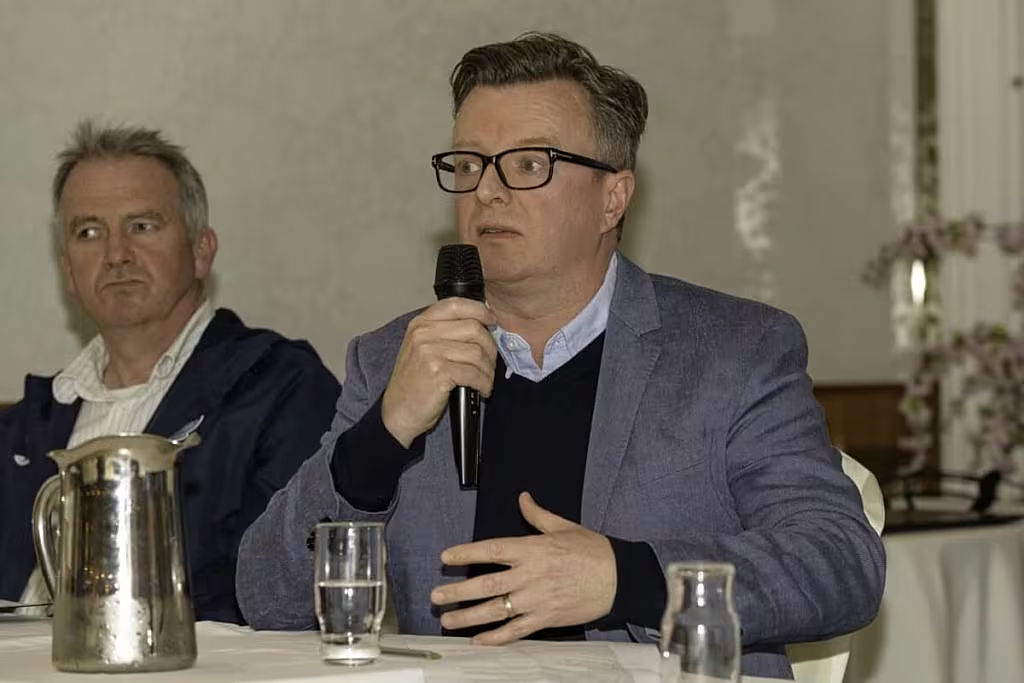 Finn Harps Chairman Ian Harkin
Progression on initial talks required securing planning permission for the stadium, which Donegal County Council granted in December 2025.
The deal is contractual and based on conditions being met while the initial €1.6m for the stadium development would be held in an escrow account and would essentially kick in as soon as contracts are signed.
Separately, and unrelated to the takeover bid, Harps will also have the services of two people appointed by Sport Ireland – a Head of Academy and Head of Coaching – who are to be appointed shortly. Indeed, Harps are understood to have made an offer to someone for the Head of Academy role.
In the summer of 1996, following a failed takeover bid and an attempt to relocate the club to Letterkenny, the Finn Harps Co-Operative Society was born. For close-to 30 years that model served a purpose, but it has been clear for some time that real buy-in and engagement from shareholders was waning. Meetings of the Finn Harps Co-Operative Society Ltd, including annual general meetings, would attract 20-30 attendees at best.
A new membership scheme, in which people paid €25 per annum to be a member, was launched in November 2024.
At the launch in Jackson’s Hotel, Harkin outlined that Harps would need to get around 6-8,000 members before the club could “confidently turn our backs on private ownership”. Only 2,000 signed up and until last week only one-third of those had renewed for 2026. Simply put, it hasn’t worked.
You may also be interested in
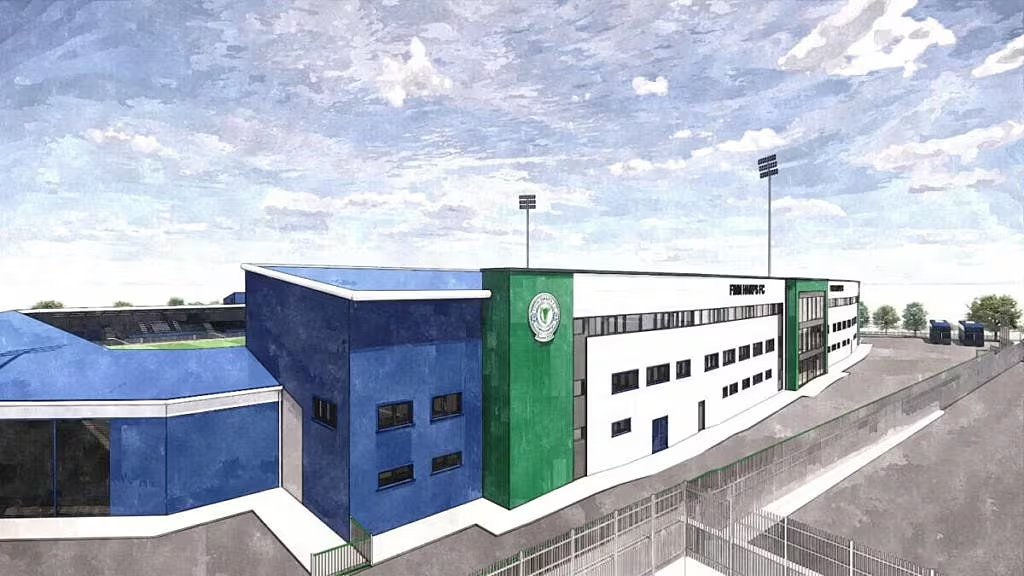 An artist’s impression of the new Finn Harps stadium in Stranorlar
Last October, Harps sought the assistance of Tom Markham, of Markham Capital and Sports Advisory Limited, to lead a search for a suitable external investment partner.
A prospectus, detailing the club’s own business plan and outlining its ambitions, was put together by Harps and circulated among prospective buyers. Around a dozen people expressed initial interest before the matching process ruled out several.
Some dropped out due to the negative balance sheet, for others the remoteness of the club was a draw-back.
Harps say that they have gone through a thorough process of due diligence. The Football Association of Ireland has been consulted on the deal and have also done their own processes.
“He related to the club in many ways,” Harkin said. “We looked at a number of different options. There are loads of people looking to invest and there are a lot of multi-club models, but we felt that that would be a stretch too far.
“Moving to a Co-Operative Society model in the 1990s was the right move at that time. We had plans to develop Finn Park, but we just couldn’t get planning for it. Infrastructure has always been the key thing to drive this club forward and we have been suffering with poor infrastructure for a long time now.”
Developing Finn Park has long since been ruled out simply due to planning permission not being possible. There are plans for the river bank behind the River End net to be raised. For every one metre that is raised, the base would have to extend by two metres – encroaching onto what is now the Finn Park pitch.
For licensing, the current parcel of grass inside the perimeter wall is not long enough and would need to be increased by some nine metres.
“It is just not workable to do anything at Finn Park,” Harkin says. “There is a lot of emotional attachment to Finn Park, and I get that, but redevelopment is just not doable. If we were to redevelop the main stand, for example, currently there is no footpath as you exit and because we are inside the town boundary it would have to be three metres in width; we just don;’t have the space.”
Finn Park has been owned by the Finn Park Trust, a group of 16 people (eight Catholics and eight Protestants), since the late 1960s and is leased to Finn Harps. Only one of the original 16 people is still alive.
There are 10 years remaining on that lease and the existing Finn Park will stay within the ownership of the Trust. In the period while the new stadium is being constructed, the lease would remain active and transfer to the new owner of the club.
Harps have realised that they are drastically falling behind their peers.
Harps can point to Waterford United, bottom of the Premier Division despite a turnover of €2.8m and with playing costs in excess of €1m.
“We are scraping by just to keep going,” Harkin says. “In our division at the moment you have Kerry, Cobh, Cork, UCD, Treaty and Athlone all pretty much full-time and you can see it from a player development and strength and conditioning point of view. That is only possible from private investment or being a college. Bray Wanderers will go the same way and you’re left with Wexford and ourselves on pretty much the same budget and focussing primarily on infrastructure development.”
Last week, in a circular to members, Harps said that they now need investment “simply to stand still, and we need significantly more investment to grasp the opportunity that is now in front of us”.
Initially, the Board of the club has unanimously approved the proposal being put to its members.
Now, they will be asked to determine the next step.
Harkin says: “It is not necessary this or bust, but it is this sort of a step or bust.”