
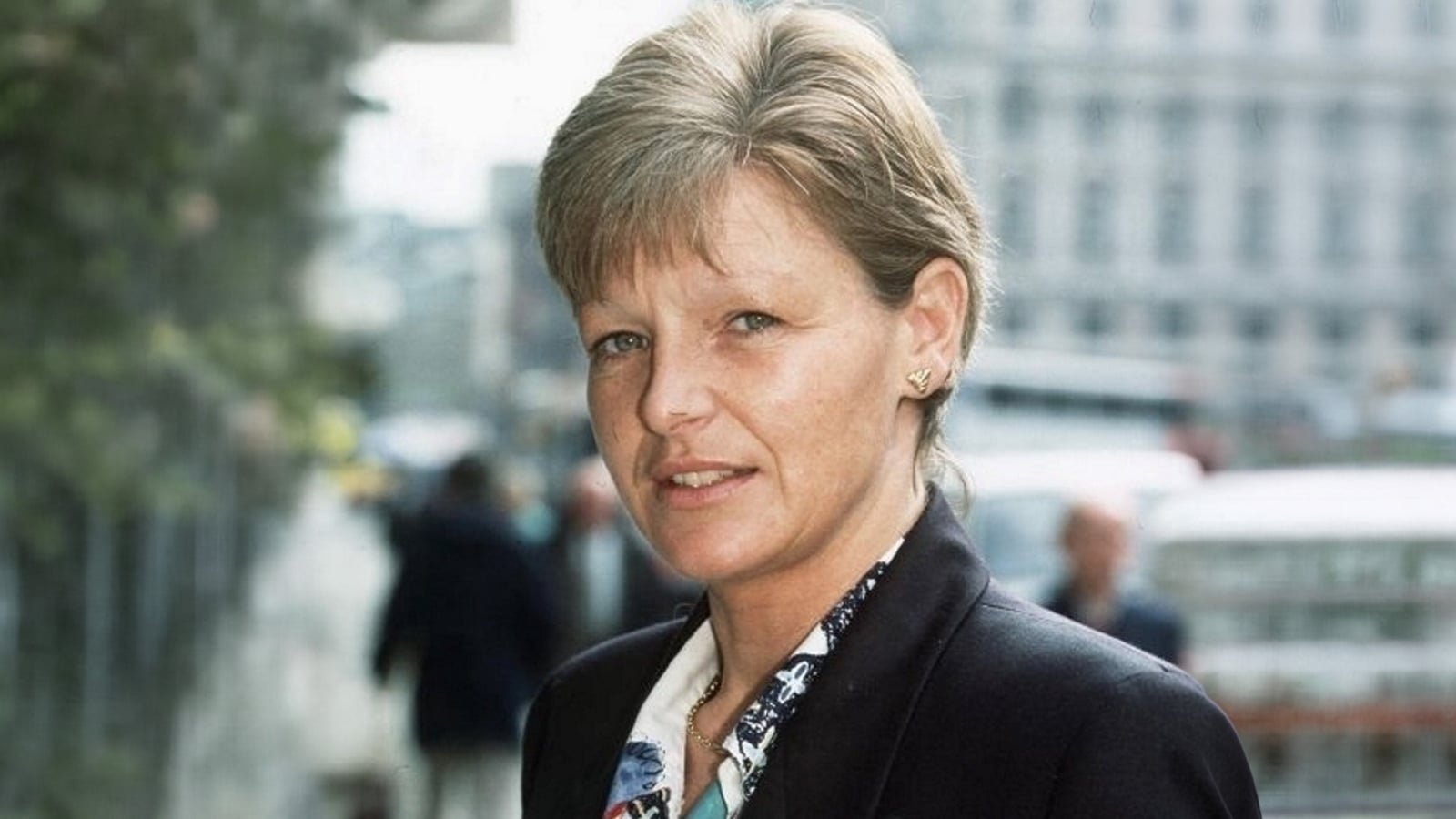
Lise Hand, friend of journalist Veronica Guerin, said her death stopped people in their tracks because not only was she a well-known journalist who was “massively well liked” but she was a wife, a mother and a young woman who had been “executed in broad daylight on a sunny day on a busy road”.
The day Ms Guerin died began as a normal day in the Sunday Independent newsroom, she said.
Ms Guerin was going to Naas to the District Court to deal with summons for speeding fines.
“She was genuinely afraid that her car was going to be taken off the road because Veronica worked in her car, it was her office, her mobile office,” Ms Hand said.
On her way back to the office, the journalist called the newsdesk and asked to speak to Ms Hand.
She said: “We arranged to meet for coffee, so I went out for lunch, turned my phone off.
“I suppose in an irony I was coming back to the office … hurrying back to the office to meet her about an hour-and-a-half later.
“I see the newsstand at the corner of the GPO arcade and Henry Street, which led to the backdoor of the Independent newspapers building and I see a crowd around the newsstand.”
Initially, Ms Hand said she was amused as it was the type of thing one sees at moon landings or the outbreak of war.
Then, she said she saw the headline of the late edition of the Herald: “Veronica Guerin shot dead.”
“To be honest, I didn’t believe it,” she said.
“But as soon as I walked into the newsroom, I knew that it was the truth,” she added.
Lisa Hand speaks about the death of her friend, Veronica Guerin
We need your consent to load this rte-player contentWe use rte-player to manage extra content that can set cookies on your device and collect data about your activity. Please review their details and accept them to load the content.Manage Preferences
Speaking on RTÉ’s News at One, she said the newsroom was quiet and then “all holy hell broke loose because this was a huge story”.
“There was that double thing where you’re consumed with all kinds of emotions and yet … a massive paper has to be got out and journalists still have to work,” she said.
Ms Hand said there was a “palpable shock and grief that spread like a wave out of the newsroom and right across the city and further”.
She said it stopped people in their tracks because not only was she a well-known journalist who was “massively well liked” but she was a wife, a mother and a young woman who had been “executed in broad daylight on a sunny day on a busy road”.
“So, I think it was the shock, the cruelty, the absolute and utter arrogance of these people that they thought they could execute a civilian,” she said.
Ms Hand said her friend was “incredibly brave” and was driven by two things: a love of journalism and a “huge sense of social justice”.
She said Ms Guerin had “a genuine love of journalism because she saw journalism as a way of getting things done, of rattling the establishment and trying to get them to act on things”.
“And the other was that Veronica was imbued with a huge sense of social justice,” she said.
Ms Hand said: “She knew the inner city, north inner city of Dublin well and she had seen the ravages that drugs had caused there.
“The more she delved into the criminal underworld, the more she realised that there was a cabal of men who were making millions and yet they were sort of walking among the population with seeming impunity.”
‘Activist mind’
At the time, Ms Hand said the laws did not have the teeth and the gardaí did not have the resources to tackle such individuals.
She added the “gangster” who brutally beat Ms Guerin the previous September before she was killed was later convicted of drug smuggling.
Ms Hand said: “Between 94 and 96, I think the Gilligan gang had imported something like IR£180 million worth of cannabis resin into Ireland.
“There were vast sums and she knew this, and Veronica’s mantra always was follow the money.
“A love of journalism and a sense that something had to be done to help people who were in the grips of these guys.”
Ms Guerin caught the public’s imagination, she said.
“She had a fabulous personality, she was incredibly bubbly and very sociable and came across as a very warm, sincere person and that was how she was,” she said.
But she added that crime was a subject that had begun to fascinate people and Ms Guerin and others had found ways to write about criminals.
She said Ms Guerin had developed a style where she would give people nicknames and “she would go and interview these guys”.
“She was so hands-on, she wasn’t sitting at a desk making calls and of course, this is way before the internet, so you couldn’t just Google these guys,” she said.
Read more: Effects of Veronica Guerin’s murder still felt 30 years on
Ms Guerin was interviewing criminals, gardaí, contacts and painting “very vivid penned pictures of these guys”.
“So, she was bringing them sort of out of the shadows and into a 3D light, where people could understand what they looked like, how they sounded,” Ms Hand said.
She said Ms Guerin was went “after the money” and so, people “admired her for… her professionalism as a journalist, but it was underpinned by a kind of activist mind”.
Ms Hand remarked that people have lost trust in journalism because they do not have connections with journalists in their communities anymore.
Local papers and media organisations, she said, had been hollowed out and their remaining staff are expected to stay in an office.
“Journalism should be the first draft of history and you can’t do that remotely,” she said.
She added: “I think it would be great to see the business foster more Veronicas, more people who are out walking the streets.
“That would be actually I think a really fitting legacy if people actually realised that.”