
Lara Marlowe
Journalist
Advancing Ukraine’s application for EU membership could be the Irish presidency’s most valuable contribution to the future of the union. The Maidan protesters overthrew Vladimir Putin’s Ukrainian puppet in 2014 because he tried to block their rapprochement with Europe. Untold thousands of Ukrainians have since died for their country’s aspiration to join the West.
Ukraine needs moral, financial and military support from Europe to end Russia’s brutal aggression. Europe needs the dynamism and ingenuity of Ukraine to defend itself from Russia.
Awkward though it may be for neutral Ireland, Europe urgently needs to organise its defence. Ukraine has expertise in drone warfare and a 900,000-strong army with more than a decade’s experience fighting Russia. Viktor Orbán’s election defeat in April and recent Ukrainian success in striking Moscow and Russian-occupied Crimea have made this a propitious time for Ukraine.
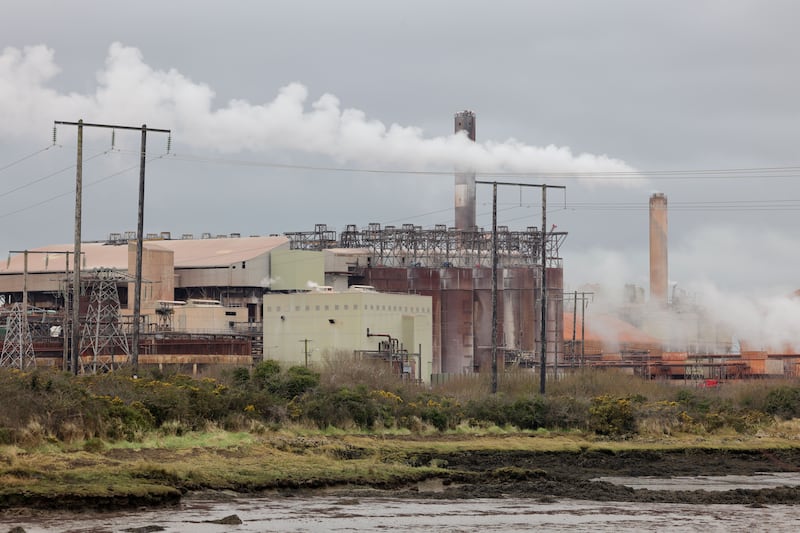 The controversial Aughinish Alumina plant in Co Limerick. Photograph: Alan Betson
The disgraceful continuation of alumina exports from Aughinish to Russia, and the scheduled curtailment of accommodation for Ukrainian refugees have cast doubt on Ireland’s commitment.
Our EU presidency could send a powerful signal to Russia, Ukraine, Europe and the world by commencing work on a draft EU accession treaty, as proposed by Sergiy Kyslytsya, an adviser to president Volodymyr Zelenskiy, in this newspaper in April.
Fintan O’Toole
Journalist
Ireland has rightly made online safety for children a priority for the EU presidency. But when it comes to specifics, the Government’s pitch has been pathetically weak. Age verification and “educational supports” seem to be the main proposals.
Yet everybody knows that nothing much will change until the social media giants are defined like every other industry: as producers of products for which they are liable and accountable. You can’t sell a teddy bear without conforming to strict safety standards and you shouldn’t be able to target content at children without doing the same.
The legal frameworks are already emerging. The European Court has ruled that companies using algorithms are not merely “hosting” content – they are pushing it. But this principle must be fully enshrined in law and, more importantly, translated into urgent action.
Micheál Martin’s legacy from his time as minister for health was the smoking ban. He’s now at a Big Tobacco moment with Big Tech. The tobacco companies produce and push an addictive and toxic product – so do the social media giants.
This is the great child abuse scandal of our times and only the combined clout of the EU can stand up to the power of these rapacious oligarchs. Martin can go down in history if he forces the EU to wake up to its responsibilities to protect its youngest citizens.
Muireann Lynch
Energy economist
The transition to decarbonised energy systems relies on renewable fuels as well as renewable electricity. But there are concerns that using electricity to produce these renewable fuels, particularly hydrogen, will lead to an overall increase in fossil fuel usage. To combat this, the European Union has introduced strict rules on the requirements for these fuels to count as “renewable” – but there is emerging evidence to suggest that these rules are too stringent, with unintended consequences for the energy transition in Europe.
China is powering ahead in hydrogen and alternative fuel investment while the EU is lagging, hindered by red tape that is not evidence-based. The Irish presidency should prioritise reviewing these rules to enable the optimal usage of sustainable alternative fuels.
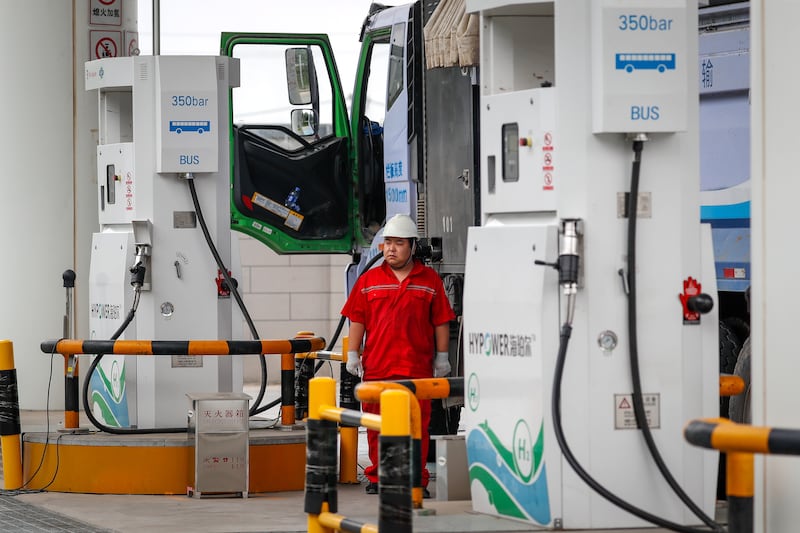 A worker refuels a truck at a hydrogen refueling station during a media tour at the Daxing International Hydrogen Energy Demonstration Zone in Beijing, China. Photograph: EPA
Madeleine Johansson
Socialist councillor
Ireland’s presidency of the EU provides people with an opportunity to reflect on the union and its purpose. For many, the EU represents a progressive community across national borders. But behind the liberal veneer is a neoliberal project designed to work in the interests of the bosses.
Recall that 42 per cent of the cost of Europe’s banking crash was paid by Ireland. This had devastating impacts in working-class communities, where community development programmes were dismantled, public services slashed and thousands of workers lost their jobs.
The fiscal treaty locks in austerity and privatisation. Corporations ensure that the EU works for them by spending hundreds of millions on lobbying – more than €380 million in 2025 alone. In light of this, what one thing could Ireland achieve during the presidency?
I don’t expect the Government to achieve anything that would benefit the working class – but perhaps it can clarify for workers that the EU does not represent them. I’m not arguing for a Brexit for Ireland. Britain’s exit on the basis of right-wing Tory politics has not improved the lives of workers in Britain. But a socialist Ireland with workers in the driving seat would have to break with the EU to regain control of our economy in the interests of the working class.
Justine McCarthy
Journalist
The EU’s bootlicking of Israel amid its massacring rampages against Palestinians is fraying allegiance to the bloc in its own member states. That includes Ireland, one of its most loyal.
Micheál Martin’s Government has recognised the state of Palestine and barred two Israeli government ministers from this country, but it has diluted the Occupied Territories Bill. It needs to hold its nerve as it assumes the EU presidency to negotiate suspension of the EU-Israel Association Agreement and outlaw all trade with the Occupied Territories.
The reasons are incontrovertible.
The UN says that since Hamas attacked Israel in October 2023, 116 Palestinian communities in the West Bank have been partially or wholly displaced, dislocating nearly 6,000 people. The World Health Organisation says 1,175 Palestinians – including 246 children – were killed there up to last May. More than 75,000 people – mostly civilians – have died in Gaza, where humanitarian conditions continue to deteriorate despite a so-called ceasefire. Israel has introduced the death penalty for Palestinians, increased its area of control in Gaza since the ceasefire, and is assisting settlements in the West Bank and East Jerusalem to disrupt the region’s geographical contiguity and “bury the idea of a Palestinian state”.
Martin must persuade the EU 27 that justice and humanity outweigh the bloc’s €43.3 billion annual trade with Israel.
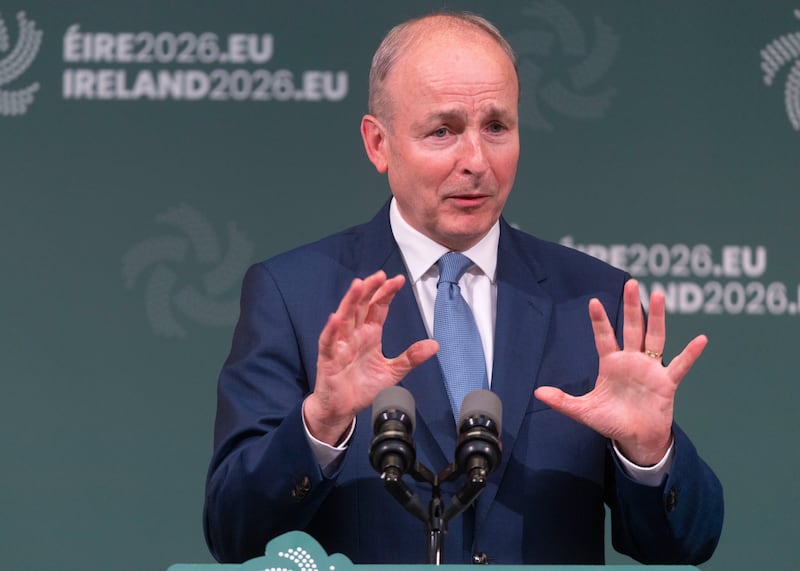 Taoiseach Micheál Martin speaks to the media after the meeting of European Parliament Conference of Presidents, kicking off events for the start of Ireland’s EU presidency. Photograph: Sam Boal/Collin Photos
Michael McDowell
Senator and columnist
Ireland should use its brief EU Council of Ministers presidency to pursue three difficult strategic goals.
First, Ireland should begin a behind-the-scenes process of mapping out and agreeing generous terms to facilitate the UK rejoining the EU. That is Ireland’s most important, and least spoken, policy interest. It is also the most important policy goal for the EU as a whole.
Second, Ireland should begin a discussion at council level on how to repatriate full responsibility to each member state for its own immigration and asylum policies, while preserving freedom of movement rights for EU citizens.
Third, Ireland should get the EU to restate and reinvigorate respect for one of its foundation pillars – the principle of subsidiarity.
None of these will give immediate, tangible results in a six-month time frame. But all are essential for a strong, democratic and healthy future for the EU.
Dermot Hodson
Professor of political economy and author of Circle of Stars: A History of the EU and the People Who Made It
The average EU presidency involves about 2,000 meetings. Ireland won’t be a bystander in these discussions – it will be actively involved in efforts to find common ground between the union’s 27 member states on a host of pressing issues.
Advancing negotiations over the commission’s €2 trillion budget proposal is a clear-cut priority, but it is not the only one. Ireland will also chair talks on the tech sovereignty package, a set of proposals to build European autonomy in areas like cloud computing, chip production and open-source technologies.
Whether fairly or not, Ireland is seen as “Big Tech’s small Member State” so this package is an opportunity to demonstrate independence and deliver on an issue that a majority of EU citizens want urgent action on.
Ireland will also oversee active accession negotiations with Albania, Moldova, Montenegro, North Macedonia and Ukraine. While we won’t see a repeat of 2004 – when Ireland’s EU presidency helped to secure the accession of 10 new member states – there is a chance that Montenegro might be ready to join the EU by the end of the year.
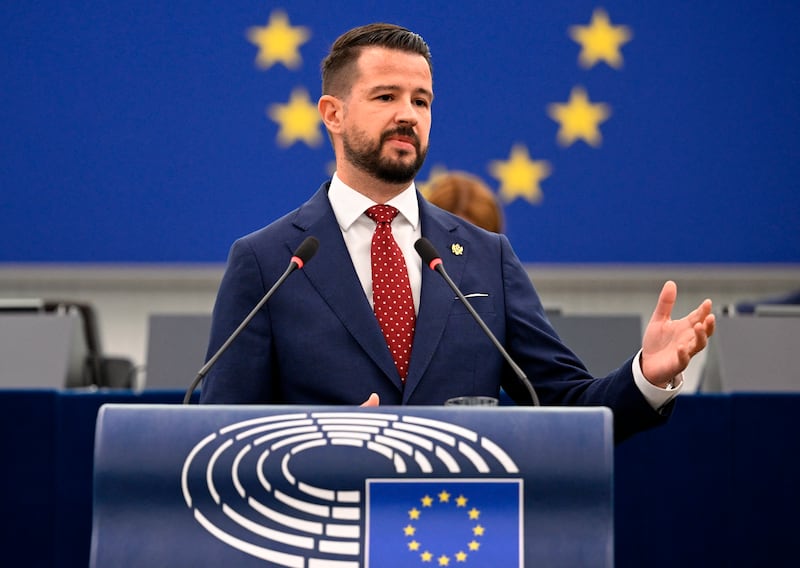 President of Montenegro, Jakov Milatovic, speaks during a plenary session at the European Parliament in Strasbourg, eastern France. Photograph: Jean-Christophe Verhaegen/AFP via Getty Images
The Government has promised to accelerate climate action during its EU presidency: ensuring that the European Grids Package puts renewable energy at the heart of Europe’s “super grid” would be an important step.
Irish officials have vast experience of EU negotiations and a talent for finding diplomatic solutions. They’ll need both over the next six months, given the scale of the challenges facing the EU.
Sineád O’Sullivan
Columnist
Ireland takes the council presidency under a banner of “delivery”; competitiveness, values, security. As the second richest country in Europe, our own delivery stands among the lowest for houses, hospital appointments or transportation. Chairing Europe’s delivery agenda from inside the clearest example of a State that cannot build could be an embarrassment to manage.
However, it could also be an argument for us to make, as we oversee the union’s next seven-year budget. Political instinct will always be to fight over the budget’s size, yet Europe’s – like Ireland’s – Achilles’ heel is converting that capital into outcomes, not simply raising it.
The one thing Ireland should try to get done is finalising that budget. The delivery condition must be that funds are tied to the capacity to spend well, not merely spend. We should ensure that capital is connected to the institutional machinery that turns budgets into infrastructure and services – planning systems, delivery bodies and procurement agencies that capital alone cannot create.
Yes, it is an unglamorous proposal, and an uncomfortable one from Dublin where our spending never experienced the same accountability. But the ability to convert money into outcomes is what will separate Europe’s ambitions from results. Ireland, of all countries, should know this.
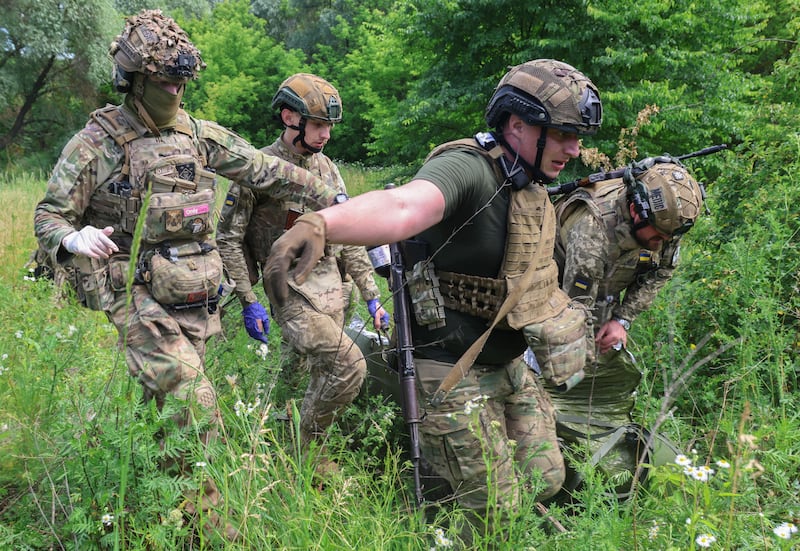 Border guards attend medical training before departure to the frontline in the Kharkiv region, Ukraine. Photograph: EPA Ben Tonra
Professor of international relations and a director of the Irish Defence and Security Association
Ireland has faced a credibility gap over its contribution to European security. This has been especially evident in its response to Russia’s invasion of Ukraine, where ambivalence on military assistance to Ukraine has been only partially offset by Ireland’s political, diplomatic and humanitarian support. Ireland could, however, use its presidency to address both issues.
The strategic case is clear. Ukraine’s accession is not a question of neighbourhood policy, economic integration or political stability, as it has been in previous enlargements. It is a central issue of European security. A democratic, prosperous and secure Ukraine anchored firmly within the EU is the strongest possible response to Russia’s brutal attempt to redraw Europe’s borders by force.
The presidency itself cannot deliver enlargement, but it can accelerate momentum, mould agendas and increase political pressure. In practical terms this could entail the creation of the “Dublin Initiative for Ukraine’s European Future”, encompassing support for the expedited opening of new negotiating chapters, a dedicated informal mini-summit, promoting deeper sectoral integration in advance of formal membership, and focusing on post-conflict reconstruction. The goal would be to make Ukrainian accession appear irreversible and to build an Irish-designed consensus that Ukrainian EU membership is a core component of Europe’s own security.
Rory Rowan
Assistant professor of geography, Trinity College Dublin
The Irish Government is advancing legislation to scrap the triple lock, which requires a United Nations mandate to send Irish troops overseas on peacekeeping missions. Despite official denials, this will see the State abandon neutrality in any meaningful sense.
At the same time the State is embarking on a rapid increase in defence spending, embracing a wider European militarisation project, as represented by the European Union’s €800 billion ReArm Europe Plan.
One of the most important things the Irish Government can do during the period of the EU presidency is to drop these plans and reaffirm Ireland’s neutrality and its legal guarantee in the triple lock.
Why? Because as a neutral country with a constitutional commitment to the peaceful resolution of international conflicts and a legal commitment to upholding international law and the United Nations as the legitimate authority for conflict resolution, Ireland has a unique position from which to promote peace, diplomacy and international law in Europe.
Ireland can offer a different vision for Europe grounded in our own foreign policy and diplomatic traditions – traditions the public are justly proud of.
The Government recently set out its priorities for the presidency: competitiveness, values and security. The increasingly militaristic orientation of the EU risks seeing these values being sold out for competitiveness and a narrow conception of security.
In practise, this would mean Ireland pushing the EU to work towards diplomatic solutions to the war in Ukraine.
And it would mean upholding international legal commitments and ensuring accountability for genocide, war crimes, and human rights abuses by meaningfully sanctioning Israel for its actions in Gaza, the West Bank, Lebanon and Iran.
Brigid Laffan
Political scientist
Ireland must try to complete negotiations on the multiannual financial framework (MFF) by the end of the presidency. The MFF is the blockbuster negotiation that runs through Ireland’s time in the chair, involving all areas of EU expenditure and how the EU funds itself.
Budgetary politics are highly charged and conflictual as the member states are acutely aware of what they put into and get out of the budget.
A battle is being fought between member states that benefit from EU largesse and those that pay. A related battle is between the traditional spending areas, agricultural and cohesion policy, on the one hand, and the EU’s need to spend more on defence and security, its role in the world, and competitiveness, on the other. There are also battles ahead about how to fund the EU budget, and the extent to which borrowing should be a more pronounced part of EU funding.
Given a French election in the first half of 2027, Ireland would greatly serve the EU if it could get these acrimonious negotiations over the line by December.