
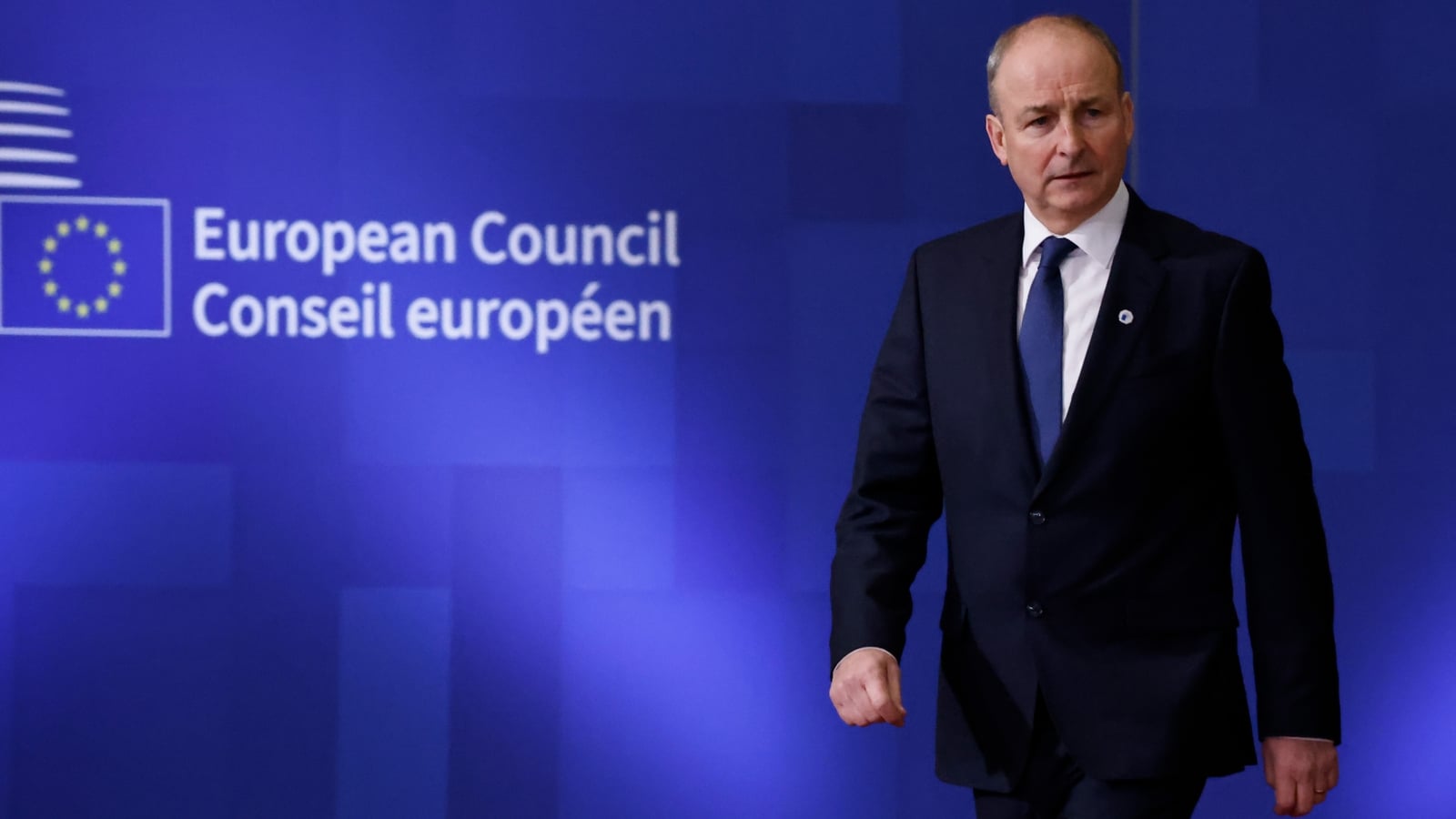
Ireland’s presidency comes at a time of severe challenge for the EU, and that will be reflected in the intensity of the legislative programme the Government will have to steer through.
The EU has been consumed by war in Ukraine and the Middle East and the high energy prices that followed.
It is undergoing a painful divorce from the Trump Administration, one which involves a dramatic recalibration of its security and defence policies.
There are big challenges in Europe’s relationship with China, whether through accusations of Chinese dumping on the European market or the EU’s dependency on its critical minerals.
The reports by former Italian prime ministers Mario Draghi and Enrico Letta have also laid bare Europe’s chronic lack of competitiveness and the incomplete nature of the single market.
The next seven-year EU budget (from 2028-2034) will therefore be different in structure and scale, with a greater emphasis on competitiveness and defence, and less on farm spending and cohesion.
Getting agreement among 26 other member states on the EU budget will be the biggest challenge facing the presidency.
Elsewhere, the EU is overhauling existing rules in the digital and tech sphere, while energy prices and EU enlargement will also dominate.
The Government’s objective is to get as much EU law over the line by December.
Here is a breakdown of the issues that will dominate.
Competitiveness
The Draghi report, and the trade war inflicted by the Trump Administration, have shocked EU leaders into tackling Europe’s own internal competitiveness problems, and how Europe competes in the world.
A raft of new initiatives has been bundled into a roadmap – One Europe, One Market – which will dominate the competitiveness agenda.
“The crucial point is that this roadmap comes with very clear and ambitious deadlines,” said Aingeal O’Donoghue, Ireland’s ambassador to the EU.
The roadmap aims to simplify the EU’s rules, remove obstacles within the single market, boost trade with third countries, reduce energy costs, and drive the digital and AI transformation.
Simplification
Part of the roadmap is simplification.
Critics call this de-regulation, and it emerged from the backlash on the European right against the EU’s climate legislation.
There are currently four so-called “Omnibus” simplification packages in the system, and they aim to reduce regulation in the environmental, digital and AI, energy, automotive, animal feed and taxation spheres.
Many of the simplification packages will attempt to reduce the sustainability reporting and due diligence requirements of the EU’s Green Deal thereby reducing compliance costs for companies.
Europeans are thought to hoard trillions in bank accounts rather than invest
Savings and Investments Union (SIU)
As part of the drive to be more competitive, there has been renewed focus on why Europe does not produce global tech champions.
Silicon Valley attracts the talent and the money, because there is a large and liquid pool of venture capital steered by Wall Street.
By contrast, Europeans tend not to invest in start-ups, because the retail investment market is fragmented across 27 member states, with different rules on taxation, pensions and insolvency.
As such, Europeans are thought to hoard €33 trillion in bank accounts rather than invest it in the real economy.
The SIU aims to create a more harmonised culture of investment, so that European start-ups can avail of indigenous venture capital from savers who will have a greater range of retail investment options to choose from.
Market Integration and Supervision Package (MISP)
Providing such a system will require a single market for financial services, in order to avoid fragmentation and differing interpretations of rules.
MISP is about improving supervisory convergence, simplifying the regulatory framework and supporting the use of digital solutions.
The Government has pledged to advance the MISP during its presidency, but Dublin (alongside Luxembourg) has strong reservations about a centralised supervisor out of a fear that it could undermine the success of the Irish Financial Services Centre (IFSC).
“We have an awful lot of domiciled investment in Ireland and we don’t want somebody else either managing it or changing the marketplace so as to make it mobile,” said Fine Gael MEP Regina Doherty, a member of the European Parliament’s economic affairs committee.
“If we change the supervisory mechanism and give more empowerment to ESMA [the European Securities and Markets Authority], it will unsettle the market.
“Maybe that perfectly suits France, Germany, Italy and others who want a piece of our pie, but economically it wouldn’t suit Ireland,” she said.
EU Inc proposal
This was launched in March by Ireland’s EU Commissioner Michael McGrath.
Europeans might be encouraged to invest their money in EU start-ups, but the problem is that investors tend to avoid such companies: if they expand across into other member states, they need to comply with 27 different sets of company law.
EU Inc (also known as the 28th regime) aims to change all that by creating a single, digital, legal framework for a company to be able to operate across 27 member states, within 48-hours at a cost of €100.
The hope is that the proposal will mean the freed-up venture capital can target those European start-ups.
National company rules will still exist, but the 28th regime will be there as an alternative, one which will be legally recognised by all member states.
Read more:
Enhanced security planned for EU Presidency, gardaí say
Protecting children online one of the goals for Ireland’s EU Presidency – Taoiseach
Industrial Accelerator Act (IAA)
Another important leg of the competitiveness stool is the Industrial Accelerator Act (IAA).
The EU is trying to decarbonise its industry while at the same time securing the future of European manufacturing, partly by increasing electrification to cut energy costs and boosting investment in large green industrial projects.
The IAA aims to attach conditions to billions of euro in annual subsidies and public procurement spending, but also to introduce a “Made in EU” standard.
In other words, public funding might prioritise European manufacturing when it comes to electric vehicles and new solar and battery plants.
Conditions could also extend to, say, Chinese companies wanting to invest in the European economy.
Critics have warned of a European brand of protectionism that could inadvertently hit some of the EU’s more trusted trading partners.
The seven-year EU budget
This is going to be the big challenge for the Irish presidency.
The budget, known as the Multiannual Financial Framework (MFF), requires the consent of 27 member states and the European Parliament.
The presidency will be under pressure to secure agreement among 27 national capitals within the next six months because the MFF will also require 22 pieces of legislation to be passed next year so funds can start rolling at the beginning of 2028.
Furthermore, a far-right victory in next year’s French presidential election could seriously disrupt the politics around the budget, given that both Jordan Bardella and Marine Le Pen have pledged to slash France’s contribution to the budget.
The new structure
When the European Commission set out its budget proposal in July last year, there was a major overhaul, reflecting a new orientation towards competitiveness and defence.
Instead of seven headings there would be four, and the number of spending programmes would fall from 52 to 16.
The proposal also sought to simplify budget rules and tie financial support to performance, steering spending away from agricultural and cohesion policies, and towards competitiveness and defence.
New National and Regional Partnership Plans (NRPPs) would bring cohesion, social, regional, agricultural, fisheries, maritime, migration and other budget lines into a single framework while a separate framework would cover competitiveness, prosperity and security.
The Common Agriculture Policy (CAP)
The CAP will be negotiated in parallel with the MFF, but it will have to adapt to the new structure.
Under the current MFF proposal, €300 billion is ringfenced for the CAP while money from national plans can also be moved into farm spending.
Ministers will be under pressure at home from the Irish Farmers Association and other farm groups
However, the Government and farm organisations acknowledge that, as things stand, the changes will reduce the CAP resource by 20%.
Furthermore, under the NRPPs, member states will have more flexibility in how they spend EU funds – such as in the realm of defence, infrastructure, competitiveness – which begs the question whether or not the level-playing-field basis for farm spending will still exist.
The next steps
The outgoing Cyprus presidency has already proposed the first so-called Negotiation Box (or Nego Box, in the jargon), essentially outlining amounts of money, overall budget ceilings and funding allocations across major policy areas.
Irish officials will be expected to bring forward a new Nego Box in October before the issue is taken up by EU leaders.
That Nego Box will be debated at the EU summit in October, while an extra summit might be required in November, before a final showdown of EU leaders at the December European Council.
Managing expectations
Ireland depends heavily on CAP funding as well as on Horizon research and science funding.
Mindful that it will have to be an honest broker, the Government set out its EU budget priorities last year.
However, ministers will be under pressure at home from the Irish Farmers Association (IFA) and other farm groups to fight the Irish corner – a balancing act that some believe will be very difficult.
“Quite a number of member states are anxious to improve on the draft budget proposals around agriculture,” Taoiseach Micheál Martin told reporters during last week’s EU summit.
“But it will be very challenging because there are a lot of competing demands. There are some who believe the budget is too high as it is, then there are other pressures on other parts of the budget. It’s going to be very, very difficult to resolve that fundamental question.”
How to fund the budget
Currently the EU budget is funded through national contributions based on Gross National Income (GNI) and other sources.
Because the EU is doing more, there is pressure for a bigger budget.
Europe will also have to start repaying tens of billions of euro related to the post-Covid NextGenerationEU programme which required heavy borrowing in the early 2020s.
The Irish presidency will have to grapple with the perennial dilemma of how to find new revenue streams for the budget.
Already, the European Commission has proposed taking 30% of the revenue from the Emissions Trading System (ETS) and putting it towards the EU budget, with further revenues flowing from the Carbon Border Adjustment Mechanism (CBAM).
There are other ideas around member states contributing €2 for every kilo of e-waste not recycled, a Tobacco Excise Duty, a levy on gambling, and a levy on EU and international corporations with a turnover above €100 million.
These ideas have drawn criticism from all quarters on the basis that they either will not raise enough cash, or will simply take monies from national exchequers that would normally have availed of them.
“If you draw a very complex Venn diagram with all the New Own Resources proposals currently on the table, there is very little overlap,” says one EU diplomat.
EU enlargement
Bringing new members into the EU is a core priority of the Irish presidency, and the Government has constantly argued that since EU membership transformed both the Irish economy and society, the EU should not deny applicants the same opportunity.
Enlargement was jolted back to life by Russia’s invasion of Ukraine in 2022 which, alongside Moldova, was quickly granted candidate status.
In mid-June, the EU opened the first cluster of negotiating chapters with both countries.
The Government hopes that Montenegro can conclude its accession negotiations during the Irish presidency, meaning it could become the 28th member state in 2028.
Albania will not be far behind.
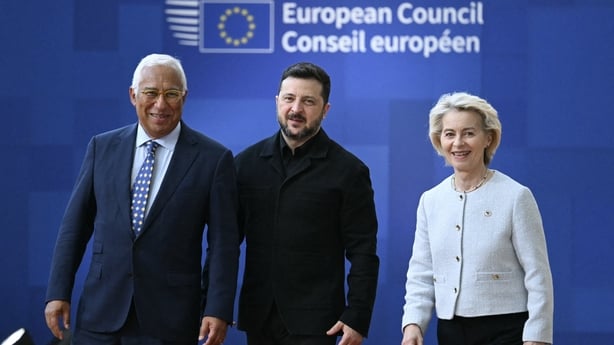
European Council President Antonio Costa, Ukraine’s President Volodymyr Zelensky and European Commission President Ursula von der Leyen arrive to attend an EU Summit earlier this month
Security and defence
Domestically, this may be the Government’s achilles heel, but from a Brussels point of view, Irish diplomats have been on message that Ireland will diligently advance the EU’s agenda on security and defence despite the country’s neutral status.
In the legislative pipeline are the Defence Readiness Roadmap, which aims to boost the EU’s readiness to face a potential Russian military threat by 2030, and the Military Mobility Package, aimed at ensuring the seamless movement of troops, equipment, and military assets across the EU in the event of a sudden threat.
The European Commission is expected to come forward with a new European Security Strategy in July which will come with new legislative proposals.
The Commission is expected to launch a second proposal for a SAFE loan programme (Security Action for Europe) given that the first €150 billion offering, in long-term loans to purchase capabilities, was over-subscribed.
The Government insists that Ireland has already supported a range of new security and defence measures prompted by Russia’s invasion of Ukraine.
One EU diplomat said: “There is rising awareness that Ireland is not an isolated island when it comes to security threats. There are the subsea cables going across the Atlantic, there’s Russian activity around those cables.
“What I see with the Irish presidency is that there’s a very professional understanding of what the role of the presidency is, and I have no doubt that it will do what other presidencies do when it comes to security and defence.”
Big tech
There will be a sizable chunk of EU legislation cutting across all aspects of big tech, child safety online, online shopping, simplification of digital and AI rules, not to mention the International AI Summit in Dublin in October.
The European Commission president Ursula von der Leyen has assembled an expert panel on online safety for children.
Its first report will be presented just two weeks into the Irish presidency, with all eyes on the prospect of a proposed EU-wide social media ban.
Technology companies have been lobbying heavily on the prospect of new rules, and it is understood that officials from TikTok had meetings with the Irish Permanent Representation to the EU between January and March on topics that will come up during the presidency.
This includes a Digital Fairness Act (DFA), which Ireland’s EU Commissioner Michael McGrath will bring forward in the latter half of the presidency.
This will cover everything from banning dark patterns, which trick consumers into making decisions they would not otherwise make, to restricting addictive design, which could encourage minors to spend more time or money than they intended, such as through relentless reward systems.
The Audio-Visual Media Services Act will also be up for a revision during the Irish presidency.
The key issue here is the ability for public sector broadcasters, like RTÉ, to achieve prominence in connect-TVs and other platforms which are dominated by global streaming behemoths like Netflix, Amazon and YouTube.
Values
The Government has identified “values” as the second of its three presidency priorities.But what does this mean?
Dublin has been pushing for tougher action against Israel over its war on Gaza, violent settlers in the West Bank and Israel’s intervention in Lebanon.
While Ireland was frequently only supported by Spain, Slovenia and others, the notion has gathered much more support with at least 20 member states now in favour of looking at proposals to ban trade from illegal Jewish settlements.
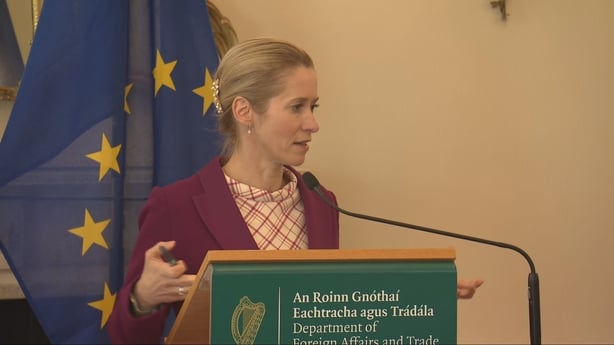
Kaja Kallas speaking in Dublin during a recent visit
Ireland’s ability to use the presidency is limited.
Under the Lisbon Treaty, meetings of foreign ministers are not chaired by the rotating presidency but by the permanent High Representative for Foreign Policy, in this case Kaja Kallas.
While she has asked the European Commission to bring forward an options paper on a potential ban on settlement goods, tougher action like sanctions on extremist Israeli ministers require unanimity.
“We have spent a lot of political capital at European level on supporting Gaza, but this is one of the areas where you need unanimity,” said Minister of State for European Affairs Thomas Byrne.
“Again, you have to understand where member states are coming from. They don’t all agree with us.”
The Government has included EU enlargement as part of its “values” mission, but it will also put an emphasis on the EU’s international development agenda and will hold an informal meeting of EU development ministers in Dublin over two days (8 October and 9 October).
“Europe is asking how it will pay for its future,” said Jim Clarken, CEO of Oxfam Ireland.
“The answer cannot be weaker protections for citizens or cuts to development and climate finance while those who have gained most from today’s economy continue to accumulate unprecedented wealth and power.
“Europe should not make the poorest pay. A competitive Europe depends on citizens who trust its institutions. A secure Europe depends on a more stable and more equal world,” he said.