
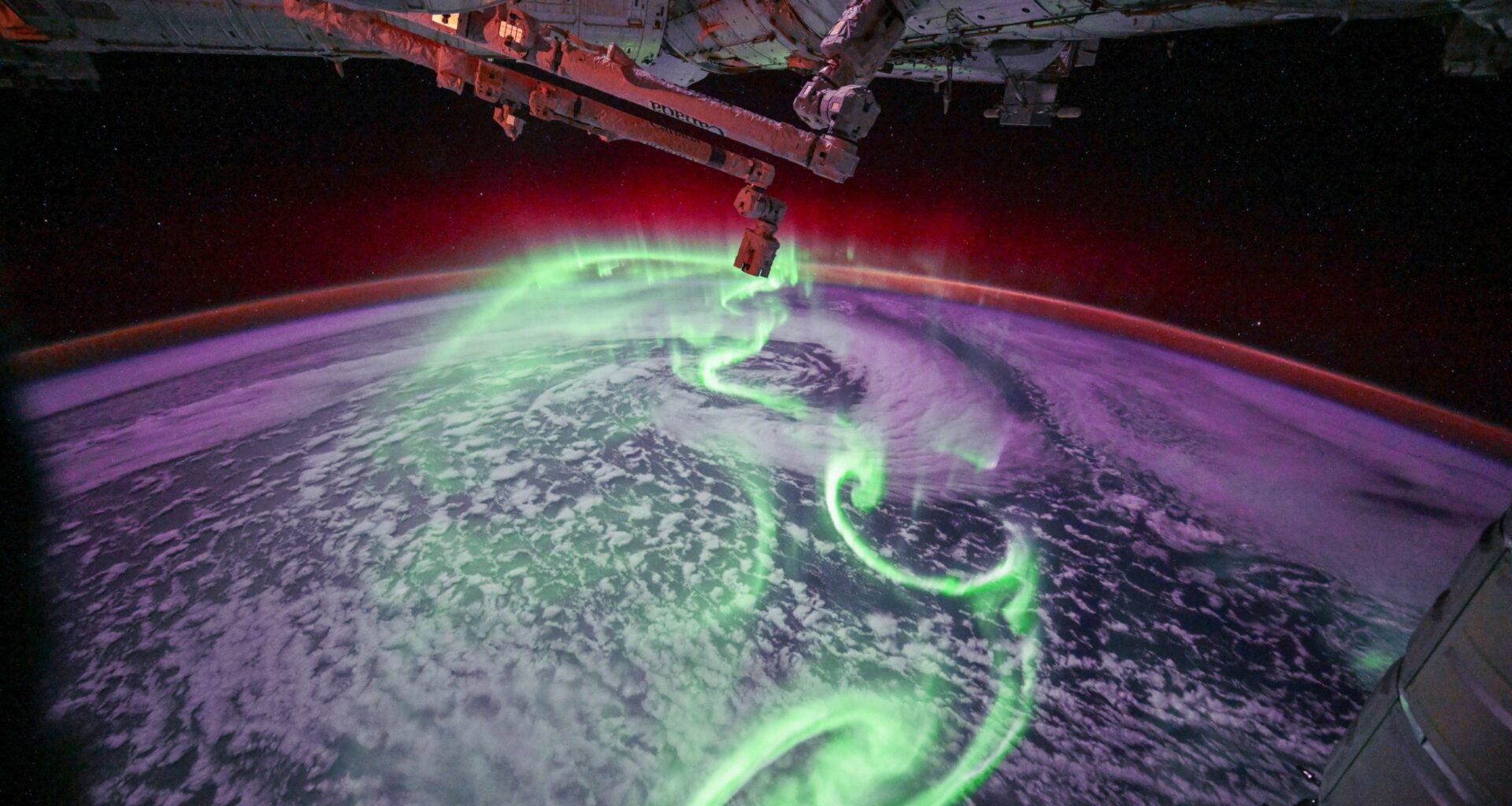
Today’s Image of the Day from the European Space Agency (ESA) captures one of Earth’s most striking natural light shows from a perspective few people will ever experience.
Looking down from the International Space Station (ISS), an intense green aurora spreads across the planet, bright enough to light the station itself.
Most people think of the northern lights as something to watch from the ground in places like Alaska or northern Canada.
From orbit, the view is completely different. Instead of looking up at glowing curtains in the sky, astronauts look down on vast waves of light flowing through the upper atmosphere.
The light sometimes stretches hundreds of miles beyond the horizon.
The image was shared by ESA astronaut Sophie Adenot, who has been documenting life aboard the International Space Station during her mission.
Even after months in orbit, this display stood apart from every aurora she had seen before.
Auroras seen from above
Auroras form when charged particles streaming from the Sun slam into Earth’s magnetic field.
The planet’s magnetic field guides many of those particles toward the polar regions, where they collide with oxygen and nitrogen high in the atmosphere. Those collisions release energy as light.
Green is the most common aurora color because oxygen atoms roughly 60 miles above Earth’s surface produce that familiar glow.
Under different conditions, oxygen can also create deep red light at higher altitudes, while nitrogen contributes shades of blue and purple.
From space, astronauts often see the aurora as a glowing ring wrapped around the polar regions rather than isolated streaks. The effect reveals just how enormous these events really are.
A view that surprised the crew
Adenot described the moment in a post accompanying the photograph.
“Day 127, orbit 1968 – That aurora was absolutely spectacular… shimmering and dancing beneath us, stretching as far as the eye could see, and so intense it lit up the Station in shades of green.”
She explained that the crew had already witnessed several auroras during the mission, but this one stood apart.
“We’ve seen several since the beginning of the mission, but this one was on a completely different level – far too bright for my usual aurora camera settings.”
The display was so bright that even camera settings normally used for photographing auroras could not properly capture its intensity.
Life aboard the ISS includes demanding scientific work, maintenance, and exercise every day. Yet astronauts often pause whenever something unusual appears outside the windows.
Earth rarely looks the same twice from 250 miles above the planet.
Why auroras have become more active
Recent years have produced some of the strongest aurora displays in decades because the Sun is near the peak of its roughly 11-year solar cycle.
During this period, solar activity increases, producing more sunspots, solar flares, and eruptions of charged particles that interact with Earth’s magnetic field.
That heightened activity has allowed people far from the Arctic Circle to witness northern lights that would normally remain hidden over high latitudes.
Brilliant displays have appeared across much of the United States and Europe during major geomagnetic storms.
Astronauts experience these storms from an entirely different vantage point.
Orbiting Earth about every 90 minutes, the International Space Station regularly passes over both the northern and southern auroral zones, giving crews repeated opportunities to observe the phenomenon from above.
A moment that never gets old
Even after nearly 2,000 trips around Earth, Adenot said the excitement of seeing an extraordinary aurora has not faded.
“Moments like these never get old up here; the whole crew suddenly find themselves vying for a good spot at a window!”
That reaction reflects something many astronauts have described over the years. Scientific experiments fill much of every day aboard the station, but Earth itself remains one of the biggest attractions.
Storm systems, volcanic eruptions, city lights, and glowing auroras constantly reshape the view below.
Images like this also help scientists and the public appreciate how closely connected Earth and the Sun really are.
The same solar activity that creates beautiful displays in the night sky also affects satellites, radio communications, power grids, and spacecraft operating beyond Earth’s atmosphere.
For astronauts, though, some moments are simply worth stepping away from work. When an aurora bright enough to illuminate the station begins dancing beneath their feet, everyone heads for the nearest window.
Image Credit: ESA
—–
Like what you read? Subscribe to our newsletter for engaging articles, exclusive content, and the latest updates.
Check us out on EarthSnap, a free app brought to you by Eric Ralls and Earth.com.
—–