
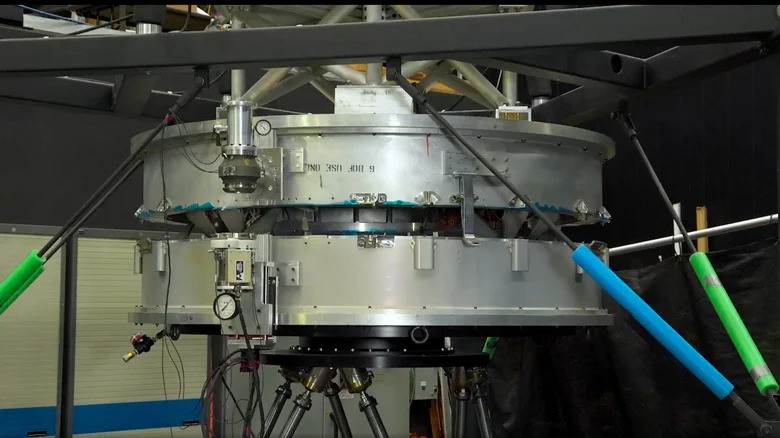
How can in-orbit refueling be used to improve future space missions? This is what a recent test hopes to address as a team of scientists and engineers from NASA and L3Harris successfully tested a cryocoupler, which is a novel method for fueling spacecraft in the harsh space environment. This cryocoupler has the potential to enhance in-orbit refueling, especially since an in-orbit vehicle-to-vehicle refueling mission has never been achieved.
For the test, the team subjected the cryocouplers to a series of stress tests designed to see if they could tolerate functioning in the vacuum of space, to include extreme temperature differences. This included flowing liquid nitrogen through the cryocoupler, which is -321 degrees Fahrenheit (-196 degrees Celsius), with the vacuum of space being -454.81 degrees Fahrenheit (-270.45 degrees Celsius). Finally, the teat tested the cryocoupler’s ability to dock with another cryocoupler if the two are misaligned.
“In-orbit cryogenic refueling between two spacecraft has yet to be done and remains one of the toughest engineering challenges in spaceflight,” said Travis Belcher, who is a Cryogenics Activity Lead at NASA’s Marshall Space Flight Center. “These propellant transfers are essential for the kinds of missions NASA wants to fly in the future, so developing a coupler that can handle ultra-cold propellants is a critical step toward making that capability real.”
This test comes as NASA is preparing to launch its Artemis III mission next year to practice in-orbit refueling between the Orion capsule, that will be launched by the Space Launch System, and either SpaceX’s Starship or Blue Origin’s Blue Moon lander, or both. Successful in-orbit refueling would make missions to the Moon and Mars far easier and reduce the financial burden for needing to build bigger spacecraft to launch from Earth.
How will this cryocoupler help improve in-orbit refueling and future space missions in the coming years and decades? Only time will tell, and this is why we science!
As always, keep doing science & keep looking up!
Sources: NASA
Featured Image Credit: NASA/Tyson Eason